




IL-10: A Review of Core Anti-inflammatory Cytokine Mechanisms, Functions, and Research Applications


Interleukin-10 (IL-10) is a core member of the type II cytokine family and a widely recognized pleiotropic anti-inflammatory and immunoregulatory cytokine in the field of biological research.
- Recent Advances
- Product Information
Interleukin-10 (IL-10) is a core member of the type II cytokine family and a widely recognized pleiotropic anti-inflammatory and immunoregulatory cytokine in biological research. Its primary role is to regulate immune homeostasis and suppress excessive inflammatory responses. It is extensively applied in basic immunology research, immune mechanism analysis, scientific detection development, and targeted drug development, making it a high-frequency research target and core biomarker in the biotech industry.
From a molecular perspective, human IL-10 is encoded by the IL10 gene on chromosome 1. Its mature active form is a homodimeric structure with high conservation, ensuring the stability of its immunoregulatory function. IL-10 expression exhibits significant cell specificity, primarily secreted by immune cells such as monocytes/macrophages, regulatory T cells (Tregs), Th2 cells, and dendritic cells. Non-immune cells like intestinal epithelial cells and adipocytes can also induce IL-10 expression under inflammatory stress, contributing to local microenvironment homeostasis.
The biological functions of IL-10 are mediated through the classical IL-10R/JAK-STAT3 signaling pathway. IL-10 binds to the IL-10RA/IL-10RB heterotetrameric receptor complex on the cell membrane, activating downstream JAK1 and TYK2 kinases, which promote STAT3 phosphorylation and nuclear translocation. This precisely regulates the transcription of anti-inflammatory and immunoregulatory target genes while relying on SOCS3 protein for negative feedback to prevent excessive immune activation.
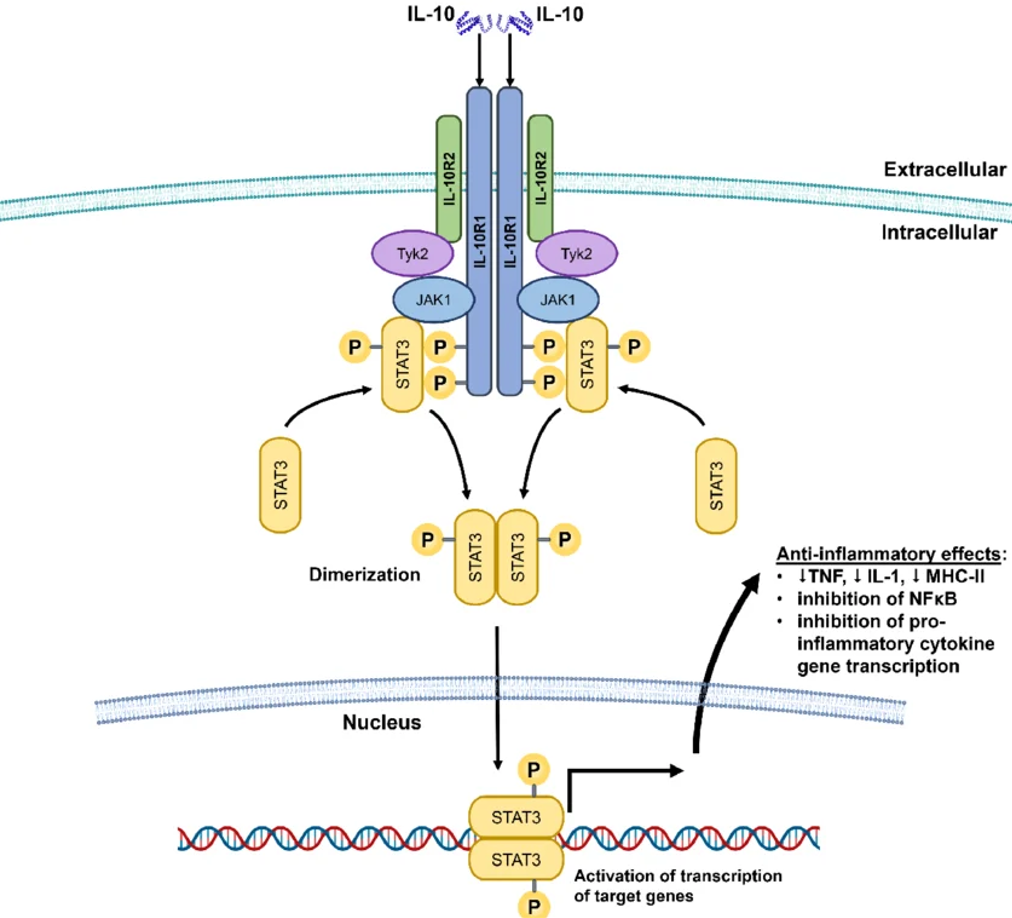
In terms of immunoregulation, IL-10's most critical value lies in balancing inflammatory responses. It significantly inhibits the activation of antigen-presenting cells like macrophages and dendritic cells, drastically reducing the release of pro-inflammatory cytokines such as TNF-α, IL-1β, and IL-6, while downregulating MHC class II molecules and co-stimulatory molecules. This weakens excessive inflammatory immune responses and minimizes inflammation-mediated tissue damage. Simultaneously, IL-10 participates in immune balance regulation by maintaining immune tolerance through Treg cell function, suppressing aberrant autoimmune responses, and modulating T cell and B cell proliferation and differentiation. It also contributes to humoral and mucosal immune protection, aiding tissue repair.
In biotech and research applications, IL-10 holds immense research and translational value. First, it serves as a core biomarker for immune status evaluation, widely used in basic research on immune balance, cell polarization, and immune tolerance mechanisms. It is a key indicator for elucidating inflammation and immune disorder-related mechanisms. Second, IL-10 and its signaling pathway are important targets for anti-inflammatory and immunomodulatory drug development. Recombinant IL-10 derivatives and pathway-targeted modulators have become a major focus in biopharmaceutical research.
In detection technology, IL-10 assays are highly mature and adaptable to various research scenarios. ELISA, with its high sensitivity, stability, and cost-effectiveness, is the industry-standard method for precise quantification in serum, cell supernatants, and other samples. Additionally, ELISPOT for single-cell secretion analysis, flow cytometry for intracellular protein detection, and high-sensitivity micro-immunoassays meet refined research needs such as high-throughput screening, single-cell functional analysis, and trace sample detection.
Overall, IL-10, as the immune system's key "anti-inflammatory brake," is a central molecule linking inflammatory regulation, immune homeostasis, and tissue repair. With advancing biotechnologies, deeper mechanistic insights into IL-10, optimized targeted drugs, and upgraded high-precision detection technologies will continue to empower basic immunology research, bioreagent development, and innovative drug discovery, making it a focal point for future advancements in the field.
Product Recommendation
The UniOne® TR-FRET Human IL10/IL10RA Binding Kit (Catalog No.: UA086016), independently developed by Nanjing UA-Bio Technology Co., Ltd. (UA-Bio), is a homogeneous, wash-free, high-throughput detection kit designed for IL-10/IL-10RA interaction and anti-inflammatory pathway research. It provides a precise and stable all-in-one solution for IL-10-targeted drug screening, receptor function validation, and inflammation mechanism studies.
IL-10 initiates downstream JAK-STAT anti-inflammatory signaling by specifically binding to its receptor IL-10RA. This binding activity directly determines IL-10's physiological function and drug efficacy. Traditional ELISA only measures protein concentration and cannot reflect true ligand-receptor interactions. In contrast, this kit directly quantifies the specific binding activity between human IL-10 and IL-10RA, more closely mirroring in vivo anti-inflammatory functional states, making it a core tool for mechanism research and drug screening.
Core Product Advantages
Direct functional binding detection, replicating in vivo activity: Unlike traditional ELISA, which only measures protein concentration, this kit directly quantifies IL-10–IL-10RA binding levels, accurately reflecting ligand-receptor interactions and functional activity. It is ideal for studying IL-10 mutants, receptor functional defects, and binding changes post-drug intervention.
Ultra-high sensitivity and broad detection range: Leveraging TR-FRET time-resolved fluorescence technology, it effectively eliminates background noise with an exceptional signal-to-noise ratio. It detects interactions as low as nM-level affinity, suitable for low-abundance samples, weak-binding mutants, and low-expression receptor cells, covering common research concentration ranges.
Homogeneous and wash-free, enabling high-throughput efficiency: The "add-incubate-read" one-step workflow eliminates washing, color development, or termination steps. Compatible with 96/384-well plates, batch detection is completed in 1–2 hours, significantly enhancing drug screening and large-sample cohort study efficiency.
High specificity, low matrix interference: Specifically designed for human IL-10/IL-10RA, it shows no cross-reactivity with other cytokines (e.g., IL-6, TNF-α) or receptors. Minimal interference in complex matrices like serum, cell supernatants, and tissue homogenates ensures data accuracy.
Excellent stability and batch-to-batch consistency: Optimized fluorescent probes and recombinant protein formulations resist freeze-thaw cycles and long-term storage. Rigorous quality control from raw materials to finished products ensures stable binding activity and consistent signals across batches, supporting long-term continuous experiments.
Multi-Scenario Research Applications
This kit is widely applicable for IL-10/IL-10RA signaling pathway mechanism studies, high-throughput anti-inflammatory drug screening, receptor mutant functional validation, and inflammatory disease mechanism exploration (e.g., very early-onset inflammatory bowel disease, systemic lupus erythematosus-related pathway defects). It also supports antibody/antagonist competitive binding assays and IL-10 engineering activity evaluation, providing a reliable tool for basic immunology research and innovative drug development.
Complete Solution & Professional Support
The kit includes pre-optimized fluorescent probes, recombinant human IL-10/IL-10RA proteins, standards, and specialized buffers, accompanied by detailed protocols, sample data, and result interpretation guides to facilitate rapid establishment of stable and reproducible assays. Nanjing UA-Bio's technical team provides comprehensive support for experimental design, optimization, and data analysis.
Nanjing UA-Bio Technology Co., Ltd. is dedicated to providing cutting-edge, high-quality core reagents and tools for immunology, cell therapy, and innovative drug development. For detailed technical parameters, validation data, or application inquiries regarding the UniOne® TR-FRET Human IL10/IL10RA Binding Kit (Catalog No.: UA086016), please feel free to contact us.
This article is reviewed and published by the technical expert team of UA
Disclaimer: This article partially utilizes artificial intelligence assistance in its creation. If any content involves copyright or intellectual property issues, please let us know and we promise to verify and remove it as soon as possible.
Purchase recombinant protein, choose Nanjing UA-Bio
UA protein focuses on providing various protein reagents, raw materials, and services required for drug research and development, cell therapy, gene therapy, and basic scientific research, including drug target proteins, immune checkpoint proteins, cytokines, tool enzymes, customized protein expression, and full-length transmembrane protein development. Youai is committed to providing customers with high-quality products and professional services, and building a High-tech Biological Enterprise with International Competitiveness.







 Business license (three certificates in one)