




The pleiotropic role of thymic stromal lymphopoietin (TSLP) in immune homeostasis and disease


Thymic Stromal Lymphopoietin (TSLP) is a key cytokine expressed in epithelial cells and various stromal cells.
- Recent Advances
- Product Information
I. Biological Characteristics and Immunoregulatory Functions of TSLP
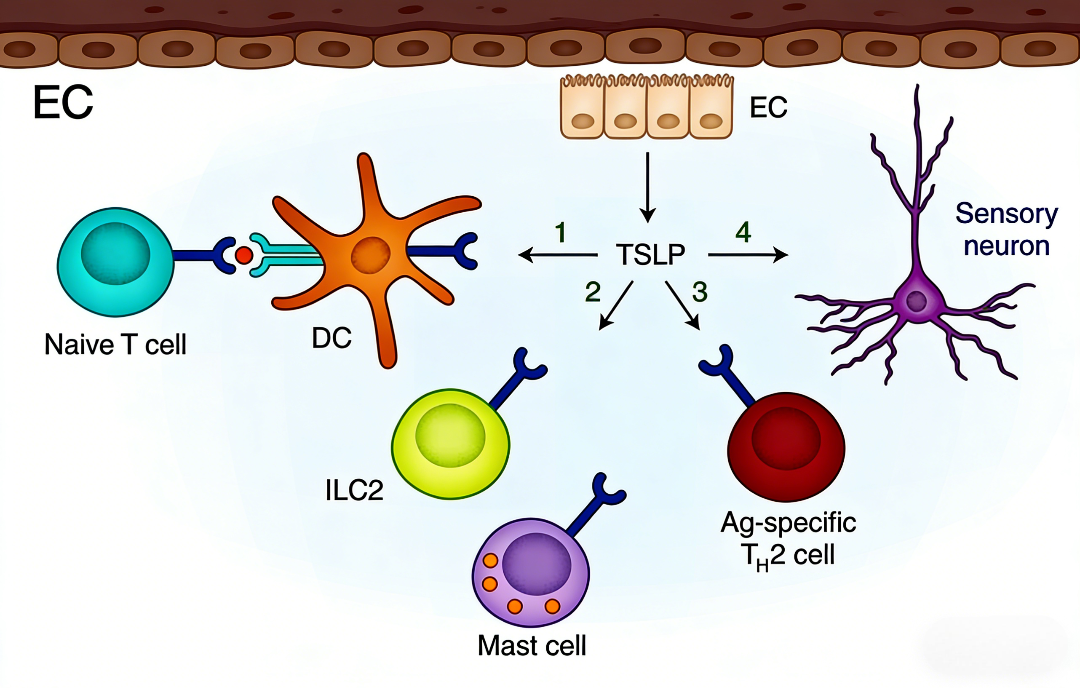
Thymic Stromal Lymphopoietin (TSLP) is a key cytokine expressed in epithelial cells and various stromal cells, playing a central role in maintaining mucosal barrier immune homeostasis and regulating inflammatory responses. TSLP signaling is primarily mediated through a heterodimeric receptor complex composed of the TSLP receptor (TSLPR) and the IL-7 receptor α-chain (IL-7Rα). Initially, TSLP was extensively studied for its pivotal role in initiating and driving type 2 immune responses (Th2), as it can directly act on dendritic cells (DCs), promoting their maturation and inducing the differentiation of naïve T cells into Th2 cells, while also activating innate lymphoid cells, mast cells, and other immune cells.
II. Role of TSLP in Allergic and Inflammatory Diseases
Dysregulation of TSLP is closely associated with various barrier tissue-related allergic and inflammatory diseases, and its genetic polymorphisms have been confirmed as significant risk factors for disease susceptibility.
1. Atopic Dermatitis: In patients with atopic dermatitis, TSLP expression is significantly upregulated in both acute and chronic lesions, with levels correlating with disease severity and epidermal barrier dysfunction. Genetic studies indicate that specific TSLP gene variants (e.g., rs1898671) are linked to disease persistence and severity.
2. Asthma: As a critical regulator of respiratory barriers, TSLP plays a key role in the pathogenesis of asthma. Large-scale genome-wide association studies have confirmed that TSLP single nucleotide polymorphisms (e.g., rs1837253) are significant risk loci for asthma across diverse ethnic populations.
3. Food Allergy and Eosinophilic Esophagitis: While direct associations between TSLP gene variants and peanut allergy remain unclear, TSLP has been identified as a major genetic risk locus for food allergy-related conditions such as eosinophilic esophagitis, highlighting its importance in gastrointestinal barrier immune regulation.
III. The Complex Role of TSLP in the Tumor Immune Microenvironment
Recent studies have revealed that TSLP's biological functions extend beyond type 2 immunity, exhibiting a complex and context-dependent dual role in tumor development.
1. Promoting Tumor Progression: In various solid tumors (e.g., pancreatic, gastric, ovarian, and breast cancers), tumor cells or cancer-associated fibroblasts (CAFs) can secrete TSLP. Tumor-derived IL-1α/β can induce CAFs to express TSLP, which then acts on immune cells such as dendritic cells in the tumor microenvironment, promoting a Th2-biased immune response that may impair effective anti-tumor immunity and is associated with poor prognosis. Additionally, TSLP can directly act on vascular endothelial cells to promote tumor angiogenesis or upregulate anti-apoptotic proteins (e.g., Bcl-2, Bcl-xL) in tumor cells to enhance their survival.
2. Potential Anti-Tumor Effects: Some studies suggest that in certain tumor types or specific contexts, TSLP may also exert anti-tumor effects by activating specific immune responses. Whether TSLP ultimately promotes or suppresses tumors likely depends on tumor type, microenvironment composition, and spatiotemporal specificity of signaling.
IV. The Value of TSLP Protein as a Research Tool and Future Perspectives
To elucidate the precise molecular mechanisms of TSLP in the aforementioned diseases and advance the development of targeted therapies, high-purity, functionally intact TSLP His Tag Protein is an indispensable core research tool. This recombinant protein can be used for:
1. In Vitro Functional and Mechanistic Studies: Stimulating target cells such as DCs, T cells, and endothelial cells to investigate TSLP's effects on cell differentiation, proliferation, apoptosis, migration, and cytokine secretion, as well as elucidating downstream signaling pathways (e.g., JAK-STAT).
2. Receptor Interaction and Signaling Analysis: Studying its binding properties and affinity with the TSLPR/IL-7Rα receptor complex.
3. Disease Model Construction: Exogenous application of TSLP protein in animal models to mimic its pathological roles in allergy, inflammation, or the tumor microenvironment.
4. Drug Screening and Evaluation: As a target protein, for screening and evaluating the bioactivity and potency of anti-TSLP antibodies (e.g., tezepelumab) or other inhibitors.
V. Future Perspectives
The biological landscape of TSLP continues to expand. Clinical studies show that TSLP-targeting monoclonal antibodies (e.g., tezepelumab) are effective not only for eosinophilic asthma but also for preventing acute exacerbations in non-eosinophilic asthma, indicating TSLP signaling's critical role throughout disease progression and in non-type 2 inflammation. Additionally, TSLP co-stimulation with CD40 can induce DCs to produce IL-23, suggesting its potential function in Th17-type inflammation. Future research using tools like TSLP His Tag Protein will further clarify TSLP's specific mechanisms in different tumor types and inflammatory cascades, providing a solid scientific foundation for extending TSLP-targeted therapies from allergic diseases to broader fields such as oncology.
VI. Which Manufacturers Provide TSLP His Tag Protein?
Nanjing U-Protein Biotechnology has independently developed TSLP His Tag Protein, Human (Catalog No.: UA011336), a high-purity, high-activity recombinant human thymic stromal lymphopoietin (TSLP) protein. It is produced using a mammalian expression system and carries a C-terminal His tag for easy purification and detection. TSLP is a key cytokine initiating type 2 immune responses and plays a central role in allergic diseases, asthma, and skin inflammation. This product is suitable for immune regulation research, drug screening, and cell function experiments, offering a reliable and efficient research tool.
| Core Advantages of the Product |
|---|
| High Purity and Native Conformation: Expressed in a mammalian system to ensure proper folding and glycosylation. Purified via affinity chromatography with >95% purity and low endotoxin levels, enabling effective binding to the TSLP receptor complex (TSLPR and IL-7Rα) and maintaining native biological functions. |
| High Affinity and Specific Binding: Retains intact receptor-binding domains, validated by SPR/BLI or cell reporter assays for high affinity and specificity to TSLP receptors. Suitable for ligand competition assays, inhibitor screening, and receptor function studies. |
| His Tag for Convenience: C-terminal His tag enables rapid purification via nickel columns and compatibility with His tag-based detection, immobilization, or related detection systems, enhancing experimental flexibility. |
| Excellent Stability and Batch Consistency: Standardized production and stringent quality control ensure long-term stability and high batch-to-batch consistency, guaranteeing reliable and reproducible data. |
| Broad Applications: Suitable for various in vitro experiments, including cell stimulation and signaling studies, antibody/antagonist screening (e.g., ELISA/SPR/BLI), immunoprecipitation, asthma/allergy model construction, and as an immunogen for antibody development. |
| Professional Technical Support: Detailed product manuals, recommended protocols, storage guidelines, and expert consultation for TSLP research in allergy, inflammation, and autoimmune diseases. |
Nanjing U-Protein Biotechnology is committed to providing high-quality, high-performance recombinant protein tools for immunology, allergic disease research, and innovative drug development. For detailed technical parameters, binding activity data, or application guidance on TSLP His Tag Protein, Human (Catalog No.: UA011336), please feel free to contact us.
This article is reviewed and published by the technical expert team of UA
Disclaimer: This article partially utilizes artificial intelligence assistance in its creation. If any content involves copyright or intellectual property issues, please let us know and we promise to verify and remove it as soon as possible.
Purchase recombinant protein, choose Nanjing UA-Bio
UA protein focuses on providing various protein reagents, raw materials, and services required for drug research and development, cell therapy, gene therapy, and basic scientific research, including drug target proteins, immune checkpoint proteins, cytokines, tool enzymes, customized protein expression, and full-length transmembrane protein development. Youai is committed to providing customers with high-quality products and professional services, and building a High-tech Biological Enterprise with International Competitiveness.







 Business license (three certificates in one)