




Application of Mouse Colon Organoid Cytokine Panel in Colon Organoid Research


Organoids are organ-specific cell aggregates derived from stem cells or multipotent progenitor cells, which essentially simulate the microenvironment of a specific organ in vitro to conduct three-dimensional cultivation of stem cells and their derived various cell types.
- Recent Advances
- Product Information
I. Overview of Organoid Technology
Organoids are organ-specific cell aggregates derived from stem cells or multipotent progenitor cells, which essentially simulate the microenvironment of specific organs in vitro through three-dimensional culture of stem cells and their derived cell types. In vitro-cultured organoids closely resemble their corresponding organs in terms of cellular composition, tissue architecture, and specific functions, achieving replication of specific organs in an in vitro culture environment. Unlike traditional two-dimensional cell culture, organoid culture involves growing multiple cell clone populations of specific organs in a three-dimensional environment, making the culture system more similar to the real microenvironment in vivo. Common basic experimental techniques such as immunohistochemistry, immunofluorescence, mass spectrometry, and gene chips are all applicable to organoid platform research. Additionally, organoid culture technology can be integrated with other emerging biotechnologies, such as gene editing (CRISPR/Cas9), real-time imaging, microfluidics, and single-cell genomics, providing new perspectives for understanding disease occurrence, development, and treatment. Currently, various studies have reported the construction methods and applications of organoid models for the intestine, stomach, liver, pancreas, brain, kidney, prostate, and other organs.
II. Concept and Construction Principles of Colon Organoids
Colon organoids are three-dimensional cell culture models derived from colon stem cells or pluripotent stem cells. They are essentially cultured in a matrix gel (e.g., Matrigel) supplemented with various growth factors to support the three-dimensional growth of colon stem cells and their derived epithelial cells, enteroendocrine cells, and goblet cells. In vitro-constructed colon organoids closely resemble colon epithelial tissue in terms of cellular composition, tissue architecture, and specific functions, achieving replication of colon epithelial tissue in an in vitro environment. The colon epithelium lacks villi, with intestinal stem cells located at the base of the crypts. These stem cells rapidly divide and proliferate to produce transit-amplifying cells, which migrate upward along the crypt axis while continuing to proliferate and differentiate, forming the crypt structure and generating mature, fully differentiated intestinal functional cells, including absorptive enterocytes and secretory cells such as goblet cells and enteroendocrine cells. At the base of the crypts, stem cells and niche cells are interwoven, with the latter expressing epidermal growth factor (EGF) and Notch ligands on their surfaces. These factors play crucial roles in maintaining stem cell survival and differentiation. The key factors included in the mouse colon organoid cytokine kit can be used to optimize colon organoid culture conditions, supporting their in vitro construction and long-term maintenance.
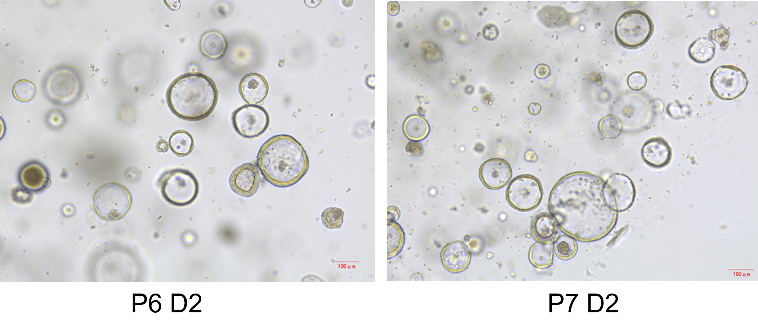
III. Culture System for Colon Organoids
The colon organoid culture system primarily consists of a matrix gel and culture medium. The matrix gel is a matrix protein gel rich in laminin and collagen, with components similar to the extracellular matrix of many tissues, providing three-dimensional matrix support for in vitro colon organoid culture. The culture medium is divided into expansion medium and differentiation medium: the expansion medium is enriched with growth factors essential for colon stem cell proliferation, mimicking the proliferative signals of colon epithelial stem cells for long-term culture and expansion of colon organoids; the differentiation medium removes specific components from the expansion medium to induce stem cell differentiation into various types of terminally differentiated colon epithelial cells. In vitro-constructed colon organoids exhibit a spherical structure composed of a single layer of epithelial cells, with a central lumen containing cell debris and secretions, and the periphery in contact with the matrix gel. Differentiated colon organoids contain all types of terminally differentiated cells, including colon epithelial cells, goblet cells, and enteroendocrine cells. The mouse colon organoid cytokine kit provides an optimized combination of cytokines for colon organoid culture, supporting stable expansion and functional maintenance.
IV. Main Types of Colon Organoids
Currently, there are two mature colon organoid models based on adult cells, derived from adult stem cells and induced pluripotent stem cells (iPSCs), respectively. Adult stem cell-based colon organoids are first obtained by isolating and purifying colon stem cells from colon tissue specimens collected via surgery or endoscopy. These stem cells are mixed with matrix gel and supplemented with several essential growth factors to maintain their self-renewal and differentiation capabilities, ultimately yielding continuously expanding colon organoids. This model is currently the most common colon organoid model. iPSC-based colon organoids simulate embryonic intestinal development in vitro by inducing pluripotent stem cells to differentiate directionally into colon tissue through a series of signaling stimuli. The two models differ in expansion capacity, cellular composition, culture duration, and phenotypic characteristics: iPSC-based colon organoids lack unlimited expansion capacity, contain mesenchymal cell components, proliferate and passage more slowly, and exhibit phenotypes closer to embryonic tissue; adult stem cell-based colon organoids mature stably within 1-2 weeks of in vitro seeding and can be expanded long-term. The mouse colon organoid cytokine kit is suitable for optimizing the culture of both types of colon organoids.
V. Which Manufacturers Provide Mouse Colon Organoid Cytokine Kits?
Nanjing UA-Bio Technology Co., Ltd. (UA-Bio) has independently developed the "Colon Organoid Cytokine Set, Mouse", a high-performance cytokine kit specifically designed for constructing and maintaining normal mouse colon organoids. This kit employs an optimized combination of cytokines to simulate the microenvironment signals for colon crypt stem cell proliferation and differentiation, supporting long-term expansion and organoid formation of mouse colon stem/progenitor cells. It provides standardized and reliable solutions for intestinal development research, inflammatory bowel disease (IBD) model construction, drug evaluation, and other fields.
| Core Product Advantages |
|---|
| Optimized Organoid Growth Support: The kit features a carefully selected and proportioned combination of cytokines, including key signaling pathway regulators (e.g., EGF, Noggin, R-spondin, Wnt agonists), accurately simulating the microenvironment signals for colon stem cell proliferation and differentiation. It efficiently supports the establishment, long-term expansion, and colon epithelial lineage differentiation of normal mouse colon organoids. The optimized cytokine ratio promotes organoid formation while effectively maintaining cellular diversity and functional integrity of the colon crypt structure. |
| Exceptional Batch-to-Batch Consistency and Stability: Leveraging an internationally leading cytokine development platform and standardized production processes, combined with a stringent quality control system, ensures stable biological activity, consistent organoid support capability, and excellent long-term stability for each batch of reagents. This provides solid and reliable quality assurance for long-term and continuous colon organoid research. |
| Flexible and Convenient Operating System: The kit provides a complete organoid culture protocol and optimized cytokine combination for simple and quick operation. Its formulation is compatible with various organoid culture matrices and containers, flexibly applicable to the establishment, expansion, differentiation, cryopreservation, and drug screening of normal mouse colon organoids. |
| Comprehensive Solutions and Professional Support: We offer thoroughly validated standard experimental protocols, typical organoid growth data, and detailed result interpretation guides to help you quickly establish a stable and reproducible mouse colon organoid culture system. Nanjing UA-Bio's professional technical team provides full-process, expert technical consultation and support for your research design, experimental optimization, and data analysis. |
Nanjing UA-Bio Technology Co., Ltd. is committed to providing cutting-edge, high-quality core reagents and tools for immunology, cell therapy, and innovative drug development. For detailed technical parameters, validation data, or specific application inquiries regarding the "Colon Organoid Cytokine Set, Mouse" (Catalog No.: UA090047), please feel free to contact us.
This article is reviewed and published by the technical expert team of UA
Disclaimer: This article partially utilizes artificial intelligence assistance in its creation. If any content involves copyright or intellectual property issues, please let us know and we promise to verify and remove it as soon as possible.
Purchase recombinant protein, choose Nanjing UA-Bio
UA protein focuses on providing various protein reagents, raw materials, and services required for drug research and development, cell therapy, gene therapy, and basic scientific research, including drug target proteins, immune checkpoint proteins, cytokines, tool enzymes, customized protein expression, and full-length transmembrane protein development. Youai is committed to providing customers with high-quality products and professional services, and building a High-tech Biological Enterprise with International Competitiveness.







 Business license (three certificates in one)