




Structural characteristics and biological functions of FGF-basic protein


The fibroblast growth factor protein family is a group of multifunctional cell growth factors that play a broad and critical role in the development, growth, and repair processes of organisms.
- Recent Advances
- Product Information
I. Overview of the Fibroblast Growth Factor Family
The fibroblast growth factor protein family is a group of multifunctional cell growth factors that play extensive and critical roles in the development, growth, and repair processes of organisms. This family comprises numerous members, with 22 identified in humans, sharing structural and functional similarities while each exhibiting distinct characteristics. FGF-basic protein is a key member of this family, consisting of 146 amino acid residues. It belongs to the same subfamily as the 154-amino acid variant of FGF-basic, sharing high biological functional similarity. This protein binds to its specific receptors, activating downstream signaling pathways to regulate various physiological processes.
II. Structural Features of FGF-basic Protein
FGF-basic protein exhibits typical structural characteristics of the fibroblast growth factor family. Its 146-amino acid sequence contains a highly conserved core domain composed of approximately 120 amino acid residues, forming a stable β-sheet structure that provides the structural basis for receptor binding. The protein surface features heparin-binding sites, enabling interaction with heparin or heparan sulfate to form functional signaling complexes. Compared to the 154-amino acid FGF-basic variant, the 146-amino acid FGF-basic protein has an N-terminal truncation, which may affect its receptor-binding affinity and biological activity. The protein has a molecular weight of approximately 16-18 kDa and a high isoelectric point, giving it strong alkaline properties and the ability to bind negatively charged cell surface proteoglycans.
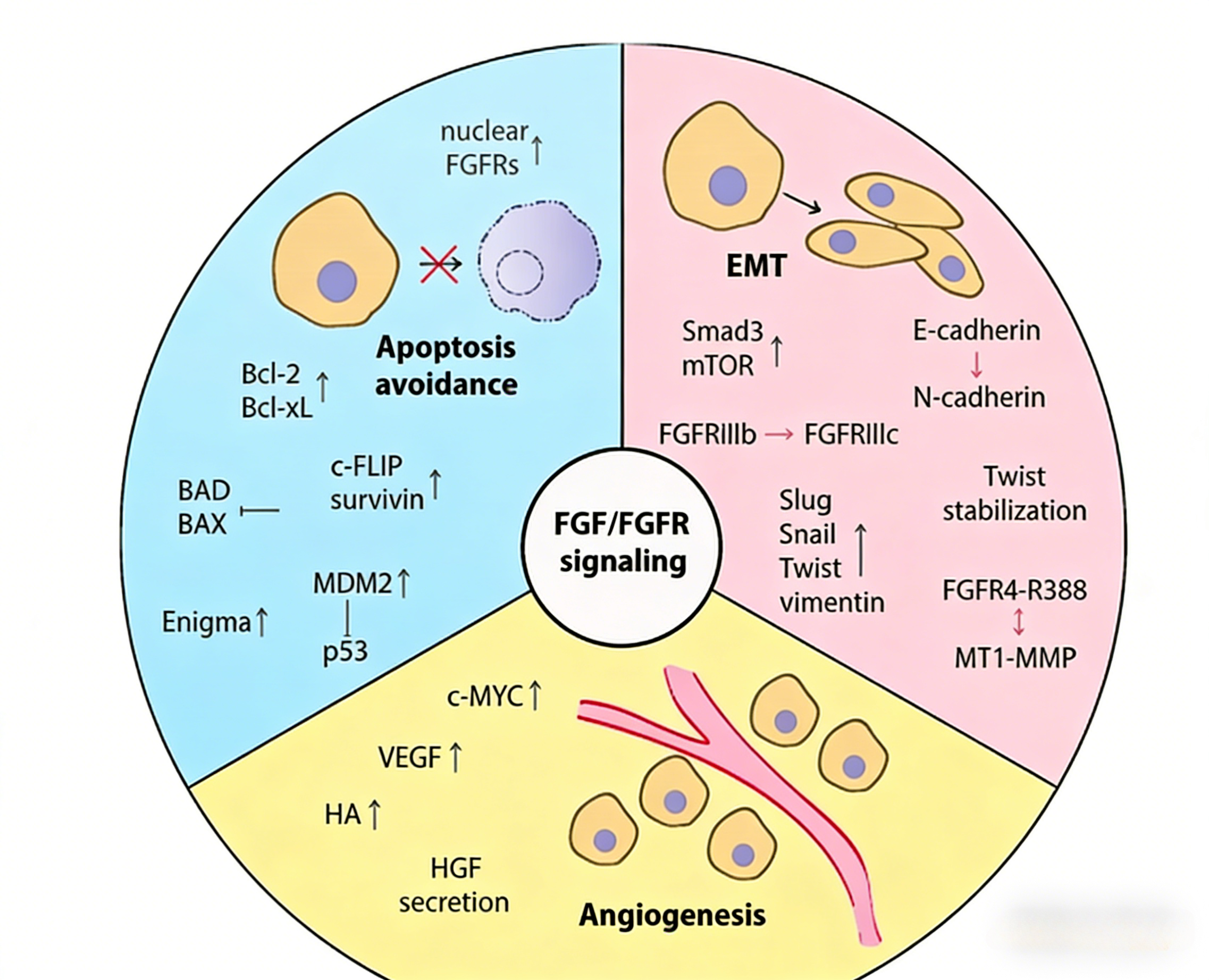
III. Interaction Mechanism of FGF-basic Protein with Receptors
FGF-basic protein exerts its biological effects by binding specifically to fibroblast growth factor receptors (FGFRs) on the cell surface. FGFRs belong to the receptor tyrosine kinase family and include multiple subtypes. The binding of FGF-basic protein to its receptors requires heparin or heparan sulfate as cofactors. During binding, FGF-basic protein first forms a low-affinity complex with heparan sulfate, which then interacts with FGFR, inducing receptor dimerization and activation. The activated receptors undergo autophosphorylation, recruiting various adapter proteins and downstream signaling molecules. This mechanism ensures precise signal transduction and enables signal amplification and regulation.
IV. Signaling Pathways Regulated by FGF-basic Protein
Upon binding to its receptors, FGF-basic protein activates multiple intracellular signaling pathways. The Ras-MAPK pathway is one of the primary pathways, where a cascade of kinase phosphorylations transmits signals from the cell membrane to the nucleus, regulating the expression of genes related to cell proliferation and differentiation. The PI3K-Akt pathway primarily mediates cell survival and anti-apoptotic signals by inhibiting pro-apoptotic protein activity. Additionally, activation of the PLCγ pathway triggers intracellular calcium release and protein kinase C activation, participating in cell metabolism and cytoskeletal rearrangement. These pathways interconnect, forming a complex regulatory network that enables cells to respond precisely to external stimuli.
V. Role of FGF-basic Protein in Cell Proliferation and Differentiation
FGF-basic protein is a potent mitogen that promotes proliferation in various cell types. Fibroblasts are key target cells, with FGF-basic stimulation driving them from quiescence into the cell cycle for rapid expansion. In endothelial cells, FGF-basic protein induces migration and lumen formation, contributing to the establishment of new vascular networks. For neural stem cells, it not only promotes proliferation but also influences differentiation into specific neuronal subtypes. In the skeletal system, FGF-basic protein regulates the proliferation and differentiation of chondrocytes and osteoblasts, playing a critical role in bone development and repair. The balance between its pro-proliferative and pro-differentiation effects makes FGF-basic protein a central regulator in tissue development and repair.
VI. Role of FGF-basic Protein in Tissue Repair and Regeneration
During tissue repair following injury, FGF-basic protein expression is upregulated, participating in multiple stages of the repair process. It promotes fibroblast proliferation and migration at the injury site, synthesizing collagen and extracellular matrix components to form granulation tissue. Simultaneously, FGF-basic protein stimulates vascular endothelial cell proliferation and lumen formation, establishing new vascular networks to supply oxygen and nutrients. In epithelial tissue injury, it accelerates re-epithelialization by stimulating keratinocyte migration and proliferation. Additionally, FGF-basic protein exhibits chemotactic effects, recruiting inflammatory cells and stem cells to the injury site to coordinate the repair process. These multifaceted functions make it a key player in tissue repair and regeneration.
VII. Which Manufacturers Provide FGF-basic (146aa) Protein?
Nanjing UA-Bio Technology Co., Ltd. (UA-Bio) has independently developed "FGF-basic (146aa) Protein, Human", a high-quality recombinant protein reagent designed for stem cell culture, tissue engineering, and angiogenesis research. This protein is the human basic fibroblast growth factor (FGF-basic, 146-amino acid form) that efficiently activates FGFR signaling pathways, promoting cell proliferation, self-renewal, and differentiation. It serves as a stable and reliable standardized tool for embryonic stem cell culture, organoid construction, and regenerative medicine research.
| Core Product Advantages |
|---|
| High Purity and Full Biological Activity: The product utilizes internationally advanced recombinant expression systems and highly standardized purification processes, validated through multi-dimensional quality control to ensure >95% purity, correct native conformation, and full biological functionality. The protein efficiently binds human FGFR receptors, faithfully mimicking FGF-basic-mediated cell proliferation, survival, and differentiation signals under physiological conditions. |
| Excellent Batch-to-Batch Consistency and Stability: Strict management from gene construction to protein expression and purification, combined with a comprehensive release testing system, ensures stable biological activity, consistent purity, and superior long-term stability for each batch. This provides reliable quality assurance for long-term, continuous cell culture and mechanistic studies. |
| Ideal Tool for Diverse Applications: This protein performs exceptionally well in human embryonic stem cell (hESC) and induced pluripotent stem cell (iPSC) maintenance, organoid construction, primary cell culture, vascular endothelial cell proliferation, and neural stem cell expansion. It is widely applicable for pluripotency maintenance, organoid expansion, cell migration and proliferation analysis, and signaling pathway research. |
| Comprehensive Solutions and Professional Support: We provide thoroughly validated standard protocols, typical biological activity data, and detailed product analysis certificates to help you quickly establish stable and reproducible experimental workflows. Nanjing UA-Bio's technical team offers professional consultation and support for research design, experimental optimization, and data analysis. |
Nanjing UA-Bio Technology Co., Ltd. is dedicated to providing cutting-edge, high-quality core reagents and tools for immunology, cell therapy, and innovative drug development. For detailed technical specifications, validation data, or application inquiries regarding "FGF-basic (146aa) Protein, Human" (Catalog No.: UA040145), please feel free to contact us.
This article is reviewed and published by the technical expert team of UA
Disclaimer: This article partially utilizes artificial intelligence assistance in its creation. If any content involves copyright or intellectual property issues, please let us know and we promise to verify and remove it as soon as possible.
Purchase recombinant protein, choose Nanjing UA-Bio
UA protein focuses on providing various protein reagents, raw materials, and services required for drug research and development, cell therapy, gene therapy, and basic scientific research, including drug target proteins, immune checkpoint proteins, cytokines, tool enzymes, customized protein expression, and full-length transmembrane protein development. Youai is committed to providing customers with high-quality products and professional services, and building a High-tech Biological Enterprise with International Competitiveness.







 Business license (three certificates in one)