




"Immunoregulatory Functions and Clinical Applications of IL-4 Protein"


IL-4 protein is a typical cytokine produced by TH2 cells, playing a crucial role in the development of T lymphocytes and B lymphocytes, as well as driving humoral immune responses and antibody production.
- Recent Advances
- Product Information
1. Biological Characteristics of IL-4 Protein
IL-4 protein is a typical cytokine produced by TH2 cells, playing a crucial role in the development of T lymphocytes and B lymphocytes, as well as driving humoral immune responses and antibody production. This protein exhibits immunomodulatory effects on B cells, T cells, mast cells, macrophages, and hematopoietic cells, making it a multifunctional immune regulatory factor. IL-4 protein activates downstream signaling pathways such as JAK-STAT upon binding to its receptors, mediating diverse biological effects. Additionally, IL-4 protein can activate cytotoxic T cells, participating in the regulation of cellular immune responses.
2. Regulatory Role of IL-4 Protein on B Cells
IL-4 protein has multiple regulatory functions on B cells. It promotes the proliferation of B cells pre-stimulated by SAC or anti-IgM, a biological function that has been used as a classic method to detect the biological activity of IL-4 protein. IL-4 protein enhances the expression of MHC class II antigens, FcεRⅡ/CD23, and CD40 in B cells, improving their antigen-presenting capacity and enabling the immune system to respond to minimal antigen stimulation. The protein also increases the expression of FcεRⅡ/CD23 and releases soluble CD23/IgE-binding factors, which bind to membrane IgE-positive cells and induce their differentiation, potentially promoting IgE production in B cells. IL-4 protein elevates IgG1 and IgE production levels in LPS-stimulated mouse B cells while inhibiting IgG3 secretion and downregulating IgG2a, IgG2b, and IgM to varying degrees. The mechanisms for enhancing IgG1 and IgE levels include selectively stimulating the proliferation and differentiation of B cells directed to produce IgG1 or IgE, as well as increasing specific heavy-chain constant region class switching. Furthermore, IL-4 protein promotes the early activation of resting B cells, transitioning them from the G0 phase to the G1 phase, increasing cell volume and inducing CD25 expression. IFN-γ significantly inhibits these functions of IL-4 protein, while IL-4 protein can also suppress IFN-γ-induced IgG2a production in B cells.
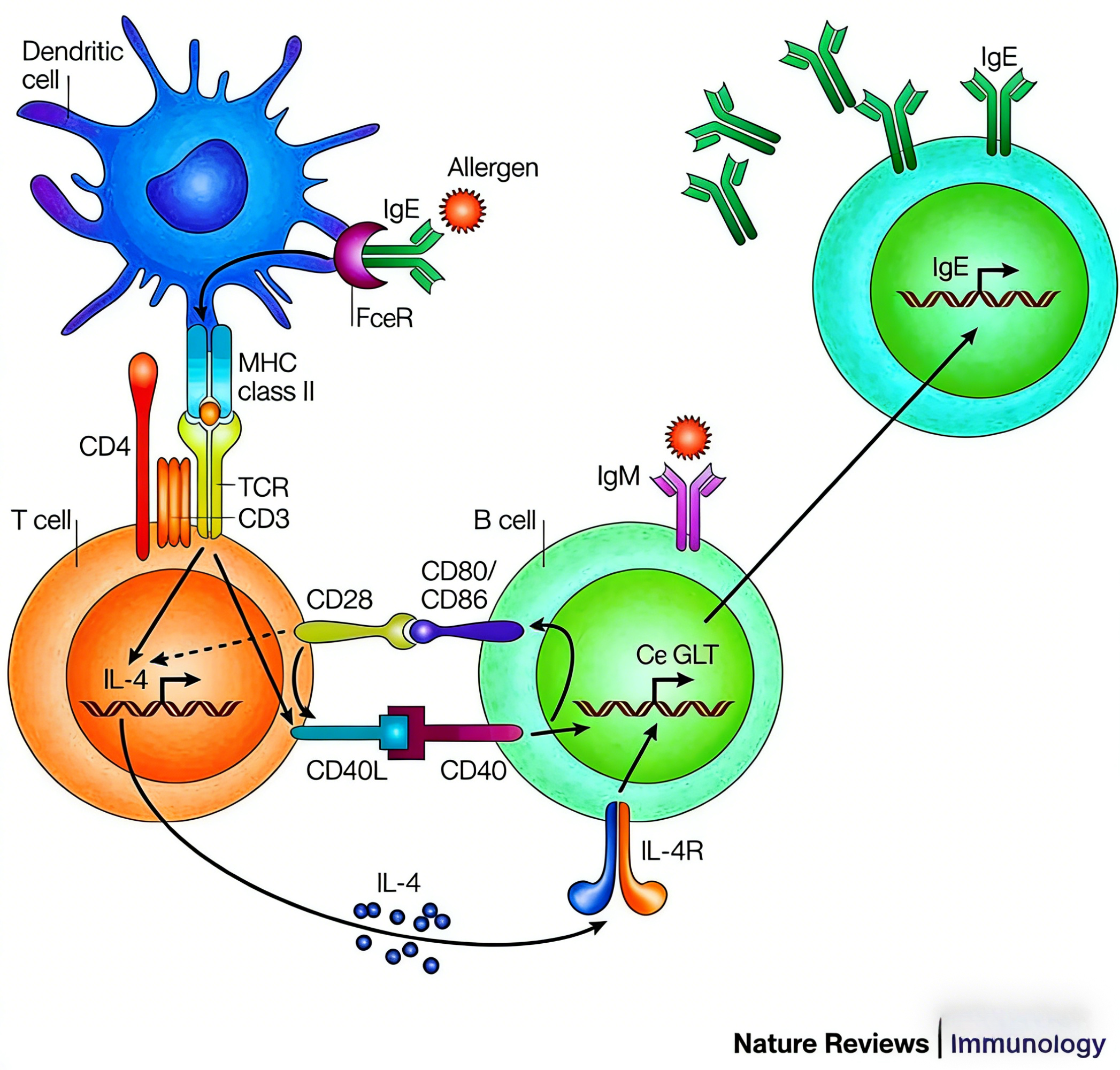
3. Regulatory Role of IL-4 Protein on T Cells
IL-4 protein is an autocrine growth factor for T cells. High doses of IL-4 protein can induce the proliferation of CD4-negative CD8-positive, CD4-positive CD8-negative, and CD4-negative CD8-negative thymocytes. The protein enhances the release of GM-CSF and G-CSF by T cells under PHA stimulation. In human killer cells, IL-4 protein exhibits negative regulatory effects. In mixed lymphocyte cultures, IL-4 protein selectively promotes the proliferation of helper T cells while reducing the functions of cytotoxic T cells, natural killer cells, and lymphokine-activated killer cells. Additionally, IL-4 protein inhibits the lymphokine-activated killer activity of natural killer leukemia cells induced by IL-2 and stimulates the growth of CD3-negative natural killer cell clones.
4. Regulatory Role of IL-4 Protein on Mast Cells, Macrophages, and Hematopoietic Cells
IL-4 protein stimulates mast cell proliferation and exhibits synergistic effects with IL-3 protein, particularly being essential for the in vitro growth of mucosal and connective tissue-type mast cells. For macrophages, IL-4 protein enhances their antigen-presenting and tumor cell-killing functions, likely by modulating MHC class II antigen and Fc receptor expression. The protein synergizes with GM-CSF, IL-3 protein, and LPS to induce peripheral blood mononuclear cells to secrete G-CSF and M-CSF, enhancing neutrophil-mediated phagocytosis, killing activity, and antibody-dependent cell-mediated cytotoxicity. In hematopoiesis regulation, IL-4 protein synergizes with colony-stimulating factors to stimulate hematopoietic cell proliferation, with G-CSF to enhance granulocyte colony formation, and with erythropoietin to boost erythroid burst-forming unit formation.
5. IL-4 Protein and the Regulation of TH1/TH2 Immune Balance
IL-4 protein plays a pivotal role in the balance between TH1 and TH2 immune responses. As a representative TH2 cytokine, it promotes humoral immune responses while suppressing cellular immune responses. IL-4 protein and IFN-γ exhibit mutual antagonism, jointly regulating the type and intensity of immune responses. During parasitic infections, elevated serum levels of IgG1 and IgE are closely related to the induction by IL-4 protein. The protein also inhibits IFN-γ mRNA transcription, further reinforcing the directionality of TH2-type immune responses. This immune balance regulation makes IL-4 protein widely studied in allergic and autoimmune diseases.
6. Clinical Applications of IL-4 Protein
As an exocrine glycoprotein, IL-4 protein holds significant value in inflammation and autoimmune disease research. Both in vitro and in vivo studies confirm that IL-4 protein inhibits the secretion of IL-1, IL-6, and TNF while promoting the production of IL-1 receptor antagonists, showing potential in sepsis shock treatment research. IL-4 protein stimulates mucus production in airway epithelial cells and activates airway smooth muscle cells, causing airway hyperresponsiveness, making it important in allergic inflammation research. In antitumor therapy, IL-4 protein has garnered widespread attention. IL-4 receptors are expressed on various tumor cells, including lymphoblastic leukemia, multiple myeloma, non-Hodgkin's lymphoma, acute promyelocytic leukemia, and certain solid tumors. As a tumor immunomodulator, IL-4 protein has entered clinical trials, showing promising results in Hodgkin's disease, non-Hodgkin's lymphoma, and chronic lymphocytic leukemia.
7. Which Manufacturers Provide IL-4 Protein?
Nanjing UA-Bio Technology Co., Ltd. (UA-Bio) has independently developed "IL-4 Protein, Human", a high-quality recombinant protein reagent specifically designed for Th2-type immune responses, B cell activation, and allergic disease research. This human interleukin-4 (IL-4) protein efficiently activates IL-4 receptor signaling pathways, inducing Th2 cell differentiation, promoting B cell class switching, and IgE production. It provides a stable and reliable standardized tool for exploring allergic disease mechanisms, immune regulation research, and drug development.
| Core Product Advantages |
|---|
| High Purity and Full Biological Activity: The product utilizes internationally leading recombinant expression systems and highly standardized purification processes, validated through multi-dimensional quality control to ensure >95% purity, correct native conformation, and complete biological functionality. The protein effectively binds to human IL-4 receptor complexes (IL-4Rα/γc or IL-4Rα/IL-13Rα1), accurately simulating IL-4-mediated Th2 cell differentiation, B cell activation, and IgE class switching signals under physiological conditions. |
| Exceptional Batch-to-Batch Consistency and Stability: From gene construction and protein expression to purification and quality control, the entire process is strictly managed, combined with a comprehensive release testing system to ensure stable biological activity, consistent purity, and excellent long-term stability for each batch. This provides solid and reliable quality assurance for long-term and continuous immunological research. |
| Ideal Tool for Multiple Applications: This protein performs excellently in various application systems, including Th2 cell differentiation induction, B cell activation and class switching research, macrophage M2 polarization induction, dendritic cell maturation regulation, and signaling pathway analysis. It is widely applicable to allergic disease mechanism exploration, immune regulation research, autoimmune disease model construction, and drug activity evaluation. |
| Complete Solutions and Professional Support: We provide fully validated standard experimental protocols, typical biological activity data, and detailed product analysis certificates to help you quickly establish stable and reproducible experimental workflows. Nanjing UA-Bio's professional technical team offers comprehensive support for research design, experimental optimization, and data analysis. |
Nanjing UA-Bio Technology Co., Ltd. is dedicated to providing cutting-edge, high-quality core reagents and tools for immunology, cell therapy, and innovative drug development. For detailed technical parameters, validation data, or specific application inquiries regarding "IL-4 Protein, Human" (Catalog No.: UA040026), please feel free to contact us.
This article is reviewed and published by the technical expert team of UA
Disclaimer: This article partially utilizes artificial intelligence assistance in its creation. If any content involves copyright or intellectual property issues, please let us know and we promise to verify and remove it as soon as possible.
Purchase recombinant protein, choose Nanjing UA-Bio
UA protein focuses on providing various protein reagents, raw materials, and services required for drug research and development, cell therapy, gene therapy, and basic scientific research, including drug target proteins, immune checkpoint proteins, cytokines, tool enzymes, customized protein expression, and full-length transmembrane protein development. Youai is committed to providing customers with high-quality products and professional services, and building a High-tech Biological Enterprise with International Competitiveness.







 Business license (three certificates in one)