




Mechanism of IL-21 Protein in Tumor-Targeted Therapy


The lack of functional tumor-infiltrating lymphocytes in the tumor microenvironment is a significant reason for the suboptimal efficacy of tumor immunotherapy. Even in tumor tissues rich in tumor-infiltrating lymphocytes, the presence of dysfunctional PD-1-positive Tim-3-positive CD8-positive T cells remains a major indicator of poor prognosis in cancer patients.
- Recent Advances
- Product Information
1. Research Background and Scientific Questions
The lack of functional tumor-infiltrating lymphocytes in the tumor microenvironment is a major reason for the suboptimal efficacy of tumor immunotherapy. Even in tumor tissues rich in tumor-infiltrating lymphocytes, the presence of dysfunctional PD-1-positive Tim-3-positive CD8-positive T cells remains a key indicator of poor prognosis in cancer patients. IL-21 protein, a 4α-helix bundle cytokine produced by CD4-positive T cells and natural killer T cells, can enhance the cytotoxicity of CD8-positive T cells and natural killer cells by stimulating their maturation, promote the differentiation of memory CD8-positive T cells, and suppress the production of regulatory T cells. However, the detailed mechanisms by which IL-21 protein influences dysfunctional CD8-positive T cell subsets in tumors remain unclear, and its short half-life also limits clinical applications.
2. Tumor-Targeted Delivery Strategy for IL-21 Protein
By analyzing The Cancer Genome Atlas database, researchers found that high expression of IL-21 protein in the tumor microenvironment of skin melanoma and head and neck squamous cell carcinoma patients is positively correlated with improved survival rates. To investigate whether the IL-21-mediated antitumor effect occurs within the tumor, researchers compared the therapeutic efficacy of local intratumoral injection and systemic intraperitoneal injection of IL-21-Fc fusion protein. They found that local delivery, but not systemic administration, effectively controlled tumor growth. Based on this, the researchers designed a cetuximab-IL21 fusion protein that directly binds to cEGFR-positive tumor cells, enabling precise tumor-targeted delivery of IL-21 protein. Experiments confirmed that this fusion protein specifically targets cEGFR-positive tumor cells and effectively inhibits tumor growth.
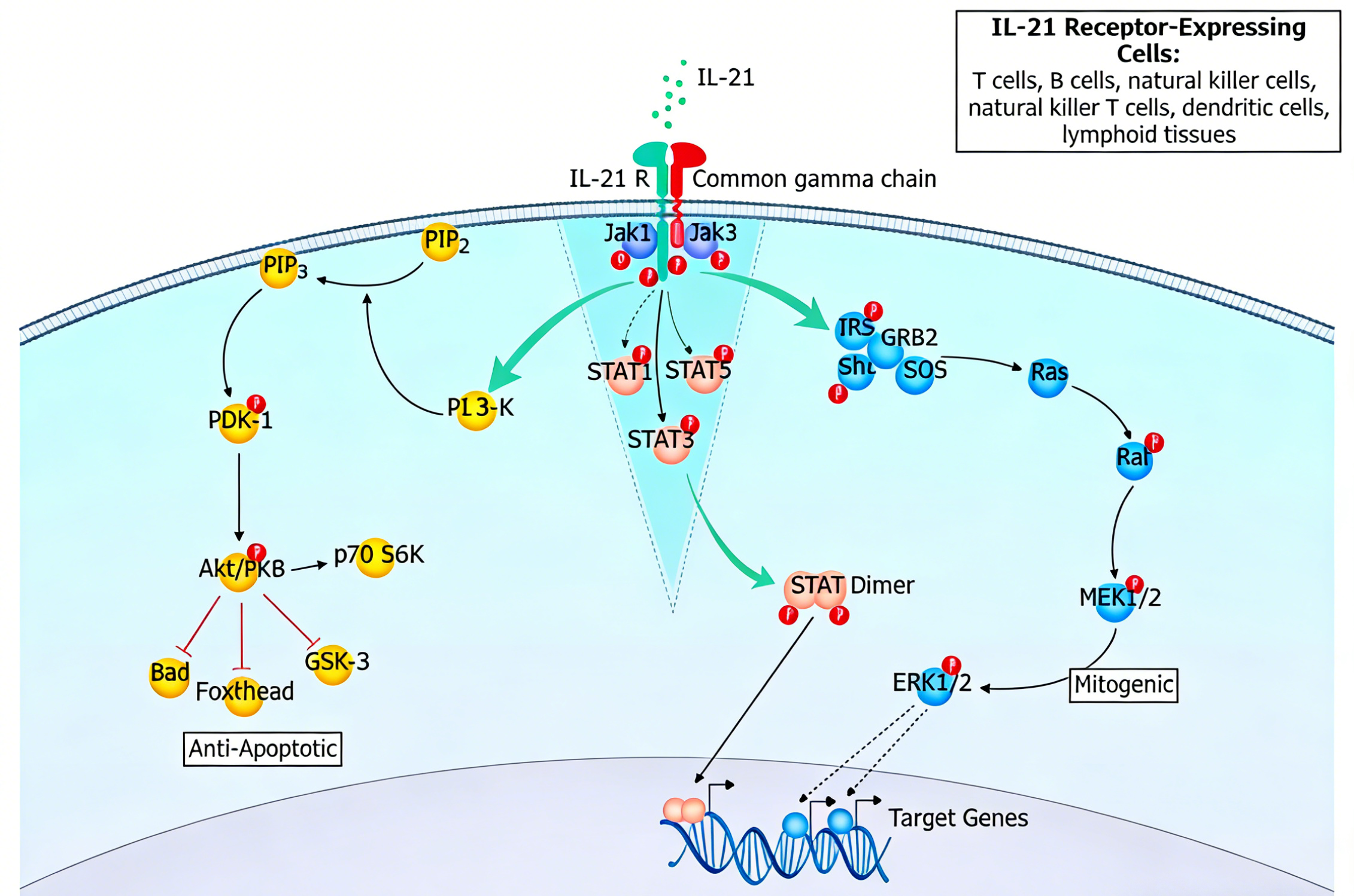
3. Comparison of Antitumor Effects Between IL-21 and IL-2 Proteins
At the same dose, tumor-targeted IL-21 fusion protein and IL-2 fusion protein exhibited similar antitumor effects, but the IL-21 fusion protein showed lower in vivo toxicity. IL-2 fusion protein treatment caused significant weight loss in mice and even death at high doses, while the same dose of IL-21 fusion protein had no obvious effect on mouse weight, and the treated mice maintained high long-term survival rates. This finding suggests that IL-21 fusion protein is a safe and effective tumor-targeted therapeutic molecule.
4. CD8-Positive T Cell-Dependent Antitumor Mechanism of IL-21 Protein
To explore the immune cell basis of IL-21 protein's antitumor effects, researchers depleted natural killer cells, macrophages, CD4-positive T cells, and CD8-positive T cells separately. The results showed that only the depletion of CD8-positive T cells abolished the antitumor effect of the IL-21 fusion protein. Flow cytometry analysis confirmed that IL-21 fusion protein treatment significantly increased the proportion and functionality of tumor-infiltrating CD8-positive T cells. Further studies revealed that pre-existing tumor-infiltrating CD8-positive T cells are crucial for IL-21 therapy, rather than newly migrated CD8-positive T cells. IL-21 treatment also established memory T cell-mediated antitumor responses, limiting the growth of distal tumors.
5. Regulatory Role of IL-21 Protein on CD8-Positive T Cell Subsets
Researchers divided antigen-specific CD8-positive T cells into three groups based on PD-1 expression levels: high, moderate, and absent. IL-21 treatment reduced the mean fluorescence intensity of PD-1 in antigen-specific CD8-positive T cells, an effect not due to new infiltrating cells. Further research found that IL-21 protein selectively proliferates PD-1 moderately expressed Tim-3-negative functional CD8-positive T cells, expanding the functional tumor-infiltrating T cell population and limiting the development of exhausted T cells in the tumor microenvironment. In tumor cells, PD-1 moderately expressed Tim-3-negative CD8-positive T cells are more functional than PD-1-positive Tim-3-positive CD8-positive T cells, suggesting that IL-21's antitumor activity primarily depends on the expansion of this specific T cell subset.
6. Synergistic Effects of IL-21 Protein and Immune Checkpoint Blockade
The study found that after initial treatment with IL-21 fusion protein, PD-L1 expression was upregulated in dendritic cells and macrophages. Based on this finding, researchers hypothesized that blocking the interaction between PD-1 and PD-L1 might enhance the therapeutic effect of IL-21. Experiments confirmed that compared with either monotherapy, the combination of IL-21 fusion protein and anti-PD-L1 significantly enhanced tumor growth inhibition in tumor-bearing mice and prolonged their survival. This synergistic effect provides a new strategy for the treatment of advanced tumors.
7. Research Significance and Future Perspectives
This study successfully extended the half-life and improved the antitumor efficacy of IL-21 protein by designing a tumor-targeted IL-21 fusion protein. The research redefined the key mechanism by which IL-21 protein exerts its antitumor effects by promoting the proliferation of specific CD8-positive T cell subsets and reducing dysfunctional CD8-positive T cells in the tumor microenvironment. The synergistic effect of IL-21 fusion protein and immune checkpoint blockade provides new insights for enhancing antitumor immune responses. As a cytokine with antitumor potential, the application value of IL-21 protein in tumor-targeted delivery and combination therapy warrants further exploration.
8. Which Manufacturers Provide IL-21 Protein?
Nanjing UA-Bio Technology Co., Ltd. (UA-Bio) has independently developed "IL-21 Protein, Human", a high-quality recombinant protein reagent specifically designed for the functional regulation of T cells, B cells, NK cells, and immunotherapy research. This protein is human interleukin-21 (IL-21), an important member of the γc family of cytokines. It efficiently activates the IL-21 receptor signaling pathway, promotes T cell proliferation and differentiation, B cell differentiation into plasma cells, and enhances NK cell cytotoxicity, providing a stable and reliable standardized tool for tumor immunotherapy, autoimmune disease mechanism exploration, and vaccine development.
| Core Product Advantages |
|---|
| High Purity and Intact Biological Activity: The product employs internationally leading recombinant expression systems and highly standardized purification processes, validated through multi-dimensional quality control to ensure >95% high purity, correct native four-helix bundle conformation, and complete biological functionality. The protein efficiently binds to the human IL-21 receptor complex (IL-21R/γc), faithfully mimicking IL-21-mediated Tfh cell differentiation, B cell antibody production, and NK cell activation signals under physiological conditions. |
| Excellent Batch-to-Batch Consistency and Stability: Strict management is implemented throughout gene construction, protein expression, and purification quality control, combined with a comprehensive release testing system, ensuring stable biological activity, consistent purity, and excellent long-term stability for each batch. This provides solid and reliable quality assurance for long-term and continuous immunological research. |
| Ideal Tool for Multiple Applications: This protein performs excellently in various application systems, including Tfh cell differentiation induction, B cell plasma cell differentiation research, NK cell activation and expansion, CAR-T cell functional enhancement, signaling pathway analysis, and drug activity evaluation. It is widely applicable to tumor immunotherapy research, autoimmune disease mechanism exploration, vaccine adjuvant development, and biosimilar drug activity evaluation. |
| Complete Solutions and Professional Support: We provide fully validated standard experimental protocols, typical biological activity data, and detailed product analysis certificates to help you quickly establish stable and reproducible experimental workflows. Nanjing UA-Bio's professional technical team offers comprehensive and professional technical consultation and support for your research design, experimental optimization, and data analysis. |
Nanjing UA-Bio Technology Co., Ltd. is committed to providing cutting-edge, high-quality core reagents and tools for immunology, cell therapy, and innovative drug research. For detailed technical parameters, validation data, or specific application inquiries regarding "IL-21 Protein, Human" (Catalog No.: UA040009), please feel free to contact us.
This article is reviewed and published by the technical expert team of UA
Disclaimer: This article partially utilizes artificial intelligence assistance in its creation. If any content involves copyright or intellectual property issues, please let us know and we promise to verify and remove it as soon as possible.
Purchase recombinant protein, choose Nanjing UA-Bio
UA protein focuses on providing various protein reagents, raw materials, and services required for drug research and development, cell therapy, gene therapy, and basic scientific research, including drug target proteins, immune checkpoint proteins, cytokines, tool enzymes, customized protein expression, and full-length transmembrane protein development. Youai is committed to providing customers with high-quality products and professional services, and building a High-tech Biological Enterprise with International Competitiveness.







 Business license (three certificates in one)