




The role and clinical research progress of IL-23 protein in chronic inflammatory diseases


IL-23 protein is a key pro-inflammatory cytokine that plays a significant role in the development of chronic inflammatory diseases. This protein is primarily produced by activated antigen-presenting cells such as dendritic cells, macrophages, and monocytes.
- Recent Advances
- Product Information
1. Molecular Characteristics and Cellular Sources of IL-23 Protein
IL-23 protein is a key pro-inflammatory cytokine that plays a crucial role in the development of chronic inflammatory diseases. This protein is primarily produced by activated antigen-presenting cells such as dendritic cells, macrophages, and monocytes. As a member of the IL-12 cytokine family, IL-23 protein is a heterodimeric structure composed of p19 and p40 subunits. Its effects are mainly mediated by CD4-positive T helper cell subsets (Th17), unique γ/δ T cell subsets, natural killer T cell subsets, and type 3 innate lymphoid cells. Elevated levels of IL-23 protein are observed in the lesional tissues of patients with Crohn's disease, ulcerative colitis, and psoriasis, indicating its involvement in the pathological processes of these diseases.
2. Signal Transduction Mechanism of IL-23 Protein
IL-23 protein exerts its biological effects by binding to the IL-23 receptor complex on the cell surface. The IL-23 receptor complex consists of the IL-23 receptor and the IL-12 receptor β1 subunit, which are associated with JAK family members JAK2 and TYK2. The binding of IL-23 to its receptor promotes the activation of JAK kinases, leading to phosphorylation of tyrosine residues on both the JAK kinases and the cytoplasmic tails of the IL-23 receptor. These phosphorylated tyrosine residues create docking sites for STAT3 monomers, which bind via Src homology 2 domains. Activated JAK2 and TYK2 phosphorylate STAT3 monomers, resulting in STAT3 dimerization, nuclear translocation, and DNA binding to target gene promoters, thereby initiating downstream gene transcription. This signaling pathway is the core mechanism through which IL-23 protein exerts its pro-inflammatory functions.
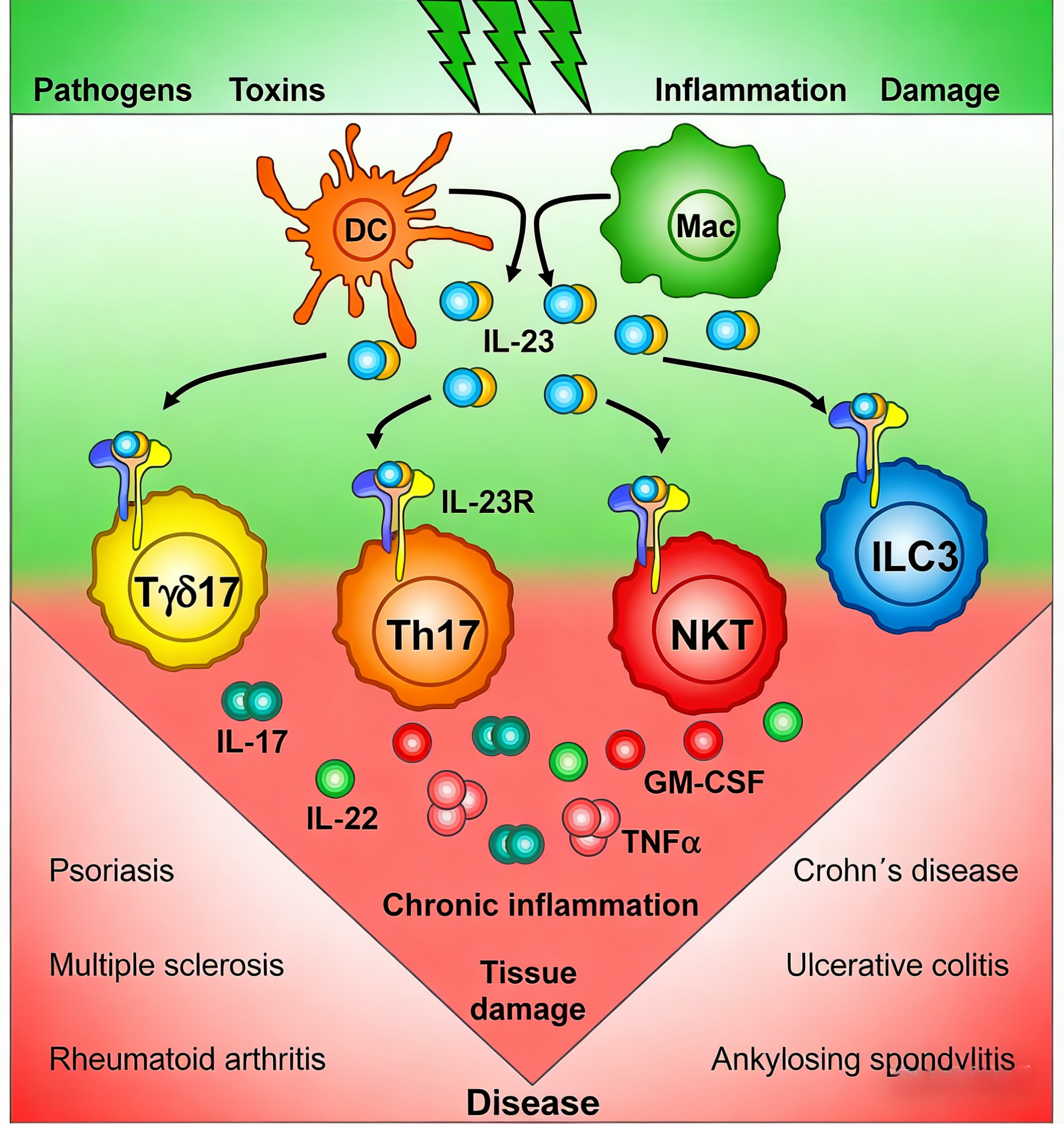
3. Pathological Role of IL-23 Protein in Chronic Inflammation
Chronic inflammatory diseases are caused by uncontrolled immune responses that trigger excessive activation of signaling cascades, leading to the accumulation of pro-inflammatory mediators and ultimately clinical symptoms. The pathological consequences of excessive IL-23 protein signaling are closely related to its ability to promote the production of inflammatory mediators. This protein can induce target cells to produce pathogenic inflammatory mediators such as IL-17, IL-22, granulocyte-macrophage colony-stimulating factor, and tumor necrosis factor-α. These mediators further promote the rapid recruitment and activation of granulocytes and macrophages, which are equipped with extensive effector tools capable of causing tissue damage that drives chronic inflammation and ultimately leads to clinical symptoms. Therefore, IL-23 protein occupies an upstream regulatory position in the pathogenesis of chronic inflammatory diseases.
4. Therapeutic Strategies Targeting IL-23 Protein and Clinical Research
Given the central role of IL-23 protein in chronic inflammatory diseases, the use of neutralizing antibodies to interfere with IL-23 signaling has shown promising therapeutic effects in various inflammatory conditions. Intervention strategies targeting IL-23 protein primarily focus on its p19 subunit, using specific antibodies to block the binding of IL-23 to its receptor, thereby inhibiting the activation of downstream signaling pathways. The advantage of this approach lies in its specificity for blocking IL-23 signaling without affecting the functions of other p40-dependent cytokines such as IL-12, enabling precise modulation. Compared to strategies targeting more downstream inflammatory mediators, targeting IL-23 protein may provide more upstream and broader control of inflammation.
Antibody drugs targeting IL-23 protein have been investigated in clinical studies for various chronic inflammatory diseases. In patients with ulcerative colitis, the first participant has been dosed in a phase 2 clinical study of an anti-IL-23 antibody. Previous research has demonstrated the therapeutic value of blocking IL-23 signaling in chronic inflammatory diseases such as Crohn's disease, ulcerative colitis, and psoriasis. Preclinical studies and early clinical trial results indicate that intervention strategies targeting IL-23 protein can effectively control disease activity, improve patient symptoms, and exhibit favorable safety profiles. These positive findings have accelerated the clinical development of IL-23-targeted drugs in the treatment of chronic inflammatory diseases.
5. Research Significance and Future Perspectives
As a key molecule linking innate and adaptive immunity, IL-23 protein plays a central role in the maintenance and amplification of chronic inflammation. Through the activation of the JAK-STAT signaling pathway, this protein induces the production of multiple pro-inflammatory mediators, promotes the recruitment and activation of immune cells, and ultimately leads to tissue damage and clinical symptoms. A deep understanding of the biological functions of IL-23 protein provides a theoretical foundation for developing therapeutic strategies targeting this signaling pathway. Currently, anti-IL-23 antibodies have entered clinical research stages for chronic inflammatory diseases such as ulcerative colitis, with preliminary results showing promising applications. Future research will further explore the specific mechanisms of IL-23 protein in different chronic inflammatory diseases, optimize IL-23-targeted intervention strategies, evaluate their long-term safety and efficacy, and investigate their potential for combination with other therapeutic approaches. As our understanding of the IL-23 protein signaling network continues to deepen, its application value in the treatment of chronic inflammatory diseases will continue to expand.
6. Which Companies Provide IL-23 Protein?
Nanjing UA-Biotech Co., Ltd. (UA-Bio) has independently developed "IL-23 Protein, Human", a high-quality recombinant protein reagent specifically designed for research on Th17-type immune responses, autoimmune diseases, and inflammatory mechanisms. This protein is human interleukin-23 (IL-23), a heterodimeric cytokine composed of p19 and p40 subunits that efficiently activates the IL-23 receptor signaling pathway, promotes Th17 cell differentiation, maintains their pathogenic functions, and induces the production of IL-17 family cytokines. It provides a stable and reliable standardized tool for constructing autoimmune disease models, exploring inflammatory mechanisms, and developing drugs.
| Core Product Advantages |
|---|
| High Purity and Full Biological Activity: The product utilizes internationally leading recombinant expression systems and highly standardized purification processes, validated through multi-dimensional quality control measures to ensure >95% high purity, correct native heterodimeric conformation, and complete biological functionality. The protein efficiently binds to the human IL-23 receptor complex (IL-23R/IL-12Rβ1), accurately simulating the physiological effects of IL-23 in mediating Th17 cell expansion, pathogenic maintenance, and pro-inflammatory signaling. |
| Excellent Batch-to-Batch Consistency and Stability: Strict management is implemented throughout the entire process from gene construction and protein expression to purification and quality control, combined with a comprehensive release testing system to ensure stable biological activity, consistent purity, and outstanding long-term stability for each batch. This provides a solid and reliable quality foundation for long-term and continuous inflammation and immune research. |
| Ideal Tool for Multiple Applications: This protein performs excellently in various application systems, including Th17 cell differentiation and expansion, γδT cell activation, innate lymphoid cell (ILC3) function studies, autoimmune disease model construction, signaling pathway analysis, and anti-inflammatory drug activity evaluation. It is widely applicable to research on the mechanisms of autoimmune diseases such as psoriasis, inflammatory bowel disease, and multiple sclerosis, as well as drug screening. |
| Complete Solutions and Professional Support: We provide fully validated standard experimental protocols, typical biological activity data, and detailed product analysis certificates to help you quickly establish stable and reproducible experimental workflows. The professional technical team at Nanjing UA-Biotech offers comprehensive technical consultation and support for research design, experimental optimization, and data analysis. |
Nanjing UA-Biotech Co., Ltd. is committed to providing cutting-edge, high-quality core reagents and tools for immunology, cell therapy, and innovative drug development. For detailed technical parameters, validation data, or specific application inquiries regarding "IL-23 Protein, Human" (Catalog No.: UA040207), please feel free to contact us.
This article is reviewed and published by the technical expert team of UA
Disclaimer: This article partially utilizes artificial intelligence assistance in its creation. If any content involves copyright or intellectual property issues, please let us know and we promise to verify and remove it as soon as possible.
Purchase recombinant protein, choose Nanjing UA-Bio
UA protein focuses on providing various protein reagents, raw materials, and services required for drug research and development, cell therapy, gene therapy, and basic scientific research, including drug target proteins, immune checkpoint proteins, cytokines, tool enzymes, customized protein expression, and full-length transmembrane protein development. Youai is committed to providing customers with high-quality products and professional services, and building a High-tech Biological Enterprise with International Competitiveness.







 Business license (three certificates in one)