





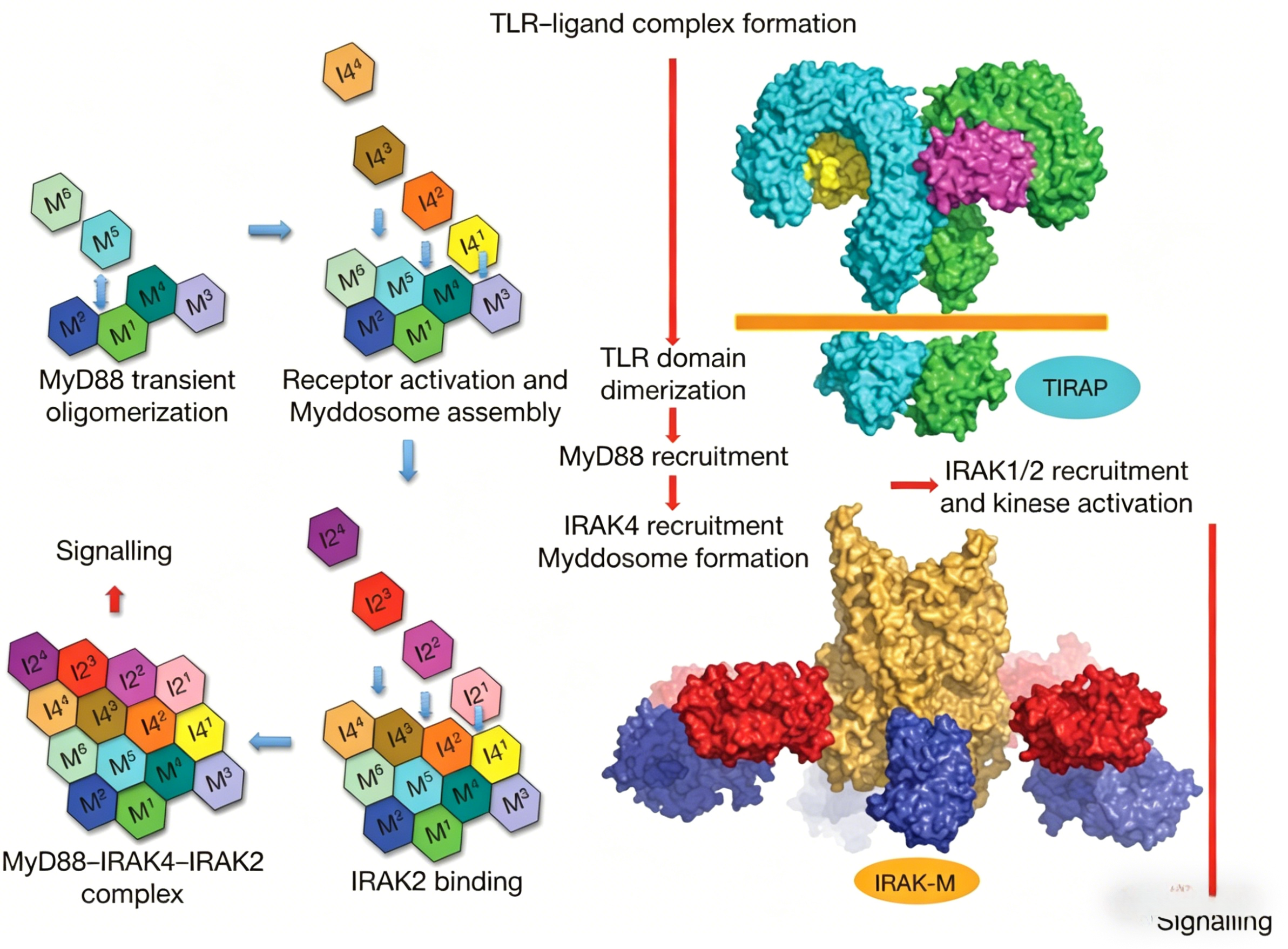
IRAK4 is a key adaptor molecule in the Toll-like receptor and IL-1 receptor signaling pathways. TLRs and IL-1R share conserved TIR domains and activate similar signaling cascades. The intracellular TIR domain recruits the adaptor protein MyD88, which in turn recruits IRAK4 to form a multiprotein complex called the Myddosome. Within this complex, IRAK4 undergoes trans-autophosphorylation for activation, subsequently phosphorylating and activating IRAK1 and IRAK2. This leads to the activation of downstream transcription factors including NF-κB, CREB, AP-1, and IRF. These transcription factors promote the secretion of pro-inflammatory cytokines and the proliferation/differentiation of immune cells. IRAK4 serves as a pivotal hub in this signaling pathway, regulating its activity through conformational changes and post-translational modifications.
Given IRAK4's critical role in TLR/IL-1R signaling, it has emerged as an important therapeutic target for autoimmune diseases and cancer immunotherapy. Studies show that IRAK4 gene mutation or inhibition in animal models confers protection against various inflammatory diseases, including septic shock, systemic lupus erythematosus, cardiovascular diseases, and Alzheimer's disease. In tumor immunology, IRAK4-mediated signaling regulates inflammatory responses in the tumor microenvironment, influencing anti-tumor immune responses. Thus, IRAK4-targeting strategies hold significant research value for both autoimmune diseases and cancer immunotherapy. The TR-FRET DDB1-CRBN & IRAK4 PROTAC Assay Kit enables quantitative detection of PROTAC molecules' dual binding activity to IRAK4 and CRBN, providing a technical tool for degrader screening.
PROTAC molecules consist of three components: a target protein ligand, an E3 ligase ligand, and a linker. They simultaneously bind the target protein and E3 ligase to induce ubiquitination and proteasomal degradation of the target. Compared to traditional small-molecule inhibitors, PROTAC technology offers advantages including targeting traditionally "undruggable" proteins, catalytic mode of action, and sustained inhibitory effects. For IRAK4, PROTAC-mediated degradation can completely block both its kinase activity and scaffolding function, overcoming potential drug resistance issues with kinase inhibitors. CRBN-based IRAK4 PROTAC molecules induce IRAK4 degradation by simultaneously binding IRAK4 and CRBN, fully inhibiting TLR/IL-1R pathway activation. TR-FRET technology can be applied to study PROTAC molecules' cooperative binding to IRAK4 and CRBN, evaluating their target degradation potential.
CRBN is the substrate recognition receptor of Cullin 4 RING E3 ubiquitin ligase, forming the CRL4CRBN complex with DDB1. DDB1 serves as an adaptor protein connecting CRBN to the Cullin 4 scaffold. Research shows that CRBN alters its substrate specificity upon binding to thalidomide and its analogs, enabling recruitment and degradation of non-native substrates. CRBN is one of the most commonly used E3 ligases in PROTAC design, with ligands exhibiting good cell permeability and pharmacokinetic properties. The formation of DDB1-CRBN complex is essential for CRL4CRBN E3 ligase activity and substrate recognition. The TR-FRET DDB1-CRBN & IRAK4 PROTAC Assay Kit can assess PROTAC molecules' dual binding activity to both DDB1-CRBN complex and IRAK4, validating their mechanism of action.
TR-FRET technology combines time-resolved fluorescence and fluorescence resonance energy transfer principles. Time-resolved fluorescence utilizes the long fluorescence lifetime of lanthanide chelates to effectively eliminate short-lived background fluorescence interference. Fluorescence resonance energy transfer occurs when donor and acceptor fluorophores are in close proximity, generating specific signals through non-radiative energy transfer. In the DDB1-CRBN & IRAK4 PROTAC Assay Kit, donor-labeled IRAK4 protein and acceptor-labeled DDB1-CRBN complex are co-incubated. When PROTAC molecules simultaneously bind both, donor and acceptor come into proximity, enabling energy transfer. Competitive compounds or degraders reduce signal intensity, reflecting their blocking effect on PROTAC-mediated binding. This homogeneous, wash-free detection method features high sensitivity and throughput, suitable for large-scale compound screening.
The TR-FRET DDB1-CRBN & IRAK4 PROTAC Assay Kit offers multifaceted value in IRAK4-targeting degrader development. During PROTAC design, it validates whether the linkage strategy between IRAK4 ligand and CRBN ligand is effective, evaluating how different linker lengths and connection sites affect dual binding capability. In structural optimization, it quantitatively compares binding affinity and cooperative binding effects among PROTAC molecules, supporting structure-activity relationship studies. For compound screening, it enables high-throughput assessment of IRAK4-binding molecules' simultaneous binding to DDB1-CRBN complex, rapidly identifying lead compounds with degradation potential. Compared to traditional methods, TR-FRET features simple operation, short detection time, and minimal sample consumption, making it ideal for early-stage drug discovery screening needs.
Nanjing UA-Bio Technology Co., Ltd. has independently developed the "UniOne® TR-FRET Human DDB1-CRBN & IRAK4 PROTAC Binding Kit" (Catalog #: UA086005), a high-performance analysis platform specifically designed for studying PROTAC molecules that target IRAK4 protein degradation. This kit employs time-resolved fluorescence resonance energy transfer (TR-FRET) technology to accurately and efficiently assess ternary complex formation between human IRAK4 protein and DDB1-CRBN complex mediated by PROTAC molecules. It provides a stable, reliable standardized solution for PROTAC technology development, inflammatory disease drug screening, and novel anti-tumor drug research.
| Core Product Advantages | Detailed Parameters / Functional Description |
|---|---|
| High Purity & Full Biological Activity | The kit's core components include high-purity, fully bioactive human IRAK4 protein and DDB1-CRBN complex validated through multi-dimensional quality control. Both maintain correct native conformations and intact protein-protein interaction capabilities, accurately simulating PROTAC-mediated ternary complex formation to ensure data accuracy, reproducibility, and functional relevance. |
| Exceptional Batch Consistency & Stability | Utilizing internationally leading protein expression platforms and highly standardized production processes combined with stringent QC systems, the product delivers outstanding long-term stability and excellent batch-to-batch consistency, providing solid quality assurance for continuous PROTAC drug screening and mechanistic studies. |
| Ready-to-Use Flexible Platform | This TR-FRET-based kit features a simple "add-incubate-read" workflow without washing steps. Its optimized formulation supports automated multi-well plate (96/384-well) platforms, flexibly adapting to various research needs including high-throughput IRAK4-targeting PROTAC screening, ternary complex evaluation, degrader affinity measurement, and competitive binding assays. |
| Complete Solution & Professional Support | We provide fully validated standard protocols, typical dose-response curves, and detailed data interpretation guides to help quickly establish stable, reproducible workflows. Nanjing UA-Bio's technical team offers comprehensive professional consultation and support for experimental design, optimization, and data analysis. |
Nanjing UA-Bio Technology Co., Ltd. remains committed to providing cutting-edge, high-quality core reagents and tools for immunology, cell therapy, and innovative drug development. For detailed technical parameters, validation data, or specific application inquiries regarding the "UniOne® TR-FRET Human DDB1-CRBN & IRAK4 PROTAC Binding Kit" (Catalog #: UA086005), please feel free to contact us.








