





Human pluripotent stem cells possess unlimited self-renewal and multidirectional differentiation potential, holding great promise for generating transplantable hematopoietic stem/progenitor cells and various mature blood cells such as platelets and red blood cells. However, current differentiation methods can only produce limited quantities of functionally imperfect blood cells. Unraveling the mechanisms of hematopoietic differentiation in human pluripotent stem cells and designing efficient blood cell production strategies are critical scientific challenges in this field. The R-Spondin protein family, a group of secreted glycoproteins, plays a vital role in the hematopoietic microenvironment. Preliminary studies have shown that R-Spondin 2 protein can significantly enhance the efficiency of hematopoietic differentiation in human pluripotent stem cells, yielding large numbers of hematopoietic stem/progenitor cells. R-Spondin 1(21-146) protein, as an important member of this family, contains two cysteine-rich furin-like domains and retains key functional regions for receptor binding, serving as a valuable molecular tool for investigating its mechanisms.
Researchers systematically analyzed the dynamic expression of R-Spondin protein receptors and other G protein-coupled receptors during hematopoietic differentiation of human pluripotent stem cells. The results revealed that LGR4 and LGR5 exhibit high expression patterns during differentiation. LGR4 and LGR5 belong to the leucine-rich repeat-containing G protein-coupled receptor family and are high-affinity receptors for R-Spondin proteins. This finding suggests that LGR family receptors may participate in regulating hematopoietic differentiation in human pluripotent stem cells. By constructing LGR4 and LGR5 single or double knockout human pluripotent stem cell mutants and comparing their differentiation potential, researchers found that only LGR4 knockout affects mesoderm differentiation in these cells. Further animal model experiments confirmed that LGR4, but not LGR5, is a critical regulator of early hematopoietic development in vivo and in vitro, with LGR4 knockout significantly impacting embryonic mesoderm development.
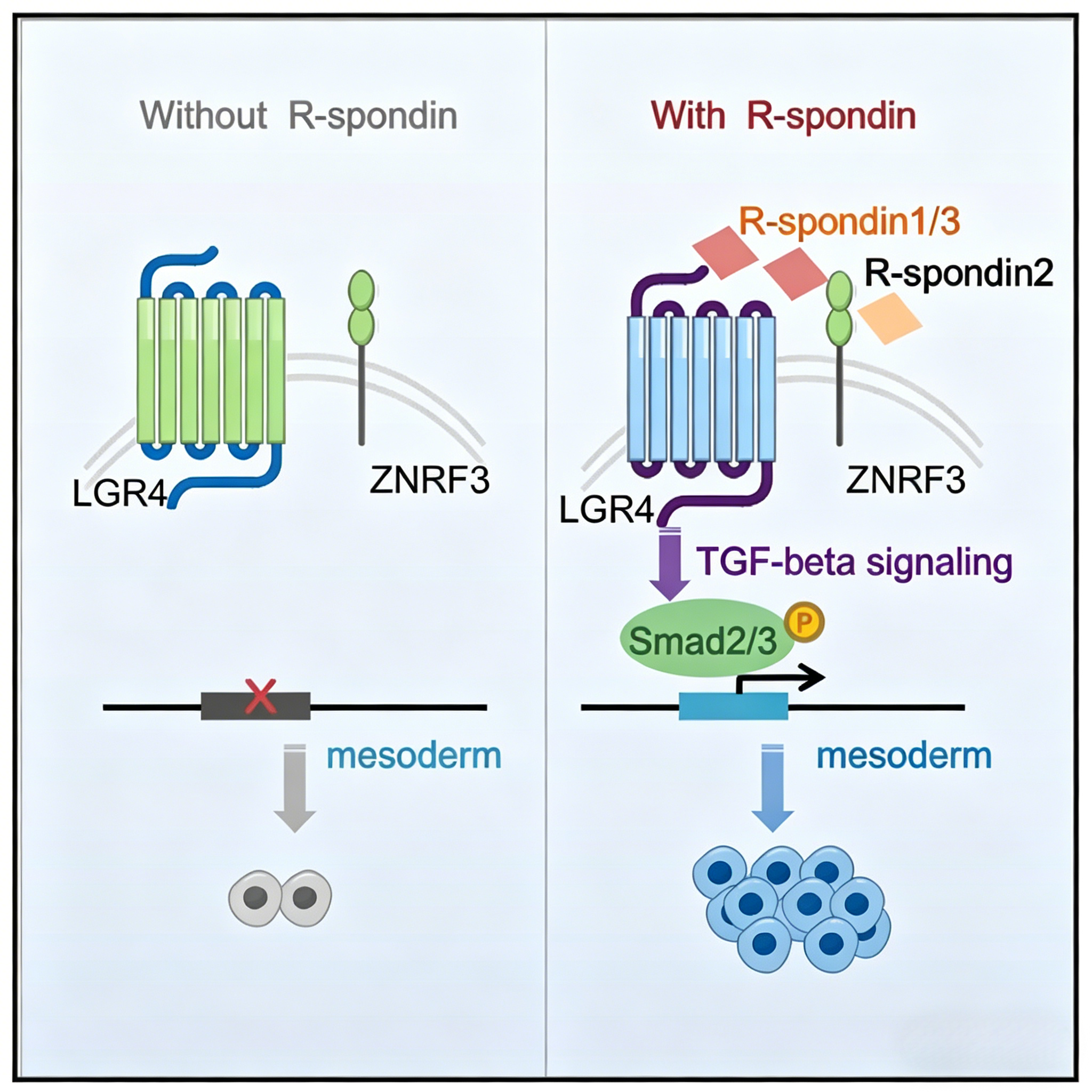
The study found significant differences in the roles and mechanisms of the four R-Spondin protein family members during hematopoietic differentiation of human pluripotent stem cells. R-Spondin 1, R-Spondin 2, and R-Spondin 3 all promote hematopoietic differentiation by enhancing mesoderm cell production, whereas R-Spondin 4 shows almost no promoting effect. In terms of receptor dependency, R-Spondin 1 and R-Spondin 3 rely on LGR4 and ZNRF3 receptors to promote hematopoietic differentiation, while R-Spondin 2 functions independently of LGR4 and LGR5, acting through ZNRF3 receptors. ZNRF3 is an E3 ubiquitin ligase that negatively regulates the WNT signaling pathway. R-Spondin proteins interact with ZNRF3, inhibiting its ubiquitin-mediated degradation of WNT receptors, thereby enhancing WNT signaling intensity. The R-Spondin 1(21-146) protein, retaining the furin-like domains, effectively binds to LGR4 and ZNRF3 to exert regulatory functions.
Mechanistic studies revealed that both LGR4 and R-Spondin proteins function by activating the TGF-beta signaling pathway. After binding to LGR4, R-Spondin proteins form a complex with ZNRF3, inhibiting ZNRF3-mediated ubiquitination and degradation of WNT receptors, thereby stabilizing WNT receptor expression on the cell membrane. This process enhances WNT signaling intensity, subsequently activating the TGF-beta signaling pathway and promoting mesoderm cell differentiation and hematopoietic stem/progenitor cell formation. Specifically, activated TGF-beta signaling upregulates the expression of key mesoderm transcription factors, including BRA, MESP1, and EOMES, which collaboratively drive mesoderm cells toward hematopoietic lineage differentiation. LGR4 occupies a central position in this signaling cascade, and its absence disrupts the pathway, significantly impairing hematopoietic differentiation efficiency.
Using human pluripotent stem cells and gene knockout animal models, this study elucidated the critical functions of the secreted R-Spondin protein family and LGR receptors in mesoderm induction and hematopoietic differentiation. The research identified LGR4, but not LGR5, as a key regulator of early hematopoietic development, clarified the differences in receptor dependency and mechanisms among R-Spondin family members, and demonstrated the pivotal role of the TGF-beta signaling pathway in R-Spondin/LGR4-mediated hematopoietic differentiation. These findings indicate that R-Spondin proteins can serve as valuable tools for generating large quantities of blood cells, offering significant potential for improving hematopoietic differentiation efficiency in human pluripotent stem cells and uncovering differentiation mechanisms. At the application level, adding R-Spondin 1(21-146) protein to differentiation media significantly enhances the yield and quality of hematopoietic stem/progenitor cells.
As a functional fragment of the R-Spondin family, R-Spondin 1(21-146) protein holds broad application potential in hematopoietic differentiation research. Future studies will further explore the binding patterns of R-Spondin proteins with different receptors and resolve the fine structures of ternary complexes formed by R-Spondin 1(21-146), LGR4, and ZNRF3 using structural biology approaches. Optimization strategies based on R-Spondin proteins may provide technical support for producing clinically viable blood cells, addressing shortages in platelet and red blood cell transfusion sources. Additionally, the roles of the R-Spondin/LGR signaling axis in other tissue stem cell differentiation systems, including intestinal, liver, and skeletal stem cells, warrant in-depth investigation.
Nanjing UA-Bio Technology Co., Ltd. has independently developed "R-Spondin 1 (21-146) Protein, Human" (Catalog No.: UA040022), a high-quality recombinant protein reagent specifically designed for organoid culture, stem cell self-renewal, and Wnt signaling pathway research. This protein is a functional truncated form of human R-Spondin 1 (amino acids 21-146) containing intact furin-like (FU) domains, capable of efficiently binding LGR4/5/6 receptors and enhancing Wnt/β-catenin signaling activity. It serves as a stable and reliable standardized tool for applications such as intestinal, gastric, and liver organoid construction and regenerative medicine research.
| Core Product Advantages | Detailed Parameters / Functional Description |
|---|---|
| High Purity and Intact Bioactivity | The product employs an internationally advanced recombinant expression system and highly standardized purification processes, validated through multi-dimensional quality control to ensure >95% purity, correct native conformation, and intact biological functionality. This truncated form retains the core functional domains for LGR receptor binding found in the full-length protein, effectively enhancing Wnt signaling activity and faithfully mimicking R-Spondin 1-mediated stem cell self-renewal and tissue development regulation under physiological conditions. |
| Exceptional Batch-to-Batch Consistency and Stability | From genetic construction and protein expression to purification quality control, the entire process is strictly managed under a comprehensive release testing system, ensuring stable biological activity, consistent purity, and excellent long-term stability across batches. This provides a solid foundation for long-term, continuous organoid culture and stem cell research. |
| Ideal Tool for Multi-Scenario Applications | This protein performs exceptionally in intestinal organoid construction, gastric organoid culture, liver organoid expansion, stem cell self-renewal studies, Wnt signaling pathway analysis, and drug activity evaluation. It is widely applicable for optimizing organoid culture systems, regenerative medicine research, developmental biology mechanism exploration, and drug screening. |
| Low Endotoxin and High Batch Consistency | The product undergoes multi-step chromatography purification and endotoxin removal processes, resulting in extremely low endotoxin levels (<0.1 EU/μg) that meet stringent requirements for cell culture and organoid construction. Rigorous quality control ensures high consistency in protein activity and purity across batches. |
| Comprehensive Solutions and Professional Support | We provide thoroughly validated standard protocols, representative biological activity data, and detailed product analysis certificates to facilitate the rapid establishment of stable and reproducible experimental workflows. Nanjing UA-Bio's professional technical team offers full-spectrum support for research design, experimental optimization, and data analysis. |
Nanjing UA-Bio Technology Co., Ltd. is dedicated to providing cutting-edge, high-quality core reagents and tools for immunology, cell therapy, and innovative drug development. For detailed technical parameters, validation data, or application consultations regarding "R-Spondin 1 (21-146) Protein, Human" (Catalog No.: UA040022), please feel free to contact us.








