





Guanylate cyclase C, also known as GUC2C or STAR, is a guanylate cyclase that catalyzes the synthesis of cyclic guanosine monophosphate (cGMP) from GTP. It plays a central role in regulating intestinal homeostasis and is critically involved in intestinal health and colorectal cancer development, making it a highly promising therapeutic target. The GUCY2C gene is located on chromosome 12q12 and encodes a type I transmembrane protein with a molecular weight of approximately 120 kDa, consisting of an extracellular domain, transmembrane domain, and intracellular domain. The extracellular domain is responsible for recognizing and binding specific ligands, the transmembrane domain anchors the receptor to the cell membrane, and the intracellular domain possesses guanylate cyclase activity, which is central to its signal transduction function. GUCY2C is primarily expressed in the gastrointestinal tract, with expression observed in enteroendocrine cells, Paneth cells, proximal intestinal epithelial cells, intestinal goblet cells, undifferentiated cells, and distal intestinal epithelial cells. Alexa Fluor 647-labeled GUCY2C Fc chimera protein can be used for quantitative detection of GUCY2C protein expression levels and binding activity, providing a technical tool for colorectal cancer research.
Upon ligand binding, GUCY2C catalyzes the formation of cGMP from GTP. The increase in intracellular cGMP levels leads to the activation of cGMP-dependent protein kinase II (PKGII). PKGII-mediated phosphorylation inhibits the sodium-hydrogen exchanger 3 (NHE3), resulting in reduced intestinal sodium absorption. PKGII phosphorylates and activates the cystic fibrosis transmembrane conductance regulator (CFTR) anion channel, increasing intestinal chloride and water secretion. Elevated cGMP activates cyclic nucleotide-gated ion channels, promoting calcium ion influx and recruiting calcium-sensing receptors to the plasma membrane. cGMP production activates PKGII and p38 mitogen-activated protein kinase (MAPK), leading to phosphorylation of the Sp1 transcription factor. Sp1 upregulates p21 expression and mediates cell cycle arrest. The activation of these signaling pathways collectively regulates intestinal electrolyte balance and cell proliferation.
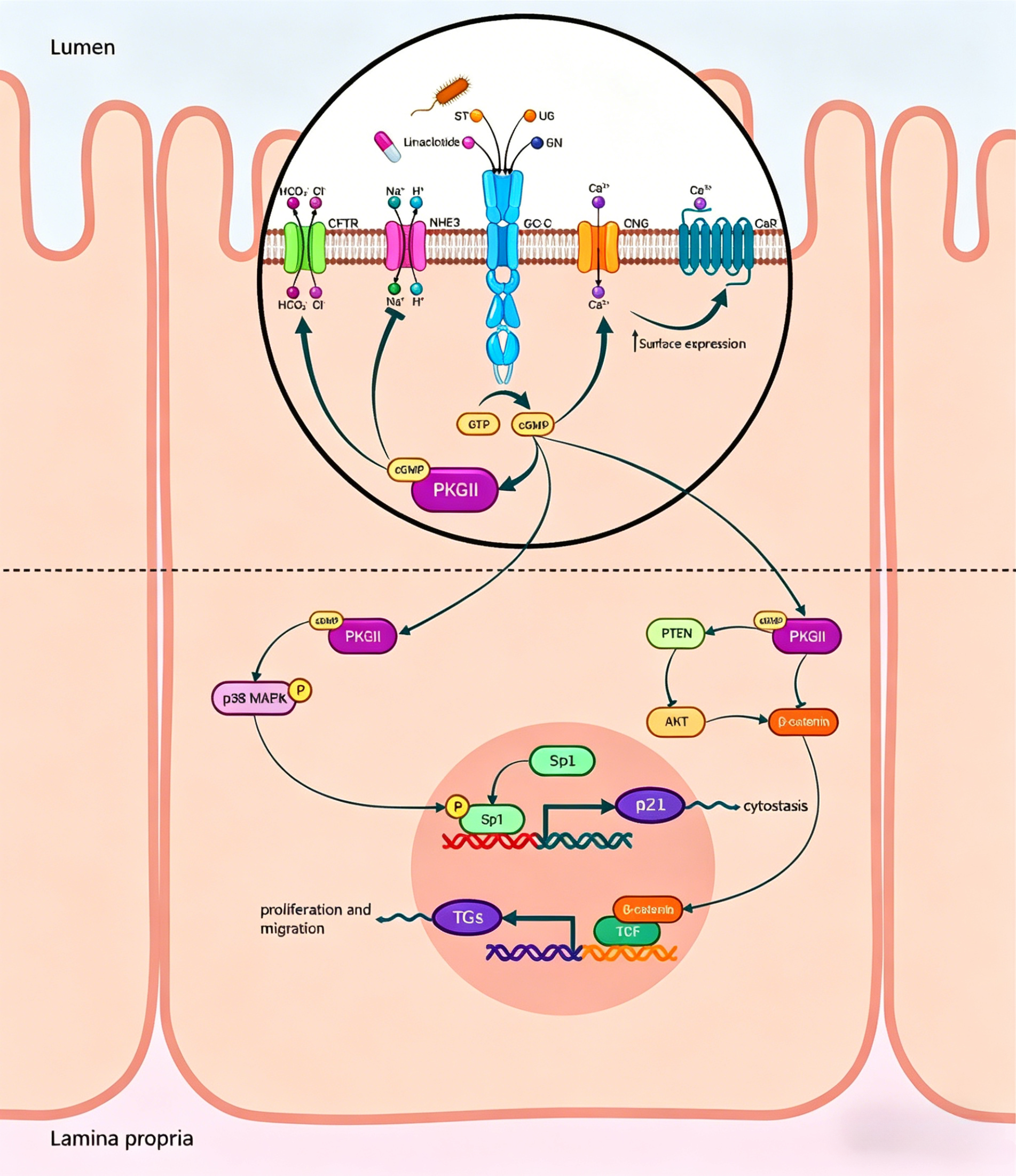
PKGII-mediated signaling can counteract the pro-survival and pro-proliferative phenotypes mediated by the β-catenin/TCF and Akt pathways. The β-catenin/TCF pathway is central to the canonical Wnt signaling pathway, and its aberrant activation is closely associated with the development and progression of colorectal cancer. The Akt signaling pathway is a critical cell survival pathway that promotes cell proliferation and inhibits apoptosis. GUCY2C activates PKGII to suppress the activity of these pathways, thereby inhibiting tumor cell proliferation. p21, a cyclin-dependent kinase inhibitor, is upregulated under the regulation of the GUCY2C signaling pathway, leading to cell cycle arrest and suppression of tumor growth. These mechanisms make GUCY2C an important target for colorectal cancer treatment. Alexa Fluor 647-labeled GUCY2C Fc chimera protein can be used to study the interaction between GUCY2C and downstream signaling molecules, providing a quantitative analysis tool for mechanistic research.
GUCY2C plays a dual role in the development of colorectal cancer. Under normal physiological conditions, GUCY2C inhibits tumorigenesis by maintaining intestinal barrier function and regulating cell proliferation. During colorectal cancer progression, the expression and function of GUCY2C may undergo changes. Studies have found that loss of GUCY2C ligands is a common early step in tumorigenesis, leading to genomic instability, metabolic reprogramming, and uncontrolled proliferation. However, GUCY2C protein itself remains highly expressed on the surface of colorectal cancer cells, making it an ideal therapeutic target. GUCY2C is stably expressed in over 95% of colorectal cancers and has limited expression in normal tissues, offering the potential for highly selective and low-toxicity precision cancer therapy.
Given the specific high expression of GUCY2C in colorectal cancer, GUCY2C-targeted immunotherapy strategies have garnered significant attention. CAR-T cells expressing chimeric antigen receptors that specifically recognize GUCY2C can precisely target and eliminate GUCY2C-expressing tumor cells. Compared to traditional treatments, CAR-T cell therapy offers advantages such as high specificity, potent cytotoxic activity, and the ability to generate immune memory. Additionally, GUCY2C-targeted bispecific antibodies can redirect T cells to tumor cells, mediating specific killing. Antibody-drug conjugates can deliver cytotoxic drugs precisely to GUCY2C-positive tumor cells, enhancing efficacy while reducing systemic toxicity. Alexa Fluor 647-labeled GUCY2C Fc chimera protein can be used to evaluate the binding capacity of CAR-T cells and antibody drugs to GUCY2C antigen, validating their functional activity.
GUCY2C is primarily associated with intestinal diseases, including functional gastrointestinal disorders, inflammatory bowel disease (IBD), and gastrointestinal cancers. In functional gastrointestinal disorders, GUCY2C participates in regulating the dynamic balance of intestinal water and electrolytes, and its dysfunction can lead to diarrhea or constipation. In IBD, studies suggest that activating mutations in GUCY2C can alter the intestinal environment, leading to changes in gut microbiota and increased susceptibility to Crohn's disease. Another report indicates that familial GUCY2C diarrhea syndrome can develop into IBD in adulthood. In colorectal cancer, GUCY2C often exhibits abnormal expression in early stages of carcinogenesis and can serve as an early detection marker for postoperative recurrence and metastasis. These findings highlight the significant diagnostic and therapeutic value of GUCY2C in intestinal diseases.
Nanjing UA-Bio Technology Co., Ltd. (UA-Bio) has independently developed the "Alexa Fluor 647-Labeled GUCY2C Fc Chimera Protein, Human" (Catalog No.: UA011282), a high-performance far-red fluorescent probe specifically designed for GUCY2C-targeted research and multicolor flow cytometry analysis. This protein is a chimera composed of the extracellular domain of human GUCY2C fused with the human IgG Fc fragment and labeled with Alexa Fluor 647. It efficiently binds to anti-GUCY2C antibodies or affinity ligands, providing a stable and reliable standardized tool for CAR-T cell therapy evaluation, antibody drug screening, and multiparameter analysis of colorectal cancer biomarkers.
| Core Advantages | Detailed Parameters / Functional Description |
|---|---|
| High Purity and Intact Bioactivity | The product employs an internationally advanced eukaryotic expression system and highly standardized purification process, validated by multidimensional quality control to ensure >95% purity and correct native conformation (with intact glycosylation modifications). The Fc chimera format enhances protein stability and proper folding. The Alexa Fluor 647 labeling process is optimized to ensure high labeling efficiency while maintaining high-affinity binding to antibodies, accurately mimicking the antigenic properties of GUCY2C on colorectal cancer cell surfaces under physiological conditions.-- |
| Far-Red Fluorescence and Multicolor Compatibility | Labeled with Alexa Fluor 647 fluorescent dye, which exhibits high fluorescence brightness, excellent photostability, and low background noise. The excitation peak is approximately 650 nm, and the emission peak is approximately 665 nm, falling within the far-red region. This effectively avoids detection channels of common fluorophores like FITC and PE, supporting multicolor analysis in flow cytometry and multichannel imaging in fluorescence microscopy.-- |
| Ideal Tool for Diverse Applications | This protein performs excellently in CAR-T cell positivity rate detection by flow cytometry (supporting multicolor panel design), anti-GUCY2C antibody/antagonist screening, competitive binding assays, multiparameter analysis of colorectal cancer biomarkers, and various flow cytometry applications. It is widely applicable to GUCY2C-targeted CAR-T cell therapy product development, colorectal cancer diagnostic tool research, and drug activity evaluation.-- |
| Comprehensive Solutions and Professional Support | We provide fully validated standard experimental protocols, typical flow cytometry data, and detailed result interpretation guides to help you quickly establish stable and reproducible GUCY2C-targeted molecular detection workflows. Nanjing UA-Bio's professional technical team offers全程 (full-process) technical consultation and support for research design, experimental optimization, and data analysis.-- |
Nanjing UA-Bio Technology Co., Ltd. is committed to providing cutting-edge, high-quality core reagents and tools for immunology, cell therapy, and innovative drug development. For detailed technical parameters, validation data, or specific application inquiries regarding the "Alexa Fluor 647-Labeled GUCY2C Fc Chimera Protein, Human" (Catalog No.: UA011282), please feel free to contact us.








