




KRAS Target: The Exploration Path from Basic Discovery to Cancer Treatment


The KRAS protein is an important target protein in cancer. The KRAS gene, whose full name is Kirsten rat sarcoma viral oncogene homolog, is translated as "Kirsten rat sarcoma virus oncogene homolog". The protein encoded by the KRAS gene is a small GTPase, which belongs to the RAS superfamily of proteins.
- Recent Advances
- Product Information
I. Discovery of the RAS Gene
In the development process of modern medicine, scientists such as Pasteur achieved great success in the field of anti-infection at the end of the 19th century. Subsequently, a series of observations and studies on tumors led people to once believe that tumors were infectious diseases caused by viruses. In 1910, Peyton Rous discovered the first tumor virus, Rous sarcoma virus (RSV). Thereafter, various oncogenic viruses were successively discovered, and people firmly believed that tumors were diseases caused by viruses.
It was not until 1974 that J. Michael Bishop and Harold Varmus discovered through DNA probes that the tumor gene src, which was the same as that in the RSV virus, also existed in normal uninfected cells. This discovery revealed that tumor genes had long been present in the host genome, and viruses had merely acquired and modified these gene segments from host cells. This breakthrough opened the door to modern tumor biology, and Bishop and Varmus were awarded the Nobel Prize in Physiology or Medicine in 1989 for this achievement.
Before that, in the 1960s, Harvey, Kirsten, and others discovered the mouse tumor genes HRAS and KRAS respectively. In 1982, laboratories such as Weinberg's discovered HRAS in human bladder cancer cells, making RAS the first human tumor gene to be discovered. Nowadays, the RAS gene has been confirmed to be one of the most commonly mutated genes in tumors. Approximately 30% of tumors carry RAS mutations. When considering the mutations of its regulatory factors and the upstream and downstream of the signaling pathways, it almost covers all tumors, causing the death of over one million patients every year. It can truly be called the "King of Tumor Genes."
II. The KRAS Gene
(I) Basic Characteristics of the Gene and Protein
The full name of the KRAS gene is Kirsten rat sarcoma viral oncogene homolog, and the protein it encodes is a small GTPase, belonging to the RAS superfamily of proteins. In the human genome, there are two KRAS genes. Among them, KRAS1 is a non-functional "pseudogene" located on the short arm of chromosome 6; KRAS2 is a "true gene" with biological activity, located on the short arm of chromosome 12. Usually, the KRAS gene and protein studied refer to KRAS2 and its products.
The KRAS protein has two variants, KRAS4A and KRAS4B, which are generated by different splicing methods of exon 4 during the RNA splicing process. The expression level of KRAS4B is approximately 5 times that of KRAS4A. The KRAS protein is composed of 188 amino acids, with a molecular weight of 21.6 KD. It is a guanosine-binding protein with GTPase activity and is localized to the inner side of the cell membrane through farnesylation modification.
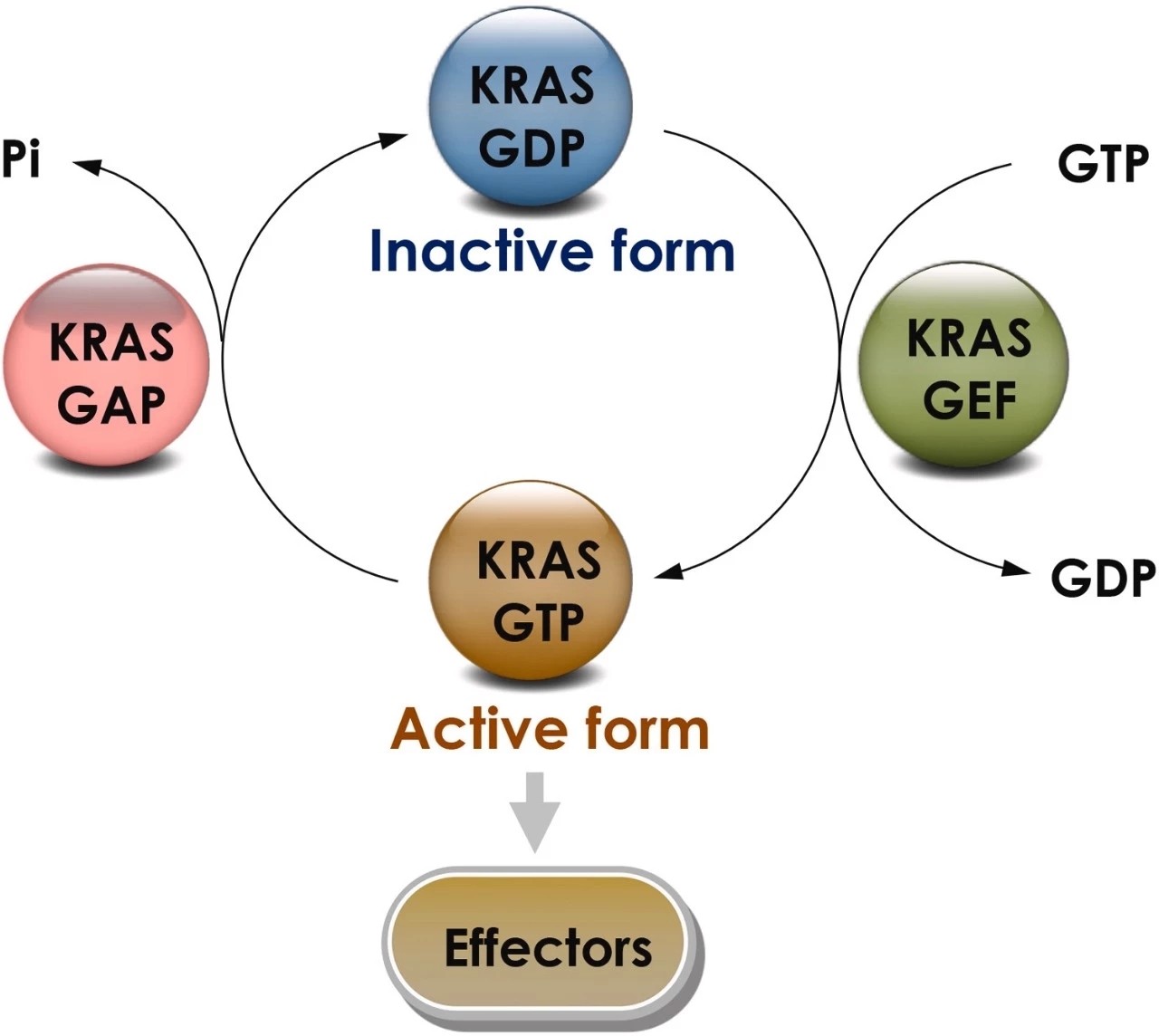
(II) Upstream and Downstream Signaling Pathways and Activity Regulation
In normal cells, receptor monomers such as EGFR and HER2 on the cell membrane bind to ligands outside the cell membrane to form dimers. These dimers undergo autophosphorylation and then phosphorylate downstream signaling proteins. One of the signaling pathways can activate Grb2-Shc, which in turn activates the SOS protein, and finally activates the KRAS protein.
The KRAS protein can switch between an inactive state (bound to GDP) and an active state (bound to GTP) within the cell. Once activated, KRAS can activate multiple downstream signaling pathways, such as the MAPK, PI3K, and Ral-GEFs signaling pathways, which are crucial for cell survival, proliferation, and cytokine release.
The activity of KRAS is regulated by two types of factors: guanine nucleotide exchange factors (GEFs, such as the SOS protein) and GTPase-activating proteins (GAPs). GEFs promote the binding of KRAS to GTP, thereby activating KRAS, while GAPs promote the hydrolysis of GTP bound to KRAS into GDP, inactivating KRAS.

III. KRAS Mutations
RAS is at the core of the cell signaling network and is associated with multiple hallmarks of cancer. KRAS is the most common subtype in the RAS family, and its gene mutations account for 85% of the total number of RAS gene mutations. In various cancers, such as nearly 90% of pancreatic cancers, 30-40% of colon cancers, 17% of endometrial cancers, and 15-20% of lung cancers (mostly non-small cell lung cancers, NSCLC), there are high proportions of KRAS gene mutations.
Among KRAS gene mutations, 97% occur at the 12th or 13th amino acid residues, and the main mutation types are G12D, G12V, and G13D. These mutations interfere with the ability of KRAS to hydrolyze GTP, causing KRAS to remain continuously bound to GTP, staying in an activated state, and continuously activating downstream signaling pathways, stimulating cell proliferation and migration, and ultimately leading to tumorigenesis.
KRAS mutations not only directly promote the proliferation and survival of tumor cells but also have an impact on the tumor microenvironment. Tumor cells carrying KRAS mutations secrete a variety of cytokines, such as IL-6 and IL-8, which can reprogram the stromal cells in the tumor microenvironment and maintain an inflammatory phenotype; the secreted granulocyte-macrophage colony-stimulating factor (GM-CSF) can stimulate the infiltration of myeloid-derived suppressor cells (MDSC), inhibiting the anti-tumor immune response.

IV. KRAS Detection and Targeted Drug Development
(I) Gene Detection Methods
Currently, the detection methods for KRAS mutations are mainly based on the principle of real-time fluorescence quantitative PCR. In 2012, the FDA approved Qiagen's KRAS mutation detection method as a companion diagnostic for cetuximab; in 2015, the FDA approved Roche's detection method for the diagnosis of metastatic colon cancer. Chinese companies such as Xiamen Adx Biotech Co., Ltd., Wuhan Yozoo Biotech Co., Ltd., and others also provide relevant detection kits.
(II) Challenges in Targeted Drug Development
For a long time, KRAS has been regarded as an "undruggable" target. This is because the KRAS protein has no obvious binding sites in its structure, making it difficult to synthesize compounds that can target and inhibit its activity. In addition, the normal activity of KRAS is crucial for many normal cell functions. Direct inhibition may lead to severe toxicity and side effects; moreover, KRAS has a high degree of homology with NRAS and HRAS, and inhibiting the activity of KRAS may also affect other proteins.
At the same time, KRAS has an extremely strong binding affinity to GDP and GTP. The normal concentrations of GDP and GTP in cells are much higher than the concentrations required for binding to KRAS. It is extremely difficult to design small molecule compounds with a binding ability comparable to that of GDP or GTP. Designing drugs that specifically inhibit the activity of mutant KRAS proteins without affecting normal proteins also faces many difficulties; indirect targeting strategies also encounter numerous challenges, including toxicity and side effects, compensatory escape mechanisms, and signal feedback redundancy.
(III) Drug Development Strategies and Progress
In recent years, breakthroughs have been made in the research of covalent inhibitors targeting KRAS mutants. For example, small molecule covalent inhibitors targeting the KRAS G12C mutant, such as AMG510 from Amgen and MRTX849 from Mirati Therapeutics, have entered the clinical trial stage. The small molecule inhibitor BI-2852 discovered by Boehringer Ingelheim can bind to different "pockets" of KRAS, affecting its binding to other proteins and exhibiting an antiproliferative effect.
Indirect targeting strategies are also being continuously explored, including inhibiting the activities of farnesyltransferase and PDEδ to regulate the binding of RAS to the plasma membrane; targeting proteins that regulate KRAS activity, such as the SOS1 inhibitor from Boehringer Ingelheim and the SHP2 inhibitors from Novartis and Revolution Medicines; indirectly inhibiting KRAS through innovative treatment modalities, such as targeted protein degraders, RNAi therapies, antisense oligonucleotide therapies, and cancer vaccines; inhibiting RAS effector signaling, such as developing targeted drugs against BRAF, and the new generation of RAF inhibitors is currently in clinical trials.
Although the research on the KRAS target faces many challenges, with the continuous advancement of science and technology, remarkable progress has been made in KRAS-related research and targeted drug development. There is hope that new breakthroughs and prospects will be brought to cancer treatment in the future.
This article is reviewed and published by the technical expert team of UA
Disclaimer: This article partially utilizes artificial intelligence assistance in its creation. If any content involves copyright or intellectual property issues, please let us know and we promise to verify and remove it as soon as possible.
Purchase recombinant protein, choose Nanjing UA-Bio
UA protein focuses on providing various protein reagents, raw materials, and services required for drug research and development, cell therapy, gene therapy, and basic scientific research, including drug target proteins, immune checkpoint proteins, cytokines, tool enzymes, customized protein expression, and full-length transmembrane protein development. Youai is committed to providing customers with high-quality products and professional services, and building a High-tech Biological Enterprise with International Competitiveness.







 Business license (three certificates in one)