





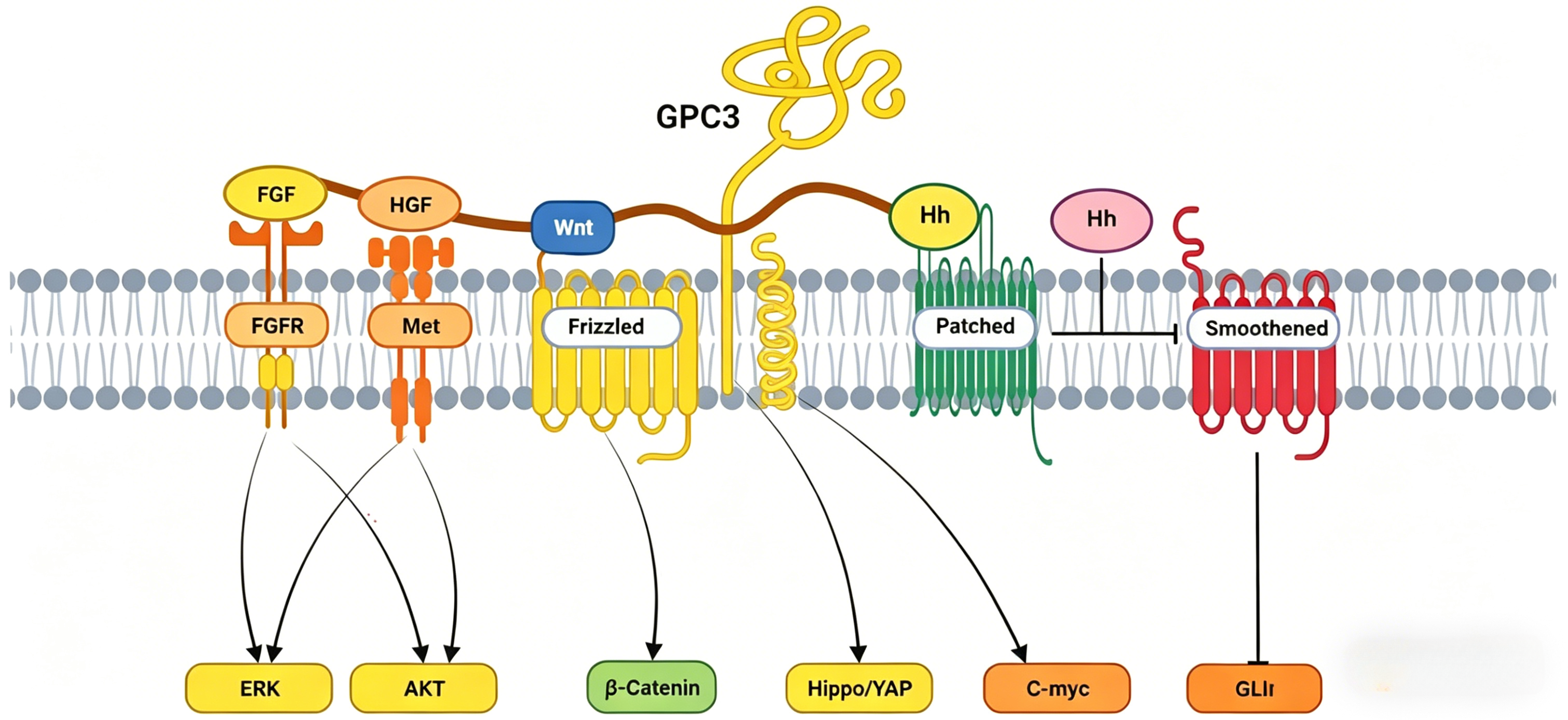
GPC3 is a heparan sulfate proteoglycan located on the cell membrane surface and serves as a liver cancer-specific associated antigen. This protein consists of a complex glycoconjugate formed by the covalent linkage of protein, lipids, and carbohydrates, anchored to the cell membrane via a glycosylphosphatidylinositol (GPI) moiety. The GPC3 gene is located on human chromosome Xq26, with a genomic structure spanning approximately 900 kb, featuring structural characteristics such as a central globular domain and C-terminal glycosaminoglycan side chain attachment sites. Its heparan sulfate groups interact with growth factors and their receptors, extracellular matrix proteins, and adhesion molecules, regulating cell proliferation, differentiation, adhesion, and migration. GPC3 primarily functions through the Wnt signaling pathway, activating the canonical Wnt pathway via autocrine and paracrine mechanisms, leading to high expression of Wnt genes and promoting the growth of various tumor tissues. GPC3 is overexpressed in liver cancer tissues but absent or minimally expressed in normal liver tissues. Given its unique structural and functional properties, GPC3 is a potential therapeutic target for liver cancer. FITC-labeled GPC3 Fc chimera protein can be used to quantitatively detect GPC3 protein expression levels and binding activity, providing a technical tool for liver cancer-targeted therapy research.
GPC3-mediated gene therapy using miRNA, shRNA, and siRNA has demonstrated promising therapeutic effects in liver cancer. Knockdown of the GPC3 gene in liver cancer cells alters the Wnt signaling pathway, increases the expression levels of cytoplasmic β-catenin and cyclin D1, and disrupts the Bax/Bcl-2/cytochrome c/caspase-3 pathway, inhibiting liver cancer cell proliferation and inducing apoptosis while reversing tumor cell resistance to chemotherapy. Specific shRNA targeting GPC3 transcription suppresses liver cancer cell proliferation, migration, and invasion, induces apoptosis, and synergizes with antitumor drugs to inhibit cancer cell proliferation, highlighting GPC3 as a potential novel therapeutic target for liver cancer. Co-culturing GPC3 gene-transfected dendritic cells with cytokine-induced killer cells triggers a specific immune response, significantly inhibiting tumor growth and enhancing tumor-killing activity. Overexpression of GPC3 negatively regulates the IGF2 and FGF2 pathways, effectively inducing apoptosis to suppress liver cancer cell proliferation and invasion. FITC-labeled GPC3 Fc chimera protein can be used to assess changes in GPC3 protein expression levels post-gene transfection and validate gene silencing efficiency.
GPC3 peptide vaccines activate patients' immune responses to inhibit tumor growth, metastasis, and recurrence. Clinical studies show that GPC3 peptide vaccines exhibit good safety and tolerability, with a median survival time of 9.0 months in treated patients. Some patients achieved complete or partial remission, with significant shrinkage of metastatic lesions in supraclavicular lymph nodes and intrahepatic tumors. These patients induced GPC3-specific cytotoxic T lymphocyte (CTL) responses, with higher CTL frequencies correlating with longer median survival and overall survival. CTL frequency can serve as a predictive biomarker for overall survival in liver cancer patients treated with GPC3 peptide vaccines. Additionally, necrotic tumor cells or exposed tumor antigens after minimally invasive interventional procedures can induce specific antitumor immune responses. Following radiofrequency ablation and transarterial chemoembolization, GPC3-specific CTL counts increased significantly compared to surgical resection, confirming upregulated GPC3 expression and induction of specific CTL-mediated tumor cell killing. FITC-labeled GPC3 Fc chimera protein can be used to detect the binding capacity of CTLs to GPC3-positive tumor cells and evaluate immunotherapy efficacy.
GC33 is a novel recombinant human monoclonal antibody targeting GPC3 with high affinity, exerting antitumor activity through antibody-dependent cell-mediated cytotoxicity (ADCC). Clinical studies indicate that liver cancer patients with high GPC3 expression may achieve better outcomes with GC33 antibody therapy, with a median time to tumor progression of 26 weeks in the high-expression group, significantly longer than in the low-expression group. GC33 exhibits good safety, with most patients experiencing only grade 1 or 2 adverse events. The HN3 antibody primarily recognizes functional epitopes and inhibits the Wnt signaling pathway, directly suppressing liver cancer cell proliferation as a single-domain fully human protein. The YP7 antibody recognizes C-terminal epitopes but does not inhibit Wnt signaling. The HS20 antibody targets GPC3's heparan sulfate chains, inhibiting Wnt3a/β-catenin activation and disrupting Wnt3a-GPC3 interactions. FITC-labeled GPC3 Fc chimera protein can be used to evaluate the binding affinity of different GPC3 antibodies to antigens, providing quantitative data for antibody screening.
GPC3-targeted photoimmunotherapy is an effective method for liver cancer treatment. Intravenous injection of IR700-YP7-labeled GPC3 antibody combined with nanoparticle albumin-bound paclitaxel into liver cancer-bearing mice enables specific tumor targeting. Subsequent near-infrared irradiation induces tumor cell death and suppresses tumor growth. In liver cancer cells, miRNA-520c-3p expression is inversely correlated with GPC3 protein levels, and increased miRNA-520c-3p expression reduces GPC3 protein levels, inhibiting liver cancer cell proliferation and invasion. YAP protein is overexpressed in liver cancer and synergizes with GPC3 in tumor progression. Recombinant human YAP-1 effectively blocks GPC3-induced liver cancer cell proliferation. GPC3 regulates hepatic stellate cells via the Hedgehog signaling pathway, suppressing their capacity to promote liver cancer cell activity. FITC-labeled GPC3 Fc chimera protein can be used to assess the impact of different therapeutic strategies on GPC3 expression and function.
Nanjing UA-Bio Technology Co., Ltd. (UA-Bio) has independently developed "FITC Labeled-GPC3 Fc Chimera Protein, Human" (Catalog No.: UA011256), a high-performance green fluorescent-labeled probe specifically designed for GPC3-targeted research and liver cancer immunotherapy evaluation. GPC3, a member of the heparan sulfate proteoglycan family, is specifically overexpressed in hepatocellular carcinoma (HCC) but nearly absent in normal adult tissues, making it an ideal target for liver cancer diagnosis and immunotherapy. This protein is a human GPC3 extracellular domain fused with human IgG Fc fragment and labeled with FITC fluorescence, enabling efficient binding to anti-GPC3 antibodies or affinity ligands. It serves as a stable and reliable standardized tool for CAR-T cell therapy evaluation, antibody drug screening, and liver cancer biomarker research.
| Core Product Advantages | Detailed Parameters / Functional Description |
|---|---|
| High Purity and Intact Bioactivity | The product is produced using internationally advanced eukaryotic expression systems and highly standardized purification processes, validated by multi-dimensional quality control to ensure >95% purity and correct native conformation (retaining complete glycosylation modifications). The Fc chimera format enhances protein stability and proper folding. The FITC labeling process is optimized to ensure high labeling efficiency while maintaining high-affinity binding to antibodies, accurately simulating the antigenic properties of GPC3 on liver cancer cell surfaces under physiological conditions.-- |
| Excellent Batch-to-Batch Consistency and Stability | Strict management from protein expression and labeling to purification and quality control, combined with a comprehensive release testing system, ensures consistent binding activity, uniform fluorescence intensity, and superior long-term stability across batches. This provides a solid foundation for long-term and continuous GPC3-targeted research.-- |
| High-Brightness FITC Labeling | An optimized FITC labeling ratio ensures stable fluorescence dye labeling per GPC3-Fc chimera protein molecule, producing bright green fluorescence signals under 488 nm excitation. This makes it suitable for flow cytometry (FACS) and fluorescence microscopy, enabling reliable evaluation and precise quantification of GPC3-targeted molecules.-- |
| Versatile Tool for Multiple Applications | This protein performs exceptionally well in CAR-T cell positivity rate detection by flow cytometry, anti-GPC3 antibody/antagonist screening, competitive binding assays, hepatocellular carcinoma (HCC) biomarker analysis, and flow cytometry applications. It is widely applicable to GPC3-targeted CAR-T cell therapy development, liver cancer diagnostic tool research, and drug activity evaluation.-- |
| Comprehensive Solutions and Professional Support | We provide fully validated standard experimental protocols, representative flow cytometry data, and detailed interpretation guides to help establish stable and reproducible GPC3-targeted molecule detection workflows. Nanjing UA-Bio's professional technical team offers end-to-end support for research design, experimental optimization, and data analysis.-- |
Nanjing UA-Bio Technology Co., Ltd. is committed to providing cutting-edge, high-quality core reagents and tools for immunology, cell therapy, and innovative drug development. For detailed technical parameters, validation data, or application inquiries regarding "FITC Labeled-GPC3 Fc Chimera Protein, Human" (Catalog No.: UA011256), please feel free to contact us.








