CD3 vs CD8: The "Route Debate" of TCEs – Which is Safer? Which is More Effective?


By 2025, the global T cell engager (TCE) drug market size had surged to $5.6 billion, with 9 TCE bispecific antibodies approved for marketing by mid-year, covering multiple hematologic malignancies such as multiple myeloma, diffuse large B-cell lymphoma, and acute lymphoblastic leukemia.
- Recent Advances
- Product Information
By 2025, the global market size of T cell engager (TCE) drugs has surged to $5.6 billion, with nine TCE bispecific antibodies approved for marketing by mid-year, covering multiple hematologic malignancies such as multiple myeloma, diffuse large B-cell lymphoma, and acute lymphoblastic leukemia.
However, beneath this flourishing landscape, a debate on "how to more precisely activate T cells" is quietly brewing—traditional CD3-targeted TCEs activate T cells in a near "indiscriminate attack" manner, achieving remarkable success in hematologic malignancies but facing repeated setbacks in solid tumors, with increasingly evident safety shortcomings. In contrast, the next-generation CD8-guided TCEs aim to deliver cytotoxic火力 precisely to CD8+ cytotoxic T cells, the true "main force" of immune response.
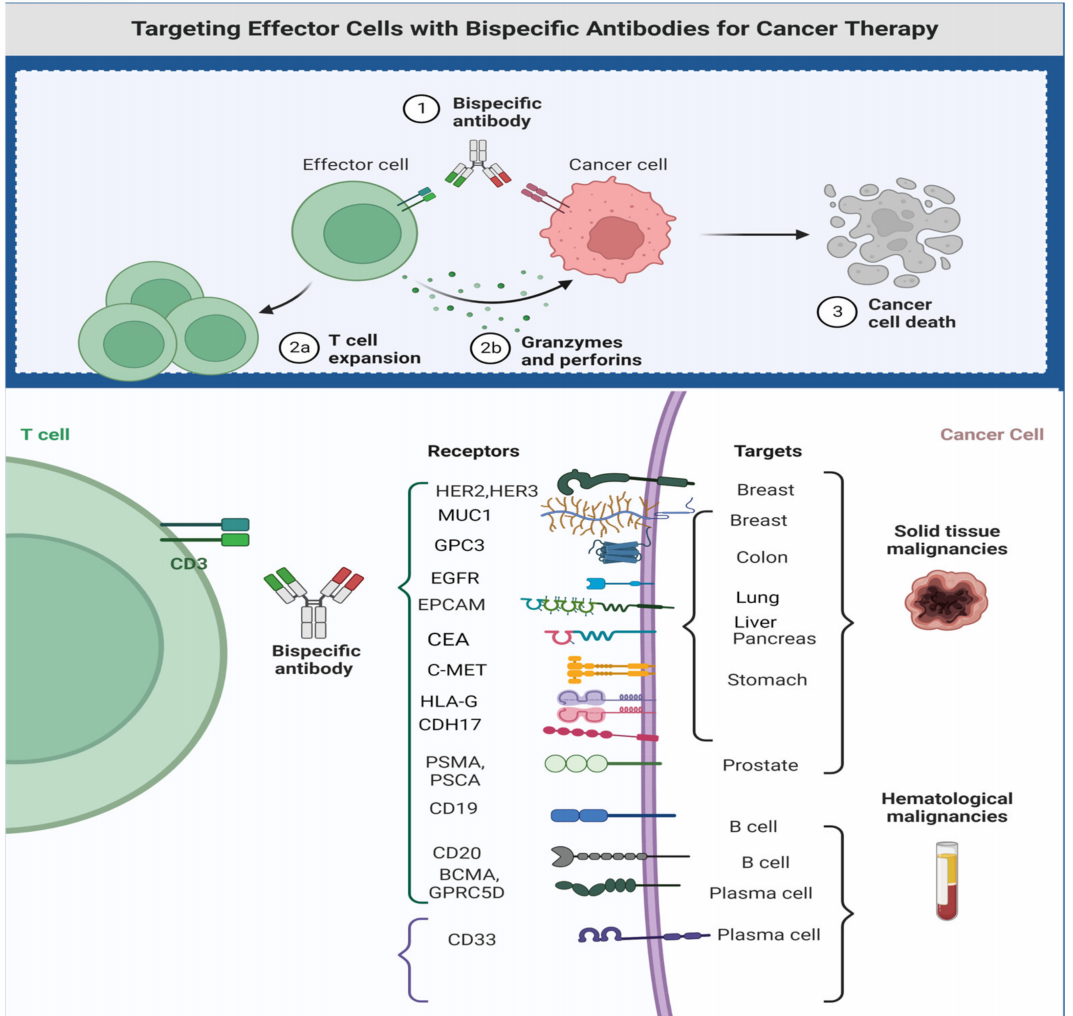
Source: Figure created by BioRender.com (accessed on 14 May 2023)
I. The Origin of Design: Underlying Logic of CD3 vs. CD8
The core concept of TCEs is straightforward—it is a "molecular bridge" that grabs a specific antigen on tumor cells with one end and T cells with the other, forcing the two into "close contact" to trigger T cell-mediated tumor killing.
Traditional TCEs almost exclusively target CD3 on the T cell side. CD3 is a core component of the T cell receptor (TCR) complex, present on the surface of all mature T cells, whether CD4+ helper T cells or CD8+ cytotoxic T cells. This means CD3-targeted TCEs activate the entire T cell repertoire upon engagement, creating a "saturation-style" immune mobilization. The logic of this design is: if the goal is to kill tumors, mobilize all available forces.
In contrast, CD8-guided TCEs take a截然不同的 path. CD8 is the "badge of identity" for cytotoxic T cells, present only on CD8+ T cells with direct killing capabilities. By switching the T cell target from the "universal protein" CD3 to the "specialized tag" CD8, this new generation of TCEs aims to achieve precise "targeted recruitment," limiting activation signals to the cytotoxic T cells真正 responsible for tumor clearance. AstraZeneca's AZD5492, currently in clinical研究, is a first-in-class CD8-guided trispecific TCE.
CD3 is a broad-spectrum T cell activation switch, while CD8 is a key that can only be inserted by specific "soldier types." One追求 "full火力," the other追求 "precision strikes"—their design起点注定走上不同的道路.
II. The Safety Debate: Balancing CRS and Off-Target Effects
In terms of safety, the shortcomings of CD3 TCEs are now widely recognized in the industry, while CD8 TCEs are厚望 with hopes of "overtaking by switching lanes."
CRS is the most dreaded adverse event associated with TCEs. When a TCE simultaneously binds T cells and tumor cells, activated T cells瞬间 release a flood of cytokines, triggering a systemic inflammatory storm.
Blinatumomab (Blincyto)'s prescribing information explicitly warns: CRS and neurological toxicity (including ICANS) can be severe, life-threatening, or even fatal. CRS is "both a marker of drug efficacy and a potential lethal risk." Real-world studies also confirm that compared to CAR-T, TCEs exhibit stronger signals for infections and tumor lysis syndrome (TLS), while CRS and ICANS signals are relatively weaker—not because TCEs have lower CRS risks, but because their blood concentrations drop rapidly after discontinuation, allowing CRS to resolve within 12-24 hours even if it occurs.
The high CRS risk of CD3-targeted TCEs归根结底 stems from their "broad-spectrum activation"特性. Any桥接 T cell will release cytokines. CD3-targeted TCEs have shown clinical activity but often伴随 high CRS and T cell exhaustion issues.
Next-generation TCEs are attempting to balance efficacy and safety by reducing CD3 affinity, adopting 2+1 valency structures, or using masking technologies, but these strategies are essentially "patching"—optimizing while acknowledging the inherent problems of the CD3 pathway.
In contrast, CD8-guided TCEs theoretically possess天然 safety advantages. By limiting activation signals to CD8+ T cells, they can avoid massive cytokine release from CD4+ T cells, potentially significantly reducing the incidence and severity of CRS. Additionally, another major safety challenge of TCEs—"on-target off-tumor toxicity"—may also be mitigated by CD8-guided designs: when TCEs precisely activate cytotoxic T cells, these cells retain some ability to distinguish between normal and tumor tissues, adding a "buffer layer" to safety.
III. The Efficacy Showdown: Hematologic Malignancies' Home Field vs. Solid Tumors'攻坚
In terms of efficacy, the performance of CD3 TCEs in hematologic malignancies is无可争议. As of July 2025, all nine globally approved hematologic malignancy TCE bispecific antibodies use CD3 designs. Blinatumomab achieves hematologic complete response rates of 30%-69% in B-ALL patients, with the Phase III TOWER trial confirming significant improvements in overall survival and event-free survival. In multiple myeloma, BCMA×CD3 bispecific antibodies作为单一疗法 achieve overall response rates exceeding 60%, with deep and durable responses. In diffuse large B-cell lymphoma, multiple CD20×CD3 bispecific antibodies still achieve 50%-80% overall response rates in refractory/relapsed patients, with持久 complete responses.
However, when CD3 TCEs shift from the "fluid battlefield" of hematologic malignancies to the "fortified stronghold" of solid tumors, the situation deteriorates rapidly. BiTEs have shown limited success in solid tumors, facing multiple barriers such as immunosuppressive tumor microenvironments, low target antigen expression, and off-target toxicity. A key mechanistic reason for CD3 TCEs' poor performance in solid tumors lies in the functional exhaustion of T cells in the tumor microenvironment, where CD3's non-selective activation模式反而加速了 T cell衰竭.
The potential of CD8-guided TCEs in solid tumors has already received strong mechanistic validation. Recent studies发现 that TCE-mediated anti-tumor responses are achieved through CD8+ T cell clonal replacement mechanisms, which can be further enhanced by combining with cytokine therapies. This finding is highly启发性的: CD8+ T cell clonal replacement suggests that CD8-targeting strategies may be more biologically aligned with TCEs' anti-tumor mechanisms.
Currently, preclinical and early clinical exploration of CD8-guided TCEs in solid tumors is accelerating. AstraZeneca's AZD5492, as a first-in-class CD8-guided trispecific TCE, has entered Phase I/II clinical studies for relapsed/refractory B-cell malignancies. Additionally, PRAME-targeted TCR-T cell therapy IMA203CD8 has shown encouraging early activity in melanoma, ovarian cancer, and synovial sarcoma, further validating the feasibility of CD8-precision导向 strategies in solid tumors.
Furthermore, another major innovation direction in TCE design—multispecific antibodies—provides even greater想象空间 for CD8-guided approaches. Trispecific TCEs simultaneously targeting CD3, co-stimulatory molecules (e.g., CD28), and tumor antigens can deliver stronger, more precise, and more持久 tumor killing by using CD3 for primary activation signals and CD28 for co-stimulation, while reducing CRS risks.
IV. The Path Forward: Collaboration or Replacement?
The comparison between CD3 and CD8 TCEs is not a simple question of "who replaces whom" but rather a strategic choice of functional complementarity. In hematologic malignancies, CD3 TCEs will likely remain the mainstream choice for some time, given their potent T cell recruitment capabilities and clinically validated efficacy. But in solid tumors, CD8-guided TCEs may carve out a superior path due to their higher precision and lower non-specific immune activation risks, especially in highly immunosuppressive tumor microenvironments.
Notably, a融合趋势 is emerging between the two approaches—trispecific TCEs using "CD3 + co-stimulatory molecule"组合 designs essentially combine CD3's potent activation with the precision control理念 of CD8-targeted designs. The "potent but粗放" approach of CD3 TCEs and the "precise but温和" approach of CD8 TCEs will likely achieve balance and fusion in more refined multispecific antibody designs. Technological evolution is never an either-or choice but rather finding the most suitable equilibrium for different scenarios.
Related Product Recommendations
| Target | Catalog No. | Product Name |
|---|---|---|
| CD3E&CD3D | UA016084 | Biotinylated CD3E&CD3D Heterodimer, His, Avi Tag&Tag Free Protein, Human |
| CD3E&CD3D | UA011360 | Biotinylated CD3E&CD3D Fc, His, Avi tag&Fc, Flag, Avi tag Heterodimer Protein, Human |
| CD3E&CD3D | UA016029 | CD3E&CD3D Fc Tag&Fc Tag Heterodimer Protein, Human |
| CD3E&CD3D | UA011373 | CD3E&CD3D Heterodimer Llama Fc&Llama Fc Tag Protein, Human |
| CD3E&CD3D | UA016006 | CD3 epsilon&CD3 delta Heterodimer Fc, His Tag&Fc, Flag Tag Protein, Human |
| CD3E&CD3D | UA016010 | CD3 epsilon&CD3 delta Heterodimer Protein, His Tag&Tag Free, Human |
| CD3E&CD3D | UA016093 | CD3E&CD3D Heterodimer, Fc, His Tag&Fc, Flag Tag Protein, Mouse |
| CD3E&CD3G | UA016046 | CD3E&CD3G Heterodimer, Fc Tag&Fc Tag Protein, Human |
| CD3E&CD3G | UA016009 | CD3E&CD3G Heterodimer, Fc, His Tag&Fc, Flag Tag Protein, Human |
| CD3E&CD3G | UA016047 | CD3E&CD3G Heterodimer, Fc, His Tag&Fc, Flag Tag Protein, Mouse |
| CD3D | UA010193 | CD3 delta His Tag Protein, Human |
| CD3D | UA010195 | CD3 delta His Tag Protein, Cynomolgus |
| CD3E | UA010199 | CD3 epsilon Fc Chimera Protein, Human |
| CD3G | UA016025 | CD3 gamma His Tag Protein, Human |
| CD3G | UA010598 | CD3 gamma Fc Chimera Protein, Human |
| CD8A&CD8B | UA016094 | Biotinylated CD8 alpha&beta (CD8A&CD8B) Heterodimer,His,Avi Tag&Tag Free Protein, Human |
| CD8A&CD8B | UA016095 | Biotinylated CD8 alpha&beta(CD8A&CD8B) Heterodimer,His,Avi Tag&Tag Free Protein, Cynomolgus |
| CD8A&CD8B | UA011214 | CD8 alpha&beta Heterodimer His Tag&Flag Tag Protein, Human |
| CD8A | UA016044 | Biotinylated CD8 alpha/CD8A His&Avi Tag Protein, Cynomolgus |
| CD8A | UA100007 | CD8 alpha hFc Tag Protein, Human |
| CD8A | UA011049 | CD8 alpha His Tag Protein, Mouse |
| Reporter Gene Assay | UA079010 | UA-Glo® One-luc Luciferase Assay System |
| Reporter Gene Assay | UA079028 | UA-Luc 4 Lucia/Gaussia Luminescence Detection Kit |
| Reporter Gene Assay | UA079029 | UA-Blue SEAP Detection Kit |
| Cell Viability & Apoptosis | UA070103 | UA-Glo® Luminescent Cell Viability Assay |
| Cell Viability & Apoptosis | UA079015 | UA-Glo® Fluorescent Cell Viability Assay |
| Cell Viability & Apoptosis | UA079012 | UA-Glo® Caspase 3/7 Assay |
This article is reviewed and published by the technical expert team of UA
Disclaimer: This article partially utilizes artificial intelligence assistance in its creation. If any content involves copyright or intellectual property issues, please let us know and we promise to verify and remove it as soon as possible.
Purchase recombinant protein, choose 
UA protein focuses on providing various protein reagents, raw materials, and services required for drug research and development, cell therapy, gene therapy, and basic scientific research, including drug target proteins, immune checkpoint proteins, cytokines, tool enzymes, customized protein expression, and full-length transmembrane protein development. Nanjing Univ is committed to providing customers with high-quality products and professional services, and building a High-tech Biological Enterprise with International Competitiveness.







 Business license (three certificates in one)