




Human Epidermal Growth Factor Receptor 3: The Cognitive Evolution from "Auxiliary Subunit" to "Signaling Hub" and Its Targeting Strategies
Author: Senior Product Manager of UA Views:125 


ERBB Receptor Family: A Landscape of Homologous but Divergent Targets in Drug Development
- Recent Advances
- Product Information
Recent Advances
Human Epidermal Growth Factor Receptor 3: The Evolution from "Auxiliary Subunit" to "Signaling Hub" and Its Targeting Strategies
1. The ERBB Receptor Family: Divergent Fates in Target Development
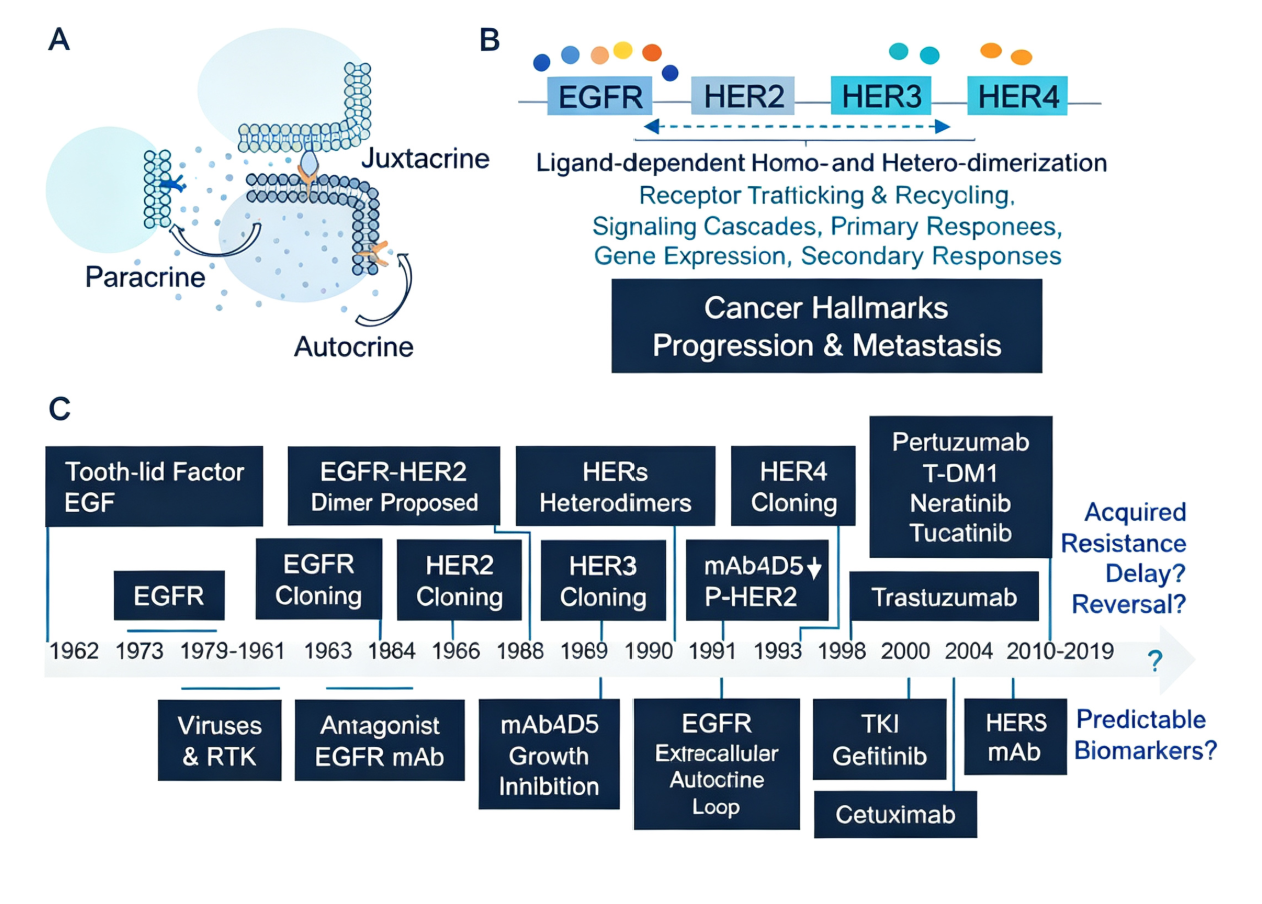
Since the advent of targeted therapies, the human epidermal growth factor receptor (HER/ERBB) family has remained one of the most scrutinized protein target families in the field of precision oncology. This family belongs to the receptor tyrosine kinase (RTK) superfamily and comprises four members: EGFR (HER1/ErbB1), HER2 (ErbB2), HER3 (ErbB3), and HER4 (ErbB4). Despite sharing highly homologous extracellular ligand-binding domains and intracellular tyrosine kinase domains, the developmental trajectories of drugs targeting these members have followed strikingly divergent paths.
Among them, EGFR and HER2 represent the most successful examples in the history of targeted cancer therapy. Since the approval of the first targeted drug, related therapies for these two targets have generated over a hundred billion dollars in global sales, profoundly transforming treatment paradigms for multiple solid tumors. Notably, HER2, identified as an oncogene with transformative activity in 1985, saw its first humanized monoclonal antibody—trastuzumab—approved in 1998, ushering in the era of precision treatment for HER2-positive breast cancer. Subsequently, antibody-drug conjugates (ADCs) like DS-8201 (trastuzumab deruxtecan) expanded HER2-targeted therapy from breast cancer to gastric, non-small cell lung, bladder, and colorectal cancers, showcasing the target's clinical accessibility and commercial value.
2. HER3: The Kinase-Deficient "Heterodimerization Partner"
Compared to its family members, HER3 exhibits unique biological characteristics in both physiological and pathological contexts. Unlike other ERBB members, HER3's intracellular tyrosine kinase domain contains critical amino acid substitutions, rendering its intrinsic kinase activity extremely weak—only one-thousandth of EGFR's—with minimal capacity for autophosphorylation or substrate phosphorylation. This structural basis dictates that HER3 cannot function as an independent signaling unit but must form heterodimers with other RTK members, relying on their kinase activity to achieve trans-phosphorylation of its C-terminal tyrosine residues and subsequent downstream signaling cascades.
In terms of ligands, HER3 is primarily activated by neuregulin (NRG) family members, particularly NRG1 and NRG2. Upon NRG binding to HER3's extracellular domain, conformational rearrangements expose the juxtamembrane dimerization arm, enabling HER3 to preferentially form stable heterodimeric complexes with EGFR or HER2. This ligand-induced dimerization not only activates classical pro-survival pathways like MAPK and PI3K/AKT but, crucially, HER3's intracellular tail contains up to six direct binding sites for the PI3K p85 subunit, granting it unparalleled efficiency in driving PI3K/AKT signaling—a feature unmatched by other family members.
3. Resistance Mechanisms and Paradigm Shifts in Targeting Strategies
HER3's unique "kinase-deficient yet adaptor-competent" mechanism positions it as a key player in therapeutic resistance. Extensive research shows that prolonged exposure to EGFR or HER2 inhibitors can induce tumors to upregulate HER3 expression or enhance its phosphorylation, creating alternative signaling bypasses to evade growth inhibition. This resistance mechanism has been well-documented in EGFR-mutant non-small cell lung cancer (post-EGFR-TKI treatment) and HER2-positive breast cancer (post-trastuzumab treatment), establishing HER3 as a critical node for overcoming targeted therapy resistance.
Early HER3 drug development followed the logic of "blocking ligand binding → inhibiting dimerization → silencing downstream signals," yielding several HER3 monoclonal antibodies. However, between 2014 and 2018, multiple HER3 antibody projects failed in mid- to late-stage clinical trials, revealing the inadequacy of单纯 antibody blockade for sustained antitumor activity. These setbacks prompted a reevaluation of HER3's本质属性—rather than treating it as a kinase to be "inhibited," it could be repurposed as an "endocytic portal" for drug delivery.
Recently, novel drug formats like ADCs have brought breakthroughs. Studies show that while HER3's signaling capacity is limited, its ligand-induced endocytic efficiency is relatively high, making it an ideal ADC target. Daiichi Sankyo's patritumab deruxtecan (HER3-DXd) met its primary endpoint of progression-free survival in a Phase III trial for EGFR-mutant NSCLC, validating HER3's clinical feasibility as an ADC target. Additionally, Bio-Thera's EGFR×HER3 bispecific ADC (BL-B01D1) has initiated multiple Phase III studies, further expanding HER3-ADC applications.
4. HER3-Fc Fusion Protein: Tool Utility and Prospects
In HER3-targeted drug development, high-quality recombinant protein tools are indispensable for mechanistic studies and drug screening. The HER3-Fc fusion protein—a chimera of HER3's extracellular domain and human IgG1 Fc—epitomizes such tools. This design leverages Fc's favorable biochemical properties: extended in vivo half-life, efficient Protein A/G affinity purification, and retained Fc-mediated effector functions (e.g., ADCC). In drug discovery, HER3-Fc serves in: anti-HER3 antibody screening/affinity maturation, NRG-HER3 interaction competition assays, and bispecific antibody validation.
U爱's mammalian cell expression platform offers ErbB3/HER3 Fc Chimera Protein, Human, featuring native glycosylation and rigorous functional validation. This product supports critical experiments like antibody screening, affinity measurement, and mechanistic studies, providing reliable tools for early-stage HER3 drug discovery.
In summary, HER3's evolution from HER2's "auxiliary subunit" to a "signaling hub" with integrative and resistance-driving functions reflects oncology's shift from "single-gene dependency" to "network regulation." High-quality tools like Fc fusion proteins underpin this transition, propelling next-generation strategies for this unique target toward clinical realization.
This article is reviewed and published by the technical expert team of UA
Disclaimer: This article partially utilizes artificial intelligence assistance in its creation. If any content involves copyright or intellectual property issues, please let us know and we promise to verify and remove it as soon as possible.
Purchase recombinant protein, choose Nanjing UA-Bio
UA protein focuses on providing various protein reagents, raw materials, and services required for drug research and development, cell therapy, gene therapy, and basic scientific research, including drug target proteins, immune checkpoint proteins, cytokines, tool enzymes, customized protein expression, and full-length transmembrane protein development. Youai is committed to providing customers with high-quality products and professional services, and building a High-tech Biological Enterprise with International Competitiveness.
Target proteins | membrane proteins | cytokines | enzymes | viral antigens | protein customization
Nanjing UA Biotechnology Co., Ltd. Email:order@ua-bio.com Phone:+86-25-56221161

Product Information

Link:





©2021-2026 all rights reserved UA Biotechnology Co.,Ltd.
Privacy Policy 
网站备案号 浙ICP备2022019033号-2 浙公网安备33010202004867号
 Business license (three certificates in one)
 Tel:+86-25-56221161
E-mail:order@ua-bio.com
All products sold on this website shall not be used for clinical diagnosis or treatment of humans or animals, and shall only be used for non-medical purposes such as industrial or scientific research.
