




Determinants of CD7 receptor targeting efficiency: Internalization kinetics surpass receptor abundance
Author: Senior Product Manager of UA Views:109 


Based on the findings of a systematic comparative study, this article elucidates the experimental evidence demonstrating the superiority of CD7 over other receptors in T cell-targeted lipid nanoparticle (tLNP)-mRNA delivery. It analyzes the differential impact of receptor abundance and internalization kinetics on delivery efficiency, reveals the mechanistic basis underlying CD7's high efficiency in mediating mRNA delivery, and highlights its application value in the in vivo engineering of CAR-T cells. Additionally, it introduces the detection applications of fluorescently labeled recombinant proteins in related research.
- Recent Advances
- Product Information
Recent Advances
Determinants of CD7 Receptor Targeting Efficiency: Internalization Kinetics Outweigh Receptor Abundance
Summary: Based on the results of a systematic comparative study, this article presents experimental evidence demonstrating the superiority of CD7 over other receptors in targeted lipid nanoparticle (tLNP)-mRNA delivery to T cells. It analyzes the differential effects of receptor abundance and internalization kinetics on delivery efficiency, reveals the mechanistic basis for CD7's high-efficiency mRNA delivery, and discusses its application value in in vivo CAR-T cell engineering. Additionally, it introduces the use of fluorescently labeled recombinant proteins in related research.
1. Experimental Design and Key Findings of the Systematic Comparative Study
Targeted lipid nanoparticles (tLNPs) can efficiently deliver mRNA to T cells without ex vivo manipulation, enabling the in situ generation of chimeric antigen receptor (CAR) T cells in vivo. This strategy has demonstrated therapeutic potential in preclinical studies of cardiac fibrosis, tumors, and autoimmune diseases. Although multiple T cell surface receptors have been used for tLNP-mediated in vivo CAR-T generation, and variations in delivery efficiency have been observed across studies, there has been a lack of direct comparisons of these target receptors under uniform experimental conditions, leaving the mechanisms underlying their performance differences unclear.
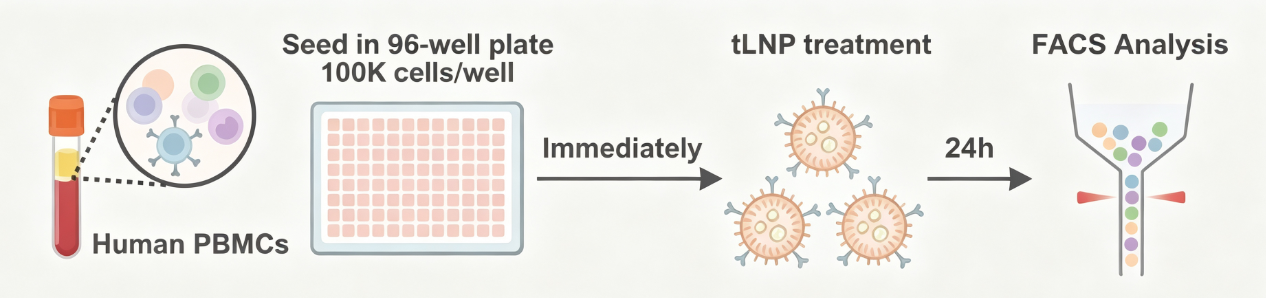
To systematically address this question, Zeng et al. constructed tLNPs targeting CD2, CD4, CD5, CD7, CD8, and a dual-targeting combination of CD4+8 in a study published in the Journal of Controlled Release. They compared the mRNA delivery efficiency of these tLNPs to human T cells and peripheral blood mononuclear cells (PBMCs) under identical conditions and validated the performance of the optimal candidate in humanized mice. The results showed that among all tested targeting molecules, CD7-targeted tLNPs achieved the highest mRNA delivery efficiency to T cells and could efficiently generate functional anti-CD20 CAR-T cells in vivo.
2. Key Determinants of Delivery Efficiency: Receptor Abundance Is Not the Primary Factor
The mechanistic analysis of this study revealed a critical finding: receptor surface abundance does not predict tLNP-mRNA delivery efficiency. This conclusion challenges the common assumption that "higher target expression leads to better delivery." Through quantitative analysis of receptor surface density and tLNP uptake efficiency, the researchers found no correlation between the two—some receptors with higher expression levels did not confer corresponding delivery advantages, while CD7 achieved optimal mRNA delivery performance at moderate expression levels.
3. Internalization Kinetics: The Core Mechanism Determining Delivery Efficiency
Further mechanistic studies demonstrated that the internalization capacity of the receptor-antibody complex, rather than receptor abundance, is the primary factor determining tLNP-mRNA delivery efficiency. Through multidimensional experiments, the research team confirmed that differences in internalization rates among receptors are the root cause of variations in tLNP delivery efficiency. The rapid internalization kinetics of the CD7 receptor enable it to efficiently mediate particle uptake after binding to antibody-modified LNPs, thereby achieving high intracellular release and protein expression of mRNA. Importantly, the researchers found that internalization capacity appears to be an intrinsic property of each receptor and is largely independent of the antibody clone used, providing critical guidance for antibody selection in targeting strategies.
This finding aligns with the results of an independent study published in Nature Communications, which similarly showed that targeting CD2 and CD7 (both fast-cycling receptors) significantly enhances nanoparticle endocytosis in resting primary CD4+ T cells and improves mRNA delivery efficiency. From the perspective of the Nature Communications study, CD7's superiority as a target stems from its classification as a "fast-internalizing receptor," while slower-internalizing receptors like CD3 and CD4 are less efficient for delivery. Therefore, the endocytic kinetics of targeting receptors, rather than their expression levels, should be prioritized in the design of tLNP targeting strategies.
4. In Vivo Application Prospects of CD7-Targeted LNP-mRNA
Based on the above mechanistic validation, CD7-targeted LNP-mRNA has been proven to enable efficient in vivo CAR-T cell engineering. This discovery provides a rational theoretical basis for the design of tLNP-mRNA platforms, suggesting that prioritizing fast-internalizing receptors (e.g., CD7) can maximize mRNA delivery efficiency to T cells after systemic administration, thereby generating sufficient therapeutic CAR-T cells in vivo. Meanwhile, another study published in the Journal for Immunotherapy of Cancer demonstrated that the CD7-targeted (combined with CD3) LNP system NCtx can efficiently co-deliver circular DNA and transposase mRNA, enabling stable genomic integration for in vivo CAR-T generation. These studies collectively indicate that CD7 is not only a marker for ex vivo CAR-T detection but also a critical functional target for in vivo gene delivery and cell engineering.
5. Conclusion
The development of targeted lipid nanoparticles has opened new avenues for in vivo CAR-T cell engineering, with the selection of optimal targeting molecules from numerous T cell surface receptors being a core challenge. Systematic comparative studies have shown that CD7-targeted strategies outperform other receptors, with the key mechanism lying in the rapid internalization kinetics of the CD7 receptor rather than its surface abundance. This finding provides a rational theoretical foundation for target selection in tLNP platforms, emphasizing the prioritization of fast-internalizing receptors to maximize mRNA delivery efficiency. U-True offers FITC-Labeled CD7 His Tag Protein, Human, which, with its precise molecular design, native conformation ensured by human expression systems, and the high brightness and stability of FITC dyes, provides a reliable detection tool for CD7-related CAR-T cell screening, targeted drug binding activity analysis, and flow cytometry.
This article is reviewed and published by the technical expert team of UA
Disclaimer: This article partially utilizes artificial intelligence assistance in its creation. If any content involves copyright or intellectual property issues, please let us know and we promise to verify and remove it as soon as possible.
Purchase recombinant protein, choose Nanjing UA-Bio
UA protein focuses on providing various protein reagents, raw materials, and services required for drug research and development, cell therapy, gene therapy, and basic scientific research, including drug target proteins, immune checkpoint proteins, cytokines, tool enzymes, customized protein expression, and full-length transmembrane protein development. Youai is committed to providing customers with high-quality products and professional services, and building a High-tech Biological Enterprise with International Competitiveness.
Target proteins | membrane proteins | cytokines | enzymes | viral antigens | protein customization
Nanjing UA Biotechnology Co., Ltd. Email:order@ua-bio.com Phone:+86-25-56221161

Product Information

Link:





©2021-2026 all rights reserved UA Biotechnology Co.,Ltd.
Privacy Policy 
网站备案号 浙ICP备2022019033号-2 浙公网安备33010202004867号
 Business license (three certificates in one)
 Tel:+86-25-56221161
E-mail:order@ua-bio.com
All products sold on this website shall not be used for clinical diagnosis or treatment of humans or animals, and shall only be used for non-medical purposes such as industrial or scientific research.
