GM-CSF: A Multifunctional Cytokine from Hematopoietic Regulation to Immune Adjuvant
Author: Senior Product Manager of UA Views:135 


This article systematically elaborates on the molecular characteristics of granulocyte-macrophage colony-stimulating factor (GM-CSF), its cellular sources, and the receptor-mediated signal transduction mechanisms. It analyzes its multifaceted roles in the proliferation and differentiation of hematopoietic progenitor cells, the regulation of myeloid cell functions, and anti-tumor immune responses.
- Recent Advances
- Product Information
Recent Advances
GM-CSF: A Multifunctional Cytokine from Hematopoietic Regulation to Immune Adjuvant
Summary
This article systematically elaborates on the molecular characteristics, cellular sources, and receptor-mediated signaling mechanisms of Granulocyte-Macrophage Colony-Stimulating Factor (GM-CSF), analyzing its multiple roles in hematopoietic progenitor cell proliferation and differentiation, myeloid cell function regulation, and anti-tumor immune responses.
This article systematically elaborates on the molecular characteristics, cellular sources, and receptor-mediated signaling mechanisms of Granulocyte-Macrophage Colony-Stimulating Factor (GM-CSF), analyzing its multiple roles in hematopoietic progenitor cell proliferation and differentiation, myeloid cell function regulation, and anti-tumor immune responses.
I. Molecular Characteristics and Cellular Sources of GM-CSF
Granulocyte-Macrophage Colony-Stimulating Factor (GM-CSF), also known as Colony Stimulating Factor 2 (CSF2), is a single-chain glycoprotein composed of 127 amino acids and an important member of the hematopoietic growth factor family. The human GM-CSF gene is located on chromosome 5q31.1, and its encoded protein exists primarily as a monomer under physiological conditions, with a molecular weight ranging from approximately 14 to 35 kDa (depending on the degree of glycosylation). Under normal physiological conditions, GM-CSF is produced by various cells, including activated T cells, macrophages, endothelial cells, fibroblasts, and mast cells, with T cells and macrophages being its primary sources under inflammatory stimulation.
GM-CSF initiates signal transduction by binding to specific receptors on the surface of target cells. The receptor is a heterodimeric complex composed of an α subunit (GM-CSFRα, CD116) and a β subunit (CSF2Rβ, CD131). After GM-CSF binds to the α subunit, the β subunit is recruited and activates downstream signaling pathways such as JAK2/STAT5, PI3K/AKT, and RAS/MAPK, ultimately regulating the proliferation, differentiation, and functional activation of target cells.
II. Regulatory Effects of GM-CSF on the Hematopoietic System
GM-CSF stimulates hematopoiesis starting from the level of myeloid stem cells, exerting multi-level and broad-spectrum regulatory effects on the hematopoietic system. In the bone marrow, GM-CSF promotes the proliferation and differentiation of hematopoietic progenitor cells, induces the directional differentiation and maturation of granulocyte and monocyte/macrophage lineages, and releases mature cells into the peripheral blood. Compared to Granulocyte Colony-Stimulating Factor (G-CSF), which acts only on late-stage progenitor cells, GM-CSF acts at an earlier stage of hematopoietic stem/progenitor cells, resulting in a more sustained and stable "white blood cell-boosting" effect. GM-CSF not only promotes the production of neutrophils but also simultaneously enhances the generation of platelets and monocytes/macrophages, playing a crucial role in the recovery of blood cells after chemotherapy, radiotherapy, or hematopoietic stem cell transplantation.
III. Enhancing Effects of GM-CSF on Myeloid Cell Functions
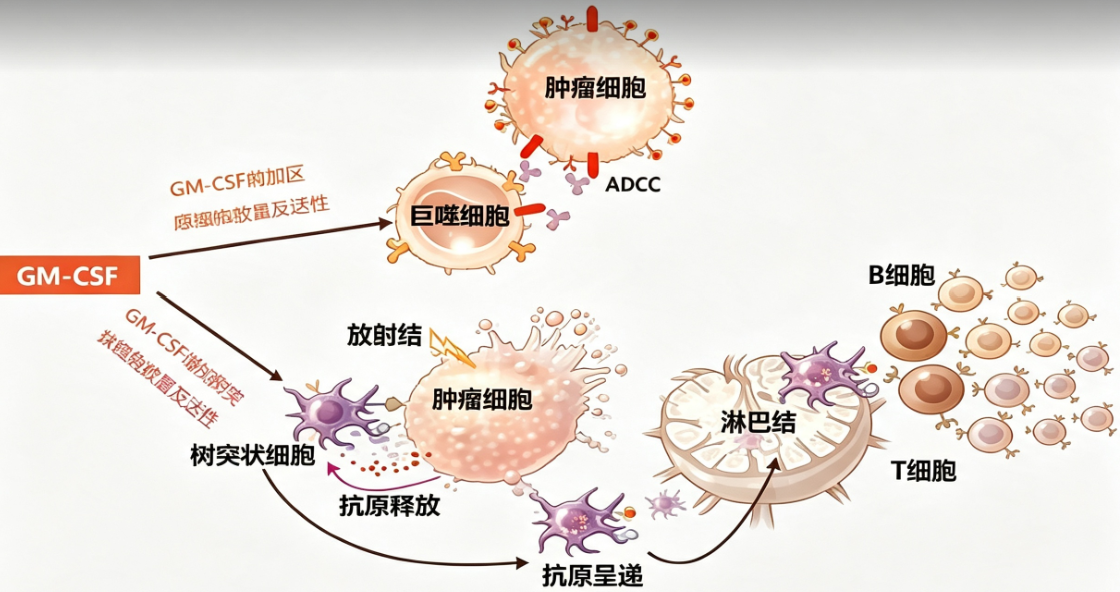
GM-CSF also plays a key role in enhancing the functions of myeloid cells. It significantly increases the phagocytic capacity, reactive oxygen species production, and extracellular trap formation of neutrophils. In monocytes/macrophages, GM-CSF promotes their polarization toward the M1-type anti-tumor phenotype, enhancing antigen-presenting capacity and pro-inflammatory cytokine secretion. In dendritic cells, GM-CSF is a core factor driving the differentiation of monocytes into DCs, promoting DC maturation, the expression of co-stimulatory molecules such as CD80/CD86, and the secretion of IL-12, thereby enhancing their ability to activate naïve T cells. In vitro experiments show that treating human monocyte-derived dendritic cells with GM-CSF (10-100 ng/mL) can upregulate MHC class II molecule expression by 1.5-2 times and CD80 expression by 3-4 times.
IV. Non-Hematopoietic Effects of GM-CSF
GM-CSF also promotes various non-hematopoietic cells. In endothelial cells, GM-CSF induces their proliferation and migration, promoting angiogenesis. In keratinocytes, GM-CSF accelerates their proliferation and migration, facilitating epidermal wound re-epithelialization. In fibroblasts, GM-CSF stimulates their proliferation and collagen synthesis, participating in tissue repair and fibrosis regulation. Additionally, GM-CSF plays a critical role in maintaining the homeostasis and function of alveolar macrophages, and its deficiency can lead to pulmonary alveolar proteinosis.
V. GM-CSF as an Immune Adjuvant in Immunotherapy
Based on its multifaceted immunomodulatory functions, GM-CSF has been widely used as an "immune adjuvant." In tumor immunotherapy, GM-CSF enhances anti-tumor immune responses by promoting DC activation and migration, improving cross-presentation of tumor antigens, and activating effector T cells. In infectious diseases, GM-CSF exerts anti-infection effects by enhancing the bactericidal functions of neutrophils and macrophages and promoting phagocytosis by monocytes/macrophages. GM-CSF has been approved for clinical indications such as neutropenia. Meanwhile, in vaccine adjuvant development, GM-CSF serves as an auxiliary component of protein or cellular vaccines, enhancing the strength and durability of specific immune responses.
VI. Conclusion
As a multifunctional cytokine bridging hematopoietic regulation and immune responses, GM-CSF plays an irreplaceable role in both normal physiology and disease intervention, owing to its broad-spectrum hematopoietic stimulation starting from myeloid stem cells, its enhancement of myeloid cell functions, and its regulatory effects on non-hematopoietic tissues. Its extensive research and application as an immune adjuvant provide critical support for the development of anti-tumor and anti-infection strategies. Recombinant human GM-CSF protein, as a key tool in basic research and drug development, will continue to drive in-depth exploration and clinical translation in related fields.
In GM-CSF-related basic research and drug screening, high-quality recombinant human GM-CSF protein is a core tool for cell proliferation experiments, immune cell function studies, and signaling pathway analysis. To meet this research demand, U-Impact offers GM-CSF Protein, Human, suitable for proliferation and differentiation studies of human hematopoietic stem/progenitor cells, in vitro induction and maturation of human dendritic cells, and mechanistic exploration of the GM-CSF/JAK2/STAT5 signaling pathway.
This article is reviewed and published by the technical expert team of UA
Disclaimer: This article partially utilizes artificial intelligence assistance in its creation. If any content involves copyright or intellectual property issues, please let us know and we promise to verify and remove it as soon as possible.
Purchase recombinant protein, choose 
UA protein focuses on providing various protein reagents, raw materials, and services required for drug research and development, cell therapy, gene therapy, and basic scientific research, including drug target proteins, immune checkpoint proteins, cytokines, tool enzymes, customized protein expression, and full-length transmembrane protein development. Nanjing Univ is committed to providing customers with high-quality products and professional services, and building a High-tech Biological Enterprise with International Competitiveness.
Target proteins | membrane proteins | cytokines | enzymes | viral antigens | protein customization
Nanjing UNIV Biotechnology Co., Ltd. Email:order@ua-bio.com Phone:+86-25-56221161

Product Information

Link:





©2021-2026 all rights reserved UNIV Biotechnology Co.,Ltd.
Privacy Policy
网站备案号 苏ICP备2025207586号-2 浙公网安备33010202004867号
 Business license (three certificates in one)
 Tel:+86-25-56221161
E-mail:order@ua-bio.com
All products sold on this website shall not be used for clinical diagnosis or treatment of humans or animals, and shall only be used for non-medical purposes such as industrial or scientific research.