The Core Driving Role of GM-CSF in CAR-T Cell Therapy Toxicity and Its Regulatory Strategies
Author: Senior Product Manager of UA Views:195 


This article focuses on the pivotal role of granulocyte-macrophage colony-stimulating factor (GM-CSF) in the toxicity associated with chimeric antigen receptor T-cell (CAR-T) therapy. It systematically elucidates the molecular mechanisms by which GM-CSF acts as a "communication conduit" between CAR-T cells and myeloid cells, analyzes its dual pathways of exacerbating cytokine release syndrome (CRS) and neurotoxicity (NT) by triggering inflammatory cytokine cascades and recruiting immunosuppressive cells, and explores the potential of targeting the GM-CSF signaling pathway as a mitigation strategy.
- Recent Advances
- Product Information
Recent Advances
The Central Role of GM-CSF in CAR-T Cell Therapy Toxicity and Its Regulatory Strategies
Overview
This article focuses on the pivotal role of granulocyte-macrophage colony-stimulating factor (GM-CSF) in the toxicity associated with chimeric antigen receptor T-cell (CAR-T) therapy. It systematically elucidates the molecular mechanisms by which GM-CSF acts as a "communication pipeline" between CAR-T cells and myeloid cells, analyzing its dual pathways of triggering inflammatory cytokine cascades and recruiting immunosuppressive cells to exacerbate cytokine release syndrome (CRS) and neurotoxicity (NT). Based on this, it explores the potential of targeting the GM-CSF signaling pathway as a mitigation strategy.
This article focuses on the pivotal role of granulocyte-macrophage colony-stimulating factor (GM-CSF) in the toxicity associated with chimeric antigen receptor T-cell (CAR-T) therapy. It systematically elucidates the molecular mechanisms by which GM-CSF acts as a "communication pipeline" between CAR-T cells and myeloid cells, analyzing its dual pathways of triggering inflammatory cytokine cascades and recruiting immunosuppressive cells to exacerbate cytokine release syndrome (CRS) and neurotoxicity (NT). Based on this, it explores the potential of targeting the GM-CSF signaling pathway as a mitigation strategy.
I. Clinical Breakthroughs and Toxicity Challenges of CAR-T Therapy.
Chimeric antigen receptor T-cell therapy involves genetically engineering a patient's autologous T cells to express chimeric receptors that specifically recognize tumor surface antigens. It has achieved unprecedented clinical efficacy in hematologic malignancies such as B-cell acute lymphoblastic leukemia, non-Hodgkin lymphoma, and multiple myeloma. However, this therapy is accompanied by significant, sometimes life-threatening, treatment-related toxicities. Among these, cytokine release syndrome and immune effector cell-associated neurotoxicity syndrome are the most common and severe adverse reactions, with incidence rates as high as 70%-90% (CRS) and 30%-60% (any grade neurotoxicity) in CD19 CAR-T therapy, including approximately 7% and 12% for grade ≥3 severe cases, respectively.
These toxic reactions not only severely impact patients' quality of life but also often lead to prolonged hospital stays, increased intensive care unit admissions, and significant rises in healthcare resource consumption. Therefore, a deep understanding of their molecular mechanisms and the development of effective intervention strategies are critical prerequisites for further expanding the clinical application of CAR-T therapy.
II. Molecular Mechanisms of GM-CSF as an Upstream Trigger of Toxicity Cascades.
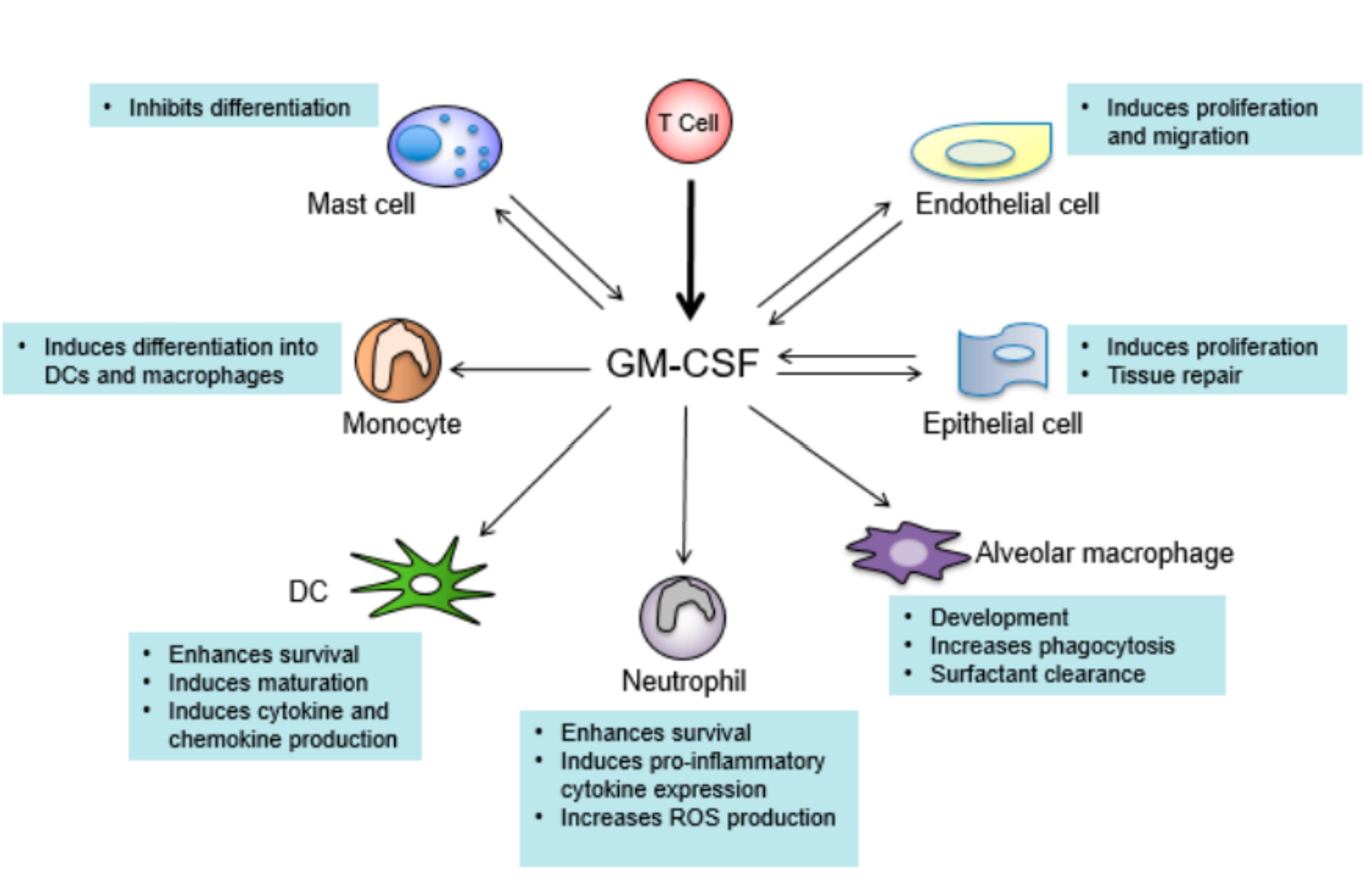
During CAR-T therapy, GM-CSF is a key cytokine rapidly produced and released by activated CAR-T cells upon contact with tumor antigens. It serves as a "communication pipeline" between CAR-T cell-specific immune responses and myeloid cell-driven off-target inflammatory cascades. GM-CSF occupies an upstream position in the inflammatory cascade network. Upon release, it activates various immune cells, particularly monocytes and macrophages, thereby inducing the cascade release of downstream inflammatory cytokines such as IL-1, IL-6, IL-8, and TNF-α. This inflammatory cytokine storm is the core pathological basis of CRS and a key initiating event in blood-brain barrier dysfunction and neurotoxicity. Studies have shown that blocking GM-CSF signaling significantly suppresses the production of downstream inflammatory factors, indicating its role as a critical node in regulating the entire inflammatory cascade.
III. The Dual Pro-Tumor and Pro-Inflammatory Roles of GM-CSF-Mediated Myeloid Immunosuppression.
Beyond directly promoting inflammatory responses, GM-CSF exerts more complex effects on tumor microenvironments and inflammatory regulation by influencing the differentiation and function of myeloid cells. GM-CSF directly acts on myeloid precursor cells and mature myeloid cells, promoting the proliferation, differentiation, and chemotactic migration of myeloid-derived suppressor cells and tumor-associated macrophages to tumor sites. These MDSCs and TAMs have been widely demonstrated to suppress T-cell proliferation and effector functions through various mechanisms, including L-arginine depletion, production of reactive oxygen and nitrogen species, and secretion of inhibitory cytokines such as TGF-β and IL-10. In the context of CAR-T therapy, this effect may create a vicious cycle—GM-CSF-driven myeloid immunosuppressive microenvironments not only weaken CAR-T cell antitumor activity but also serve as significant sources of pro-inflammatory cytokines, further exacerbating systemic inflammatory responses.
IV. Potential and Challenges of Targeting GM-CSF as a Toxicity Management Strategy.
Given the central role of GM-CSF in CAR-T-related toxicity, targeting GM-CSF or its receptor has emerged as a highly promising toxicity management strategy. Preclinical studies have shown that knocking out the GM-CSF gene using CRISPR/Cas9 technology during CAR-T cell preparation or using anti-GM-CSF monoclonal antibodies for in vivo neutralization can significantly reduce CRS-related inflammatory cytokine levels and mitigate neurotoxicity without compromising CAR-T cell antitumor activity. However, clinical translation requires careful evaluation of the safety risks associated with targeting GM-CSF, including potential increases in infection susceptibility and effects on alveolar macrophage homeostasis. The clinical benefits must be validated in subsequent large-scale randomized controlled trials.
V. Conclusion.
As a key molecular bridge between CAR-T cells and myeloid inflammatory responses, GM-CSF plays a central role as an upstream trigger in the development of CRS and neurotoxicity. It both directly drives systemic inflammation by initiating inflammatory cytokine cascades and reshapes myeloid cell composition to create immunosuppressive microenvironments, doubly exacerbating the toxicity burden of therapy. Targeting GM-CSF offers a promising solution to mitigate treatment-related toxicity while preserving CAR-T cell antitumor efficacy. Recombinant human GM-CSF protein provides a critical material foundation for in-depth analysis of the precise mechanisms of GM-CSF in CAR-T toxicity and the development of related intervention strategies.
In GM-CSF-related mechanism research and drug screening, high-quality recombinant human GM-CSF protein is an essential experimental tool. To meet this research demand, Uni offers GM-CSF Protein, Human, suitable for studies on GM-CSF mechanisms in myeloid cell activation and pro-inflammatory cytokine release, in vitro evaluation of anti-GM-CSF antibody activity, and functional studies of the GM-CSF signaling axis in co-culture systems of CAR-T cells and myeloid cells.
This article is reviewed and published by the technical expert team of UA
Disclaimer: This article partially utilizes artificial intelligence assistance in its creation. If any content involves copyright or intellectual property issues, please let us know and we promise to verify and remove it as soon as possible.
Purchase recombinant protein, choose 
UA protein focuses on providing various protein reagents, raw materials, and services required for drug research and development, cell therapy, gene therapy, and basic scientific research, including drug target proteins, immune checkpoint proteins, cytokines, tool enzymes, customized protein expression, and full-length transmembrane protein development. Nanjing Univ is committed to providing customers with high-quality products and professional services, and building a High-tech Biological Enterprise with International Competitiveness.
Target proteins | membrane proteins | cytokines | enzymes | viral antigens | protein customization
Nanjing UNIV Biotechnology Co., Ltd. Email:order@ua-bio.com Phone:+86-25-56221161

Product Information

Link:





©2021-2026 all rights reserved UNIV Biotechnology Co.,Ltd.
Privacy Policy
网站备案号 苏ICP备2025207586号-2 浙公网安备33010202004867号
 Business license (three certificates in one)
 Tel:+86-25-56221161
E-mail:order@ua-bio.com
All products sold on this website shall not be used for clinical diagnosis or treatment of humans or animals, and shall only be used for non-medical purposes such as industrial or scientific research.