

IFN-α4: A Key Subtype with Both Potent Antiviral and Immunomodulatory Effects in Anti-HBV Infection
Author: Senior Product Manager of UA Views:228 


This article systematically elucidates the molecular characteristics and biological functions of IFN-α4 (IFNA4), focusing on its mechanism of inducing antiviral protein expression and activating innate and adaptive immune responses through the JAK-STAT signaling pathway. It further analyzes its unique antiviral advantages compared to other subtypes in the treatment of chronic hepatitis B.
- Recent Advances
- Product Information
Recent Advances
IFN-α4: A Key Subtype with Dual Potent Antiviral and Immunomodulatory Effects Against HBV Infection
Overview
This article systematically elucidates the molecular characteristics and biological functions of IFN-α4 (IFNA4), detailing its mechanisms of inducing antiviral protein expression and activating innate and adaptive immune responses via the JAK-STAT signaling pathway, while analyzing its unique antiviral advantages in chronic hepatitis B treatment compared to other subtypes.
This article systematically elucidates the molecular characteristics and biological functions of IFN-α4 (IFNA4), detailing its mechanisms of inducing antiviral protein expression and activating innate and adaptive immune responses via the JAK-STAT signaling pathway, while analyzing its unique antiviral advantages in chronic hepatitis B treatment compared to other subtypes.
I. Molecular Characteristics and Genetic Localization of IFN-α4
IFN-α4 (also known as IFN-alpha-4, IFN-alpha-4B, IFN-alpha-76, or IFN-alpha-M1) is a type I interferon cytokine encoded by the IFNA4 gene, belonging to the interferon α/β/δ structural domain family. The human IFNA4 gene is located on chromosome 9p21.3, encoding a mature protein composed of 189 amino acid residues with a molecular weight of approximately 21.8 kDa and a theoretical isoelectric point ranging from 5.76 to 6.10. This protein exists as a secretory cytokine in the extracellular space, exerting its biological functions through autocrine and paracrine mechanisms.
The IFNA4 gene exhibits two variants (IFNA4a and IFNA4b) in the human population, both of which can be detected, though their functional differences remain incompletely understood. IFNA4 expression is regulated by multiple transcription factors, with studies confirming that Spi-B participates in the transcriptional activation of the IFNA4 gene.
II. Antiviral and Immunomodulatory Functions of IFN-α4
IFN-α4 primarily exerts its antiviral and immunomodulatory functions through the JAK-STAT signaling pathway. Upon binding to the type I interferon receptor (a heterodimer composed of IFNAR1 and IFNAR2) on the cell surface, IFN-α4 activates JAK1 and TYK2, leading to the phosphorylation of STAT1 and STAT2. This forms the STAT1/STAT2/IRF9 complex (ISGF3), which translocates to the nucleus and binds to interferon-stimulated response elements, initiating the transcription of hundreds of interferon-stimulated genes. These ISGs encode proteins such as protein kinase R, the 2'-5' oligoadenylate synthetase/RNase L system, Mx proteins, and various immunomodulatory molecules, collectively establishing an antiviral state.
In addition to its direct antiviral effects, IFN-α4 modulates host immune responses by enhancing the effector functions of natural killer cells and T cells, thereby promoting viral clearance. Functional studies have shown that IFN-α4 strongly induces the expression of effector molecules such as IL-2, TNF-α, IFN-γ, and granzyme B in T cells, highlighting its critical role in activating cellular immune responses.
III. Potential Value of IFN-α4 in Chronic Hepatitis B Treatment
Chronic hepatitis B virus infection is a major cause of liver cirrhosis and hepatocellular carcinoma. The persistence of covalently closed circular DNA (cccDNA) in hepatocyte nuclei is the fundamental reason for the difficulty in eradicating HBV. Interferon therapy is currently the only clinical approach that may target cccDNA, but the clinically used IFN-α2 achieves sustained responses in only about 30% of CHB patients.
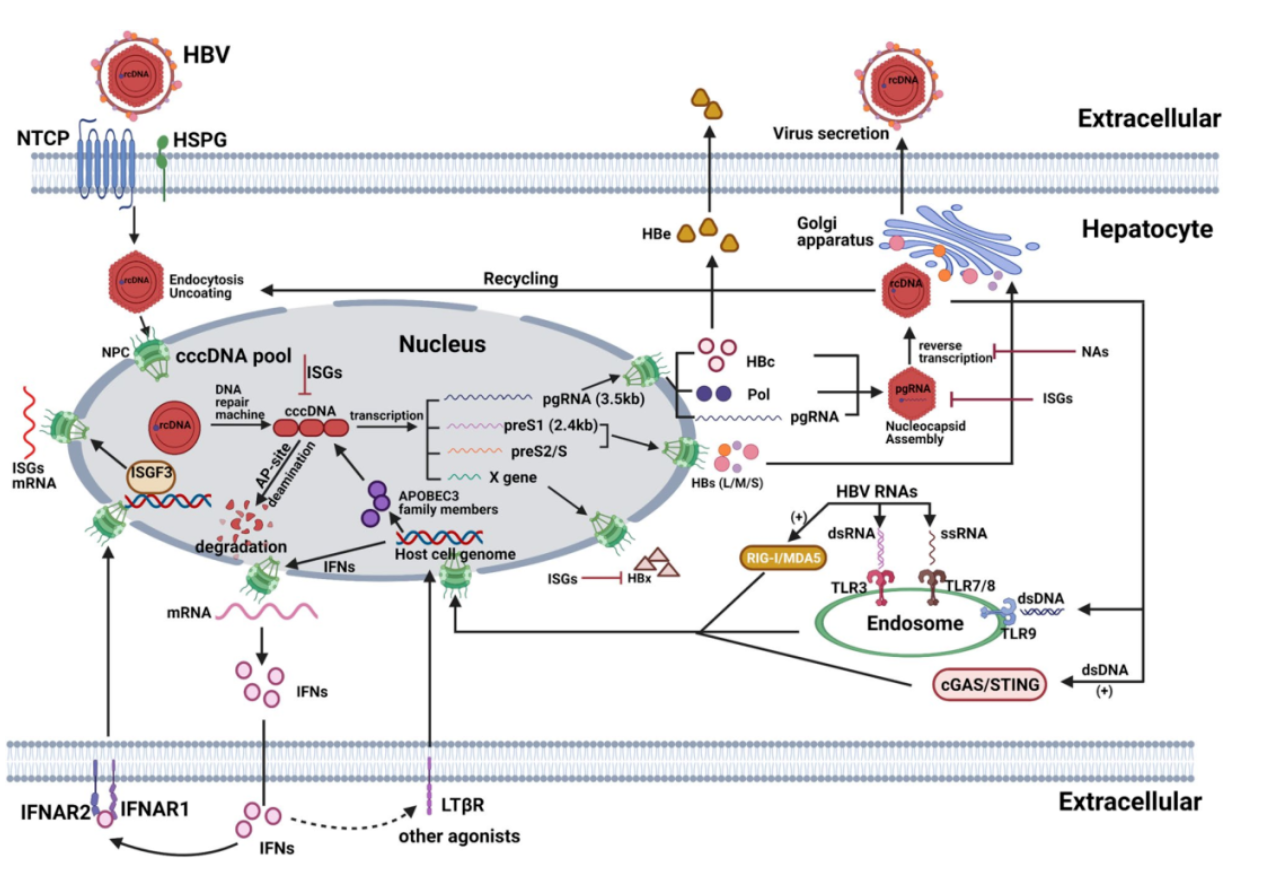
Researchers systematically compared the antiviral efficacy of various IFN-α subtypes in a mouse HBV model and found that among all tested subtypes, IFN-α4 and IFN-α5 were the most effective in suppressing HBV replication, with their ability to reduce serum HBsAg, HBeAg, and HBV DNA levels significantly superior to other subtypes. Histological analysis confirmed that IFN-α4 treatment markedly decreased the number of intrahepatic HBcAg-positive cells. The mechanism involves IFN-α4's potent induction of multiple ISGs (including ISG15, OAS, and PKR) and its activation of NK cells and T cells to modulate antiviral immune responses. Furthermore, the combined application of IFN-α4-encoding plasmids with IFN-α5 produced synergistic antiviral effects, further enhancing NK and T cell activity.
Despite IFN-α4's superior anti-HBV activity in preclinical models, its clinical translation faces pharmacokinetic and safety challenges common to IFN-α subtypes. The potential advantage of IFN-α4 lies in its ability to achieve better viral suppression at lower doses or shorter treatment cycles due to its stronger ISG induction and immunomodulatory activity, thereby mitigating the adverse effects of traditional IFN therapy. Future research should focus on establishing more precise dosing regimens and exploring combination strategies with other antiviral agents (such as nucleoside analogs or novel cccDNA-targeting drugs).
IV. Conclusion
As a subtype of the type I interferon family with unique biological activity, IFN-α4, through its demonstrated potent antiviral and immunomodulatory functions in HBV infection models, offers a new strategic direction for developing more effective treatments for chronic hepatitis B. Human recombinant IFN-α4 protein, as a critical tool for basic research and drug development, will continue to provide essential support for elucidating the differential functions of IFN-α subtypes and exploring their applications in viral infectious diseases.
In IFN-α4-related basic research and drug screening, high-quality human recombinant IFN-α4 protein is a core tool for ISG induction analysis, immune cell functional studies, and signaling pathway dissection. To meet this research demand, Uni offers IFN-α4/IFNA4 Protein, Human, suitable for JAK-STAT signaling pathway exploration, NK and T cell activation studies, and in vitro antiviral drug activity evaluation.
This article is reviewed and published by the technical expert team of UA
Disclaimer: This article partially utilizes artificial intelligence assistance in its creation. If any content involves copyright or intellectual property issues, please let us know and we promise to verify and remove it as soon as possible.
Purchase recombinant protein, choose 
UA protein focuses on providing various protein reagents, raw materials, and services required for drug research and development, cell therapy, gene therapy, and basic scientific research, including drug target proteins, immune checkpoint proteins, cytokines, tool enzymes, customized protein expression, and full-length transmembrane protein development. Nanjing Univ is committed to providing customers with high-quality products and professional services, and building a High-tech Biological Enterprise with International Competitiveness.
Target proteins | membrane proteins | cytokines | enzymes | viral antigens | protein customization
Nanjing UNIV Biotechnology Co., Ltd. Email:order@ua-bio.com Phone:+86-25-56221161

Product Information

Link:





©2021-2026 all rights reserved UNIV Biotechnology Co.,Ltd.
Privacy Policy
网站备案号 苏ICP备2025207586号-2 浙公网安备33010202004867号
 Business license (three certificates in one)
 Tel:+86-25-56221161
E-mail:order@ua-bio.com
All products sold on this website shall not be used for clinical diagnosis or treatment of humans or animals, and shall only be used for non-medical purposes such as industrial or scientific research.