

IL-13: A Key Target from Th2 Immune Response Regulation to Inflammatory Disease Therapy
Author: Senior Product Manager of UA Views:263 


This article systematically elucidates the molecular characteristics and biological functions of IL-13, focusing on its role as a Th2 cytokine in suppressing the pro-inflammatory functions of macrophages, regulating airway mucus secretion, and synergizing with IL-4 to induce Th2 differentiation. It also analyzes its dual role in inflammatory diseases such as asthma and atopic dermatitis.
- Recent Advances
- Product Information
Recent Advances
IL-13: A Key Therapeutic Target from Th2 Immune Response Regulation to Inflammatory Diseases
Overview
This article systematically elucidates the molecular characteristics and biological functions of IL-13 as a Th2 cytokine, focusing on its anti-inflammatory mechanisms in suppressing macrophage pro-inflammatory functions, regulating airway mucus secretion, and synergizing with IL-4 to induce Th2 differentiation. It also analyzes its dual role in inflammatory diseases such as asthma and atopic dermatitis.
This article systematically elucidates the molecular characteristics and biological functions of IL-13 as a Th2 cytokine, focusing on its anti-inflammatory mechanisms in suppressing macrophage pro-inflammatory functions, regulating airway mucus secretion, and synergizing with IL-4 to induce Th2 differentiation. It also analyzes its dual role in inflammatory diseases such as asthma and atopic dermatitis.
I. Molecular Characteristics and Cellular Sources of IL-13
Interleukin-13 (IL-13) is a secreted glycoprotein composed of approximately 132 amino acid residues, with a molecular weight ranging from 12 to 16 kDa (depending on glycosylation levels). Its gene is located on human chromosome 5q31.1, a region that also contains the IL-4 gene, indicating a high degree of homology in gene structure and amino acid sequence. This suggests that IL-13 and IL-4 may have originated from a common ancestral gene duplication event. Structurally, both IL-13 and IL-4 adopt a four-α-helix bundle folding pattern, which determines their partial overlap in receptor binding and signal transduction. IL-13 is primarily secreted by activated Th2 cells, mast cells, and eosinophils. In mucosal tissues, airway epithelial cells and group 2 innate lymphoid cells (ILC2) are also significant sources of IL-13. The expression of IL-13 is precisely regulated by transcription factors GATA3 and STAT6, playing a central role in Th2 immune responses. Under normal conditions, IL-13 is expressed at low levels in most tissues, but its expression is significantly upregulated in pathological states such as allergic reactions and parasitic infections.
II. Receptor System and Signal Transduction Mechanism of IL-13
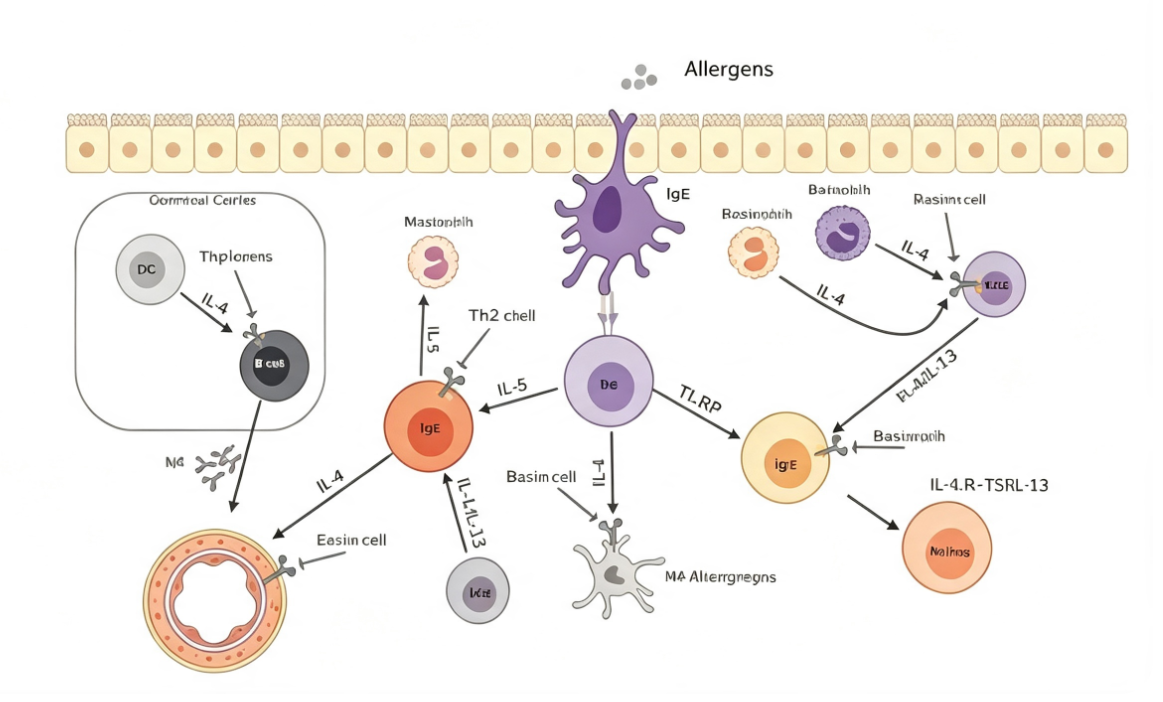
IL-13 initiates signal transduction by binding to specific receptor complexes on the surface of target cells. The IL-13 receptor system consists of two subunits: IL-13Rα1 (which forms a type II receptor complex with IL-4Rα to mediate signal transduction for both IL-13 and IL-4) and IL-13Rα2 (a high-affinity binding subunit with strong IL-13 binding affinity but a short intracellular domain, often considered a decoy receptor). In the functional receptor complex, IL-13 binds to IL-13Rα1, recruits IL-4Rα to form a high-affinity heterodimer complex, and activates JAK1 and TYK2. This leads to the phosphorylation of STAT6, which forms homodimers and translocates to the nucleus to initiate transcription of downstream target genes. This signal transduction pattern is highly similar to that of IL-4.
III. Anti-inflammatory Mechanisms and Immunoregulatory Functions of IL-13
IL-13 plays multiple regulatory roles in immune responses. In terms of anti-inflammatory effects, IL-13 can effectively inhibit macrophages from releasing pro-inflammatory cytokines and chemokines, reducing the infiltration of inflammatory cells into inflamed tissues. IL-13 synergizes with IL-4 to induce the differentiation of naïve T cells into Th2 cells, suppresses Th1 cell activation, and reduces the production of pro-inflammatory factors such as IFN-γ and IL-2, further amplifying anti-inflammatory effects. Additionally, IL-13 promotes mucus secretion by airway epithelial cells, enhancing mucosal barrier function and playing a regulatory role in allergic and airway inflammation. The function of IL-13 in chronic inflammatory diseases is dualistic. For example, in asthma, while IL-13 suppresses Th1-type inflammation, its overexpression leads to excessive mucus secretion, airway hyperresponsiveness, and airway remodeling, exacerbating airway obstruction and tissue fibrosis. Similar dual roles are observed in atopic dermatitis and chronic rhinosinusitis with nasal polyps, making IL-13 a critical therapeutic target for allergic diseases.
IV. Clinical Pathological Significance and Disease Associations of IL-13
IL-13 plays a pivotal regulatory role in various allergic and inflammatory diseases. In asthma, IL-13-induced excessive mucus secretion, airway hyperresponsiveness, and eosinophil infiltration are direct causes of airway obstruction and respiratory dysfunction. In atopic dermatitis, IL-13 disrupts skin barrier function, promotes itching, and drives local inflammation. In chronic rhinosinusitis with nasal polyps, IL-13 contributes to chronic inflammation and polyp formation in the nasal mucosa. In parasitic infections, IL-13 participates in host immune clearance of intestinal parasites by promoting mucus secretion and eosinophil infiltration.
V. Conclusion
As a core effector molecule of Th2 immune responses, IL-13 plays an irreplaceable role in the pathological processes of allergic diseases such as asthma, atopic dermatitis, and chronic rhinosinusitis, owing to its multifaceted immunoregulatory activities, including macrophage function modulation, mucus production promotion, and Th2 differentiation synergy. Its dual functionality highlights the complexity of targeting IL-13 for therapy—balancing the suppression of pathological overexpression while preserving its normal immunoregulatory functions. Recombinant human IL-13 protein, as a vital tool for basic research and drug development, will continue to provide critical support for in-depth exploration of IL-13's intricate regulatory mechanisms in inflammation and immunity.
In IL-13-related basic research and drug screening, high-quality recombinant human IL-13 protein is a core tool for receptor binding analysis, cellular function studies, and signal pathway exploration. To meet this research demand, Uni offers IL-13 Protein, Human, suitable for applications such as IL-13 binding analysis with IL-13Rα1/IL-13Rα2, STAT6 signaling pathway mechanism investigation, and in vitro activity evaluation of anti-IL-13 antibody drugs.
This article is reviewed and published by the technical expert team of UA
Disclaimer: This article partially utilizes artificial intelligence assistance in its creation. If any content involves copyright or intellectual property issues, please let us know and we promise to verify and remove it as soon as possible.
Purchase recombinant protein, choose 
UA protein focuses on providing various protein reagents, raw materials, and services required for drug research and development, cell therapy, gene therapy, and basic scientific research, including drug target proteins, immune checkpoint proteins, cytokines, tool enzymes, customized protein expression, and full-length transmembrane protein development. Nanjing Univ is committed to providing customers with high-quality products and professional services, and building a High-tech Biological Enterprise with International Competitiveness.
Target proteins | membrane proteins | cytokines | enzymes | viral antigens | protein customization
Nanjing UNIV Biotechnology Co., Ltd. Email:order@ua-bio.com Phone:+86-25-56221161

Product Information

Link:





©2021-2026 all rights reserved UNIV Biotechnology Co.,Ltd.
Privacy Policy
网站备案号 苏ICP备2025207586号-2 浙公网安备33010202004867号
 Business license (three certificates in one)
 Tel:+86-25-56221161
E-mail:order@ua-bio.com
All products sold on this website shall not be used for clinical diagnosis or treatment of humans or animals, and shall only be used for non-medical purposes such as industrial or scientific research.