




Why is the transfection efficiency of others always higher than yours in the same experiment?
Author: Senior Product Manager of UA Views:23 


If you are conducting gene function research, protein overexpression, or CRISPR-related experiments, you have likely encountered this scenario: after painstakingly plating cells, preparing reagents, and performing transfection, you eagerly check the fluorescence after 48 hours, only to find a disappointing positive rate of just 20-30%, with a significant portion of cells dead. Meanwhile, your senior labmate follows the same protocol and effortlessly achieves a transfection efficiency of over 50%.
- Recent Advances
- Product Information
Recent Advances
Why Do Others Always Achieve Higher Transfection Efficiency Than You in the Same Experiment?
If you're working on gene function studies, protein overexpression, or CRISPR-related experiments, you've likely experienced this scenario: after painstakingly plating cells, preparing reagents, and performing transfection, you eagerly check the fluorescence after 48 hours, only to find a dismal 20-30% positivity rate and a field of dead cells. Meanwhile, your labmate follows the same protocol and effortlessly achieves over 50% transfection efficiency.
What's the issue? Often, it's not your technique but the transfection reagent you've chosen.
Transfection isn't as simple as it seems.
The role of a transfection reagent is to escort nucleic acids into cells and enable target gene expression. While it sounds straightforward, the reality is fraught with pitfalls: high-efficiency reagents may be highly toxic, compromising cell health and invalidating your data; mild reagents often "fail to deliver," leaving you with sparse green fluorescence under the microscope. And when you finally find a reagent with decent efficiency and low toxicity, the price tag—often thousands per milliliter—can be a painful blow to your already tight budget.
This is especially true for commonly used cell lines like HEK293 and HeLa, where every step—cell density, reagent ratios, transfection duration—requires meticulous optimization. A single misstep can lead to vastly different outcomes.
What an "All-Rounder" Transfection Reagent Should Look Like
What makes a great reagent? High transfection efficiency, low cytotoxicity, simple operation, and affordability. The Lipo-UA Liposomal Cell Transfection Reagent (Catalog No. UA079058) checks all these boxes!
Efficiency First
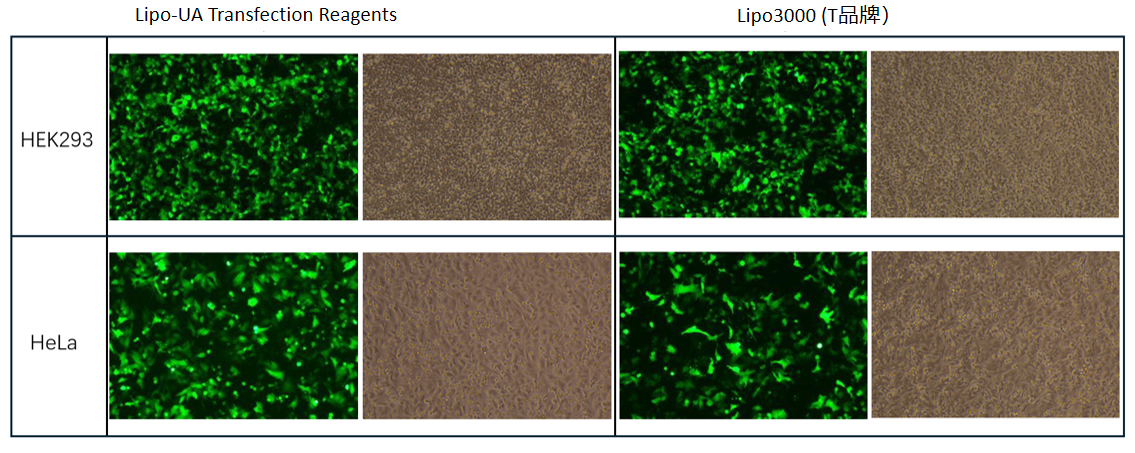
After 48 hours of transfection in HEK293 and HeLa cell lines, Lipo-UA's green fluorescence signals are on par with those of mainstream commercial imported reagents, with comparable positive cell densities in some fields. What does this mean? For the same experiment, you can achieve brighter fluorescence images and more reliable data.
Versatility
It is a highly efficient DNA transfection reagent with excellent compatibility for most commonly used cell lines. Whether you're working with standard adherent cells or hard-to-transfect cell types, you can find suitable conditions without frequently switching reagents or re-optimizing protocols.
Simplified Ratio Design
Anyone who's used transfection reagents knows the dread of cumbersome protocols and cryptic ratios. Lipo-UA simplifies this into a "foolproof" process: the kit consists of Liposomal Reagent L and Transfection Enhancer E. The recommended ratio for DNA, E, and L is 1:2:3. Mix them, incubate at room temperature for 20 minutes, then add to cells—just a few steps. For a 96-well plate, use 0.1μg DNA per well and 10μL of the prepared transfection reagent. Gently shake, and detect target gene expression after 24–96 hours as needed. It's that simple.
The formulation also includes Transfection Enhancer E to further boost nucleic acid delivery. If you observe excessive cytotoxicity, simply reduce the amount of Liposomal Reagent L—adjustments are flexible.
Affordability: A Must for Researchers
| Catalog No. | Specification | DNA Capacity (μg) | List Price | Discounted Price |
|---|---|---|---|---|
| UA079058 | 100μl | 33 | 200 | 100 |
| 1.5ml | 500 | 735 | 625 | |
| 5*1.5ml | 2500 | 2920 | 2480 |
The most compelling feature is the price. The cost per plate is significantly lower than that of mainstream imported reagents, making it a budget-friendly choice for "experimental freedom." Multiple sizes are available, with bulk pricing upon inquiry.
Try It in Your Next Transfection Experiment
For researchers working on gene overexpression, siRNA, or plasmid transfection, a high-efficiency, low-toxicity, easy-to-use, and affordable transfection reagent can save significant time and funding otherwise spent on trial and error.
Choosing the right reagent is half the battle in transfection. Before your next plating, give Lipo-UA a chance—let the results speak for themselves.
For details, click the product link: https://www.ua-bio.com/ua079058_lipo_ua_transfection_reagents.html
This article is reviewed and published by the technical expert team of UA
Disclaimer: This article partially utilizes artificial intelligence assistance in its creation. If any content involves copyright or intellectual property issues, please let us know and we promise to verify and remove it as soon as possible.
Purchase recombinant protein, choose 
UA protein focuses on providing various protein reagents, raw materials, and services required for drug research and development, cell therapy, gene therapy, and basic scientific research, including drug target proteins, immune checkpoint proteins, cytokines, tool enzymes, customized protein expression, and full-length transmembrane protein development. Nanjing Univ is committed to providing customers with high-quality products and professional services, and building a High-tech Biological Enterprise with International Competitiveness.
Target proteins | membrane proteins | cytokines | enzymes | viral antigens | protein customization
Nanjing UNIV Biotechnology Co., Ltd. Email:order@ua-bio.com Phone:+86-25-56221161

Product Information

Link:





©2021-2026 all rights reserved UNIV Biotechnology Co.,Ltd.
Privacy Policy
网站备案号 苏ICP备2025207586号-2 浙公网安备33010202004867号
 Business license (three certificates in one)
 Tel:+86-25-56221161
E-mail:order@ua-bio.com
All products sold on this website shall not be used for clinical diagnosis or treatment of humans or animals, and shall only be used for non-medical purposes such as industrial or scientific research.


