




NPC2 protein: Decoding lysosomal cholesterol transport mechanisms and a key molecule in Niemann-Pick disease type C research
Author: Senior Product Manager of UA Views:17 


This article focuses on the molecular characteristics and biological functions of NPC2 protein, systematically elaborating its core role in lysosomal cholesterol transport through a "hand-to-hand" mechanism that delivers free cholesterol to NPC1 protein, analyzing the crystal structure characteristics of NPC2 protein and the structural basis of its binding to sterol molecules, and exploring the molecular mechanism by which NPC2-mediated sterol molecule transport is coupled with proton transfer.
- Recent Advances
- Product Information
Recent Advances
NPC2 Protein: Decoding Lysosomal Cholesterol Transport Mechanisms and a Key Molecule in Niemann-Pick Type C Disease Research
Brief Introduction: This article focuses on the molecular characteristics and biological functions of the NPC2 protein, systematically elaborating its core role in lysosomal cholesterol transport through a “hand-to-hand” mechanism that delivers free cholesterol to the NPC1 protein. It analyzes the crystal structure features of the NPC2 protein and the structural basis for its binding to sterol molecules, and discusses the molecular mechanism by which NPC2-mediated sterol molecule transport is coupled with proton transfer.
I. Biological Background of Sterol Molecule Transport and Functional Positioning of NPC Proteins.
Sterol molecules (such as cholesterol), as one of the lipid components of cell membranes, play an indispensable role in the life activities of eukaryotic cells. Most eukaryotes possess the ability to synthesize the sterol nucleus (cyclopentanoperhydrophenanthrene) from small organic molecules, whereas animals lacking this ability (such as Nematoda and Arthropoda) must obtain sufficient sterol molecules from food to maintain life activities. During the metabolism of sterol molecules, sterol molecules need to undergo complex transport processes. Within cells, plasma membrane structures are the primary carriers for sterol molecule transport, but before this, free sterol molecules must first insert into membrane structures to complete subsequent transport.
Niemann-Pick Type C proteins (NPC, including NPC1 and NPC2) are among the most thoroughly studied sterol molecule (cholesterol) transport proteins. In lysosomes, NPC1 and NPC2 can bind cholesterol molecules and mediate the insertion of free cholesterol from the lysosomal lumen into the lysosomal membrane. Deficiency of either NPC1 or NPC2 can lead to cholesterol accumulation in cellular lysosomes and cause a series of pathophysiological changes (Niemann-Pick Type C disease). This disease association establishes the core position of the NPC2 protein in maintaining cholesterol homeostasis.
II. Molecular Structural Features of the NPC2 Protein and Sterol Molecule Binding Mode.
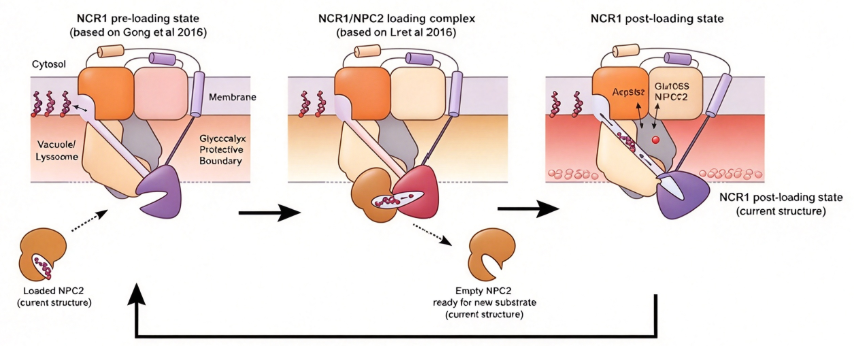
Despite long-term research on NPC proteins, the specific molecular mechanisms by which NPC proteins exert their functions remain not fully understood. It has been found that NPC2 protein within lysosomes can bind free cholesterol molecules and deliver cholesterol molecules to the NPC1 protein located on the lysosomal membrane in a “hand-to-hand” manner; the latter then mediates the insertion of cholesterol molecules into the lysosomal membrane. Notably, on the inner side of the lysosomal membrane, there exists a glycosylation layer approximately 60 A thick that isolates the lysosomal exterior structure from the acidic degradation environment within the lysosome, and NPC1 can mediate the insertion of sterol molecules through the glycosylation layer into the lysosomal membrane. In the NPC1 protein, its Middle Luminal domain located on the lysosomal inner side can bind to the NPC2 protein, while the N-terminal domain is responsible for receiving cholesterol molecules from NPC2. Subsequently, the Steroid Sensing domain located within the lysosomal membrane directly participates in the process of cholesterol insertion into the plasma membrane structure. Although the domain-function correlation of NPC1 has been studied relatively clearly, the molecular mechanisms by which its various domains work synergistically, especially the relationship between the molecular structure and function of NPC1 during the process of cholesterol crossing the glycosylation layer and inserting into the membrane structure, remain unknown.
On September 19, 2019, the laboratory of Bjorn P. Pedersen at Aarhus University in Denmark, in collaboration with researchers from the University of Southern Denmark and the University of Leeds in the United Kingdom, jointly published an article titled “Structural insight into eukaryotic sterol transport through Niemann-Pick Type C proteins” in the journal Cell, conducting more in-depth research on the process of NPC protein-mediated sterol molecule insertion into membrane structures from the perspective of structural biology. By resolving the protein structures of yeast NPC proteins NCR1 (NPC1 homolog) and NPC2, the authors verified the high degree of similarity in structure and function between yeast NPC proteins and NPC proteins of other species, and for the first time discovered a channel structure formed by multiple domains of the NCR1 protein that mediates sterol molecule transport.
III. Crystal Structure and Conservation Analysis of Yeast NPC2 Protein.
In the study, the authors first obtained crystal structures of yeast NPC2 protein in both sterol-bound and sterol-free states using X-ray crystallography, with resolutions reaching 2.8 to 2.9 A. The authors found that the NPC2 protein is arranged as a rotationally symmetric trimer, with each NPC2 monomer folding into an Ig-like β sandwich structure. Each NPC2 monomer contains a long and deep hydrophobic cavity that serves as the space for accommodating sterol molecules, and the conformation of the NPC2 protein does not change significantly upon sterol molecule binding. The overall structure of yeast NPC2 protein differs somewhat from other NPC2 proteins with known structures, particularly in that its hydrophobic cavity is much larger compared to other NPC2 proteins. However, yeast NPC2 possesses a sandwich structure similar to other NPC2 proteins, and the binding mode of sterol molecules within it is also almost identical to that of other NPC2 proteins. Therefore, the authors concluded that the interaction mode between yeast NPC2 protein and sterol molecules is highly conserved among homologous proteins across species. This finding provides a structural biology foundation for using yeast models to study the functional mechanisms of human NPC2 protein.
IV. Channel Model of NPC2 and NPC1 Cooperative Sterol Molecule Transport.
The authors next resolved the structure of the full-length NCR1 protein, with a resolution reaching 3.5 Å. Yeast NCR1 protein exists as a monomer, possesses 13 transmembrane helix structures, and has four distinct domains: the N-terminal domain, the Middle Luminal domain, the transmembrane domain, and the C-terminal domain. In the transmembrane domain, M2-M7 and M8-M13 are rotationally symmetric along an axis perpendicular to the membrane structure, and the Steroid Sensing domain of the protein is contained within M3-M7. Outside the transmembrane domain, the Middle Luminal domain and C-terminal domain exhibit two-fold rotational symmetry and insert into the glycocalyx, extending from the membrane-inner Steroid Sensing domain to near the sterol molecule binding site of the N-terminal domain, together forming a channel structure that traverses the glycocalyx. Between the N-terminal domain and the rest of the protein, there exists a Linker structure approximately 45 Å in length, allowing the N-terminal domain to be located within the vacuolar lumen after crossing the glycocalyx. Compared with other NPC1 proteins, the N-terminal domain of NCR1 is positioned closer to the symmetry center of the Middle Luminal domain and C-terminal domain. Based on the structure of NCR1 and recent studies on the structure of Patched family proteins, the authors propose that NCR1 can transport sterol molecules bound by the N-terminal domain to the Steroid Sensing domain through the channel structure formed by the Middle Luminal domain and C-terminal domain, thereby completing the function of sterol molecule insertion into the membrane structure.
V. NPC2 Functional Verification and Proton Transfer Coupling Mechanism.
While resolving the structures of yeast NPC proteins, the authors also examined the functions of yeast NPC proteins. In in vitro experiments, the authors used fluorescently excitable sterol molecule derivatives and isotope-labeled cholesterol molecules to verify the existence of sterol molecule transfer between NPC2 and the N-terminal domain of NCR1. On this basis, the authors verified the roles of several important amino acid residues in the NCR1 structure for protein function through amino acid point mutations. Among the amino acid residues tested, Asp631, Glu1068, and His1072 located in the transmembrane domain constitute a proton transfer chain. H1072A and D631N mutations lead to a significant decrease in sterol molecule transfer function between NPC proteins, suggesting that sterol molecule transport in NPC proteins may have a coupling relationship with proton transfer. In cell-level experiments, the authors observed sterol molecule transport within yeast cells using real-time imaging and confirmed the important role of yeast NPC proteins in the transport process. The authors found that disrupting vacuolar pH can block normal sterol molecule transport, similarly suggesting the important role of proton transfer in sterol molecule transport.
VI. Conclusion.
In basic research and disease mechanism exploration related to NPC2, high-quality recombinant NPC2 protein is a core tool for analyzing its sterol molecule binding mechanism and evaluating its functional activity. In response to the needs of NPC2 function research and Niemann-Pick Type C disease mechanism exploration, Ulab provides Niemann-Pick Type C2/NPC2 His Tag Protein, Human. This product is suitable for applications including binding activity analysis of NPC2 with cholesterol and sterol molecules, mechanistic studies of NPC2-NPC1 protein interactions, functional studies of NPC2-mediated lysosomal cholesterol transport, and development of diagnostic and therapeutic strategies related to Niemann-Pick Type C disease.
This article is reviewed and published by the technical expert team of UA
Disclaimer: This article partially utilizes artificial intelligence assistance in its creation. If any content involves copyright or intellectual property issues, please let us know and we promise to verify and remove it as soon as possible.
Purchase recombinant protein, choose 
UA protein focuses on providing various protein reagents, raw materials, and services required for drug research and development, cell therapy, gene therapy, and basic scientific research, including drug target proteins, immune checkpoint proteins, cytokines, tool enzymes, customized protein expression, and full-length transmembrane protein development. Nanjing Univ is committed to providing customers with high-quality products and professional services, and building a High-tech Biological Enterprise with International Competitiveness.
Target proteins | membrane proteins | cytokines | enzymes | viral antigens | protein customization
Nanjing UNIV Biotechnology Co., Ltd. Email:order@ua-bio.com Phone:+86-25-56221161

Product Information

Link:





©2021-2026 all rights reserved UNIV Biotechnology Co.,Ltd.
Privacy Policy
网站备案号 苏ICP备2025207586号-2 浙公网安备33010202004867号
 Business license (three certificates in one)
 Tel:+86-25-56221161
E-mail:order@ua-bio.com
All products sold on this website shall not be used for clinical diagnosis or treatment of humans or animals, and shall only be used for non-medical purposes such as industrial or scientific research.


