




Exploring transmembrane proteins: the key "gatekeepers" of life activities


In the microscopic world of cells, the cell membrane is like a solid wall, guarding the homeostasis inside the cell. Transmembrane proteins are the indispensable "gates" and "guards" in the wall.
- Recent Advances
- Product Information
Exploring transmembrane proteins: the key "gatekeepers" of life activities
In the microscopic world of cells, the cell membrane is like a solid wall, guarding the homeostasis inside the cell. Transmembrane proteins are the indispensable "gates" and "guards" in the wall. They run through both ends of the cell membrane and undertake important missions such as material transport, signal transduction, and cell recognition. Today, let us walk into the wonderful world of transmembrane proteins and unveil their mysterious veil.
Types and structures of transmembrane proteins
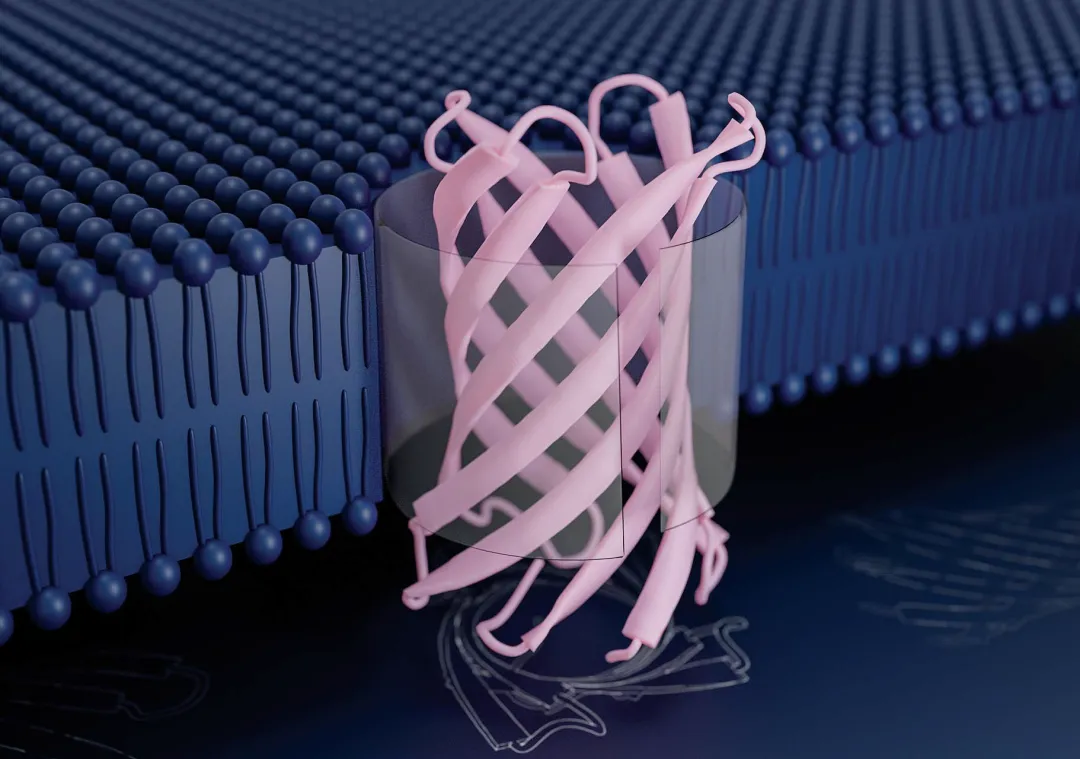
There are two main types of transmembrane proteins: α-helical transmembrane proteins and β-barrel transmembrane proteins. α-helical transmembrane proteins are the most common type. Their transmembrane regions are usually composed of α-helices composed of about 20 amino acids. Most of these amino acids are hydrophobic and can bind tightly to the lipid bilayer of the cell membrane. β-barrel transmembrane proteins are relatively special. They are composed of β-folds to form a self-enclosed barrel structure. Transmembrane proteins of this structure are more common in the outer membrane of Gram-negative bacteria, mitochondria, and chloroplasts.
Functions of transmembrane proteins
The functions of transmembrane proteins are diverse and important. They can act as channels or carriers to help ions, nutrients, and wastes pass through the cell membrane and maintain the balance of the intracellular and extracellular environment. For example, the sodium-potassium pump (Na⁺/K⁺-ATPase) is an important transmembrane protein that consumes the energy of ATP to pump sodium ions out of the cell and potassium ions into the cell, thereby maintaining the ion concentration gradient inside and outside the cell. In addition, transmembrane proteins can also act as receptors to receive external signals and transmit them to the cell, activate the intracellular signal transduction pathway, and regulate cell growth, differentiation, metabolism and other processes.
Design and application of transmembrane proteins
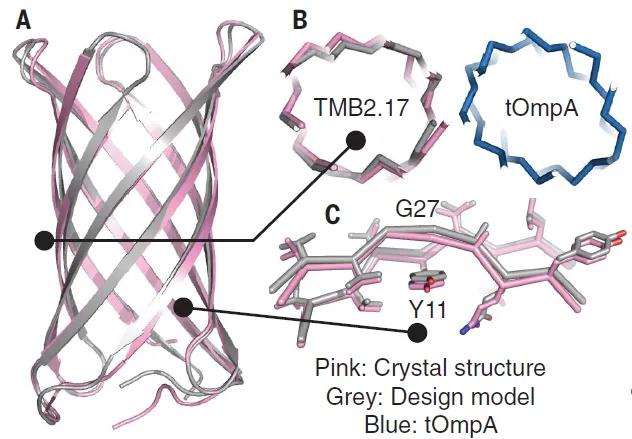
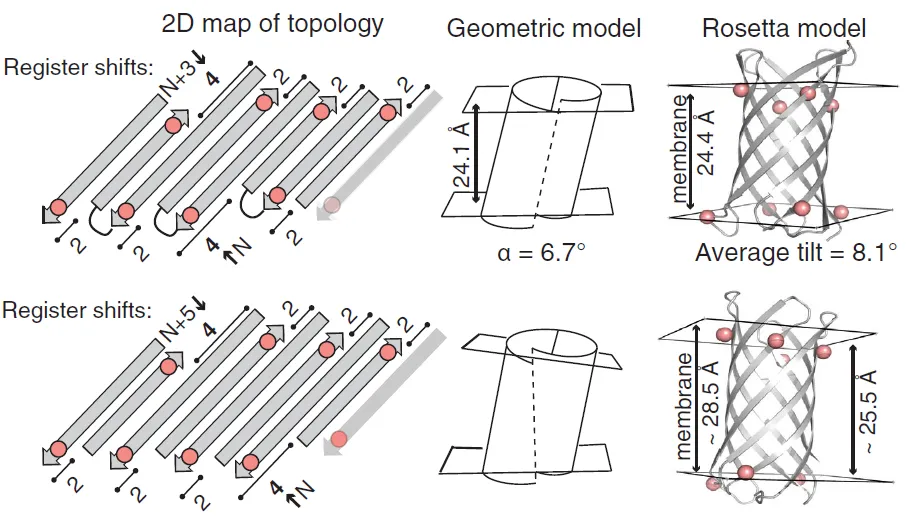
In recent years, with the development of protein design technology, scientists have begun to try to design transmembrane proteins from scratch. In 2021, David Baker's team at the University of Washington published a groundbreaking study in the journal Science, in which they achieved the first de novo design of β-barrel transmembrane proteins. This study not only deepens our understanding of the folding and structural properties of β-barrel transmembrane proteins, but also provides a basis for designing customized nanopore structures, which is expected to provide important tools for applications such as single-molecule sensing and sequencing.
In the design process of transmembrane proteins, researchers need to consider many factors, such as the folding stability of the protein, the hydrophobicity of the transmembrane region, and the interaction with the cell membrane. For example, in order to ensure that β-barrel transmembrane proteins can be correctly folded and assembled in the cell membrane, researchers need to design a β-hairpin structure that can be formed briefly before membrane insertion to avoid off-target phenomena caused by premature folding.
The design of transmembrane proteins is not only of great scientific significance, but also has broad application prospects. For example, artificially designed transmembrane pore proteins can be applied to nanopore gene sequencing technology to improve the accuracy of sequencing. In addition, transmembrane proteins can also be used as drug delivery systems to accurately transport drugs into cells and improve the efficacy of drugs.
Conclusion
As the key "gatekeepers" on the cell membrane, transmembrane proteins play an indispensable role in life activities. They not only participate in the material transport and signal transduction of cells, but also provide new ideas and methods for the treatment of diseases and the development of biotechnology. With the continuous advancement of protein design technology, I believe that in the future we will be able to design more transmembrane proteins with specific functions and make greater contributions to human health and the development of science and technology.
This article is reviewed and published by the technical expert team of UA
Disclaimer: This article partially utilizes artificial intelligence assistance in its creation. If any content involves copyright or intellectual property issues, please let us know and we promise to verify and remove it as soon as possible.
Purchase recombinant protein, choose Nanjing UA-Bio
UA protein focuses on providing various protein reagents, raw materials, and services required for drug research and development, cell therapy, gene therapy, and basic scientific research, including drug target proteins, immune checkpoint proteins, cytokines, tool enzymes, customized protein expression, and full-length transmembrane protein development. Youai is committed to providing customers with high-quality products and professional services, and building a High-tech Biological Enterprise with International Competitiveness.







 Business license (three certificates in one)