




CXCL10: A new key to unlock cancer immunotherapy


the long journey of cancer treatment, the emergence of immunotherapy was once regarded as a revolution. However, although immune checkpoint inhibitors such as anti-programmed cell death protein 1 (PD-1) antibodies have achieved remarkable results in the treatment of various cancers, a large number of patients still develop resistance to them. This has led scientists to continuously explore new strategies to enhance the effects of immunotherapy. Recently, a study on CXCL10 has brought us new hope.
- Recent Advances
- Product Information
CXCL10: A new key to unlock cancer immunotherapy
In the long journey of cancer treatment, the emergence of immunotherapy was once regarded as a revolution. However, although immune checkpoint inhibitors such as anti-programmed cell death protein 1 (PD-1) antibodies have achieved remarkable results in the treatment of various cancers, a large number of patients still develop resistance to them. This has led scientists to continuously explore new strategies to enhance the effects of immunotherapy. Recently, a study on CXCL10 has brought us new hope.
CXCL10: "Navigator" of Immune Cells
CXCL10 is a chemokine that plays a vital role in the immune system. It can guide immune cells, especially T cells, to migrate to specific tissues and organs. In the tumor microenvironment, CXCL10 attracts immune cells such as cytotoxic T cells (CTL), natural killer cells (NK), and dendritic cells (DC) by binding to its receptor
CXCR3, thereby enhancing the immune response to tumors.
Tumor microenvironment: the "battlefield" of immunotherapy
The tumor microenvironment (TME) is the "soil" on which tumor cells survive and develop. It is composed of multiple components such as tumor cells, immune cells, blood vessels, and extracellular matrix. In the TME, the infiltration of immune cells is crucial to the effect of immunotherapy. However, many tumors appear as "immune cold" tumors, that is, it is difficult for T cells to infiltrate into the tumor. This characteristic greatly reduces the effectiveness of immunotherapy. Therefore, how to transform "immune cold" tumors into "immune hot" tumors has become the focus of scientists' research.
CXCL10 and immunotherapy "cooperative combat"
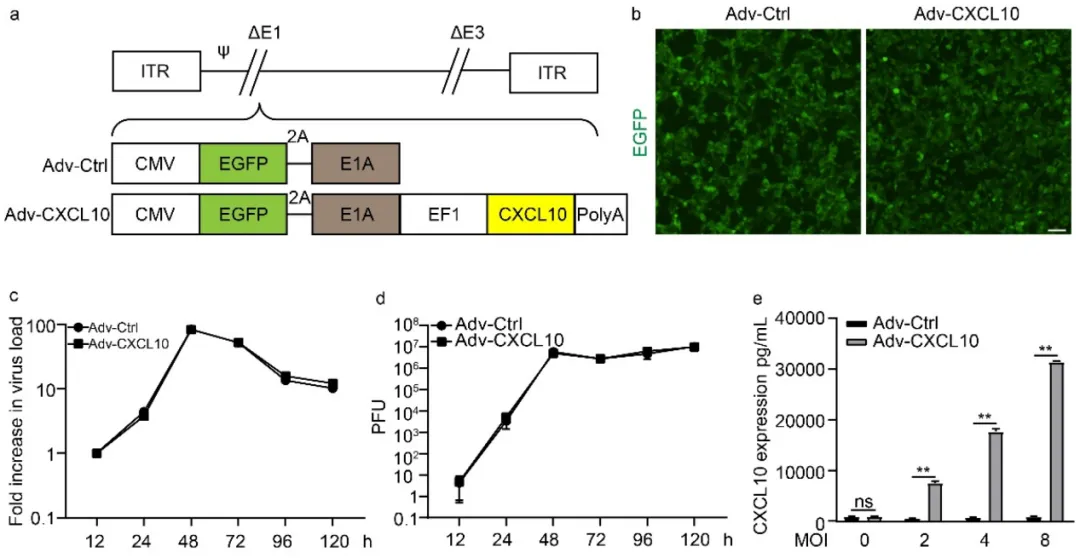
In recent years, oncolytic viruses (OVs) have received widespread attention as an emerging cancer treatment method. Oncolytic viruses can selectively infect and kill tumor cells while activating the body's immune system. The research team of Nanjing Medical University cleverly introduced the CXCL10 gene into oncolytic adenoviruses (AdVs) and constructed a recombinant oncolytic adenovirus (Adv-CXCL10) that can express CXCL10. This virus can not only kill tumor cells directly, but also attract more immune cells to infiltrate into the tumor microenvironment by expressing CXCL10, thereby enhancing the therapeutic effect of PD-1 antibodies.
The dawn of clinical transformation
This study not only achieved encouraging results in the laboratory, but also provided new ideas for clinical treatment. By increasing the number of CXCR3+ T cells in the tumor microenvironment, Adv-CXCL10 can make tumor cells that were originally insensitive to PD-1 antibodies respond to immunotherapy again. This strategy is expected to overcome immunotherapy resistance and improve patients' survival rate and quality of life.
Future Outlook
The potential of CXCL10 in cancer immunotherapy has just been tapped. With the deepening of research, we are expected to develop more CXCL10-based treatment strategies, such as combined use with other immune checkpoint inhibitors and synergistic treatment with oncolytic viruses. These innovative therapies will bring more hope to cancer patients and open up new paths for the future development of immunotherapy.
In short, CXCL10, as a key immune regulator, is becoming a new focus of cancer immunotherapy. By enhancing the infiltration and activation of immune cells, CXCL10 is expected to become a key to unlocking the puzzle of cancer treatment.
This article is reviewed and published by the technical expert team of UA
Disclaimer: This article partially utilizes artificial intelligence assistance in its creation. If any content involves copyright or intellectual property issues, please let us know and we promise to verify and remove it as soon as possible.
Purchase recombinant protein, choose Nanjing UA-Bio
UA protein focuses on providing various protein reagents, raw materials, and services required for drug research and development, cell therapy, gene therapy, and basic scientific research, including drug target proteins, immune checkpoint proteins, cytokines, tool enzymes, customized protein expression, and full-length transmembrane protein development. Youai is committed to providing customers with high-quality products and professional services, and building a High-tech Biological Enterprise with International Competitiveness.







 Business license (three certificates in one)