




The IL-12 Family of Cytokines: Dual Roles in Rheumatic Diseases and Cancer Immunotherapy


The IL-12 family is a class of structurally similar but functionally diverse cytokines that play a critical role in immune regulation. The family includes IL-12, IL-23, IL-27, IL-35 and IL-39, which regulate the differentiation of helper T cells such as Th1 and Th17 through different receptor signaling pathways, thus affecting the process of autoimmune diseases, tumor immunity and infectious diseases.
- Recent Advances
- Product Information
- Reference
The IL-12 Family of Cytokines: Dual Roles in Rheumatic Diseases and Cancer Immunotherapy
Introduction
The IL-12 family comprises structurally similar yet functionally diverse cytokines that play pivotal roles in immune regulation. This family includes IL-12, IL-23, IL-27, IL-35, and IL-39, which modulate the differentiation of helper T cells (such as Th1 and Th17) through distinct receptor signaling pathways, thereby influencing autoimmune diseases, tumor immunity, and infectious diseases. Among them, IL-12 and IL-23 have garnered significant attention due to their extensive clinical applications. This article systematically reviews the structural characteristics, biological functions, and clinical advances of the IL-12 family in rheumatic diseases and cancer immunotherapy.
1. Structural and Functional Features of the IL-12 Family
1.1 Molecular Structure and Receptor Composition
IL-12 family members are heterodimeric cytokines formed by different α and β chains:
IL-12: Composed of p35 (IL-12A) and p40 (IL-12B), it signals through the IL-12Rβ1 and IL-12Rβ2 receptor complex.
IL-23: Consists of p19 (IL-23A) and p40 (IL-12B), binding to the IL-12Rβ1/IL-23R receptor.
IL-27: Formed by p28 (IL-27) and EBI3 (Epstein-Barr virus-induced gene 3), it interacts with the WSX-1 (IL-27Rα) and gp130 receptors.
IL-35: A dimer of p35 (IL-12A) and EBI3, primarily acting on regulatory T cells (Tregs) to exert immunosuppressive effects.
IL-39 (less studied): Composed of p19 and EBI3, potentially involved in inflammatory responses.
Although IL-12 and IL-23 share the p40 subunit, their biological effects differ significantly:
IL-12 promotes Th1 differentiation, enhances IFN-γ production, and strengthens anti-tumor and anti-infection immunity.
IL-23 drives Th17 polarization, inducing IL-17A, IL-17F, and IL-22 secretion, which are closely linked to autoimmune diseases such as psoriasis and rheumatoid arthritis.
1.2 Signaling Pathways and Immune Regulation
IL-12/STAT4 Pathway: IL-12 activates the JAK2/TYK2-STAT4 axis, promoting Th1 polarization and enhancing cytotoxic T cell (CTL) and NK cell-mediated anti-tumor responses.
IL-23/STAT3 Pathway: IL-23 signals via JAK2-STAT3 to expand Th17 cells, contributing to the pathogenesis of inflammatory bowel disease (IBD), psoriasis, and other autoimmune disorders.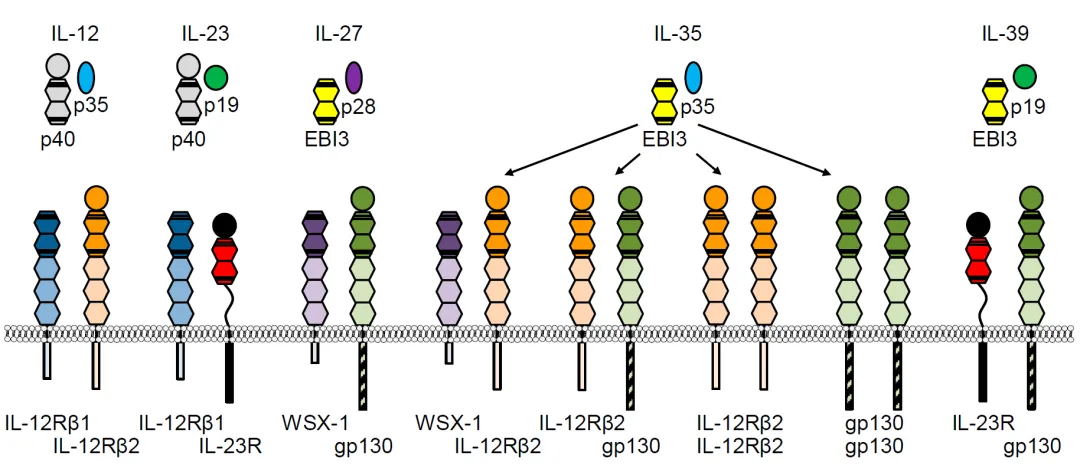
2. Therapeutic Applications of the IL-12 Family in Rheumatic Diseases
Given the critical role of IL-23 in Th17-mediated autoimmunity, monoclonal antibodies targeting IL-12/IL-23 p40 or IL-23 p19 have become cornerstone therapies for rheumatic diseases.
2.1 Anti-p40 Monoclonal Antibodies
Ustekinumab
Mechanism: Binds the shared p40 subunit of IL-12 and IL-23, blocking interaction with IL-12Rβ1 and suppressing Th1/Th17 responses.
Indications:
Plaque psoriasis (FDA-approved in 2009)
Psoriatic arthritis (PsA)
Crohn’s disease (CD)
Advantages: Sustained efficacy and favorable safety profile.
2.2 Anti-IL-23 p19 Monoclonal Antibodies
Since IL-23 specificity is determined by its p19 subunit, selective p19 inhibitors offer more precise Th17 modulation with fewer off-target effects. Approved p19 inhibitors include:
Guselkumab
First-in-class IL-23 p19 inhibitor (FDA-approved in 2017).
Superior to TNF-α inhibitors (e.g., adalimumab) and IL-17A blockers (e.g., secukinumab) in psoriasis.
Tildrakizumab
Approved in the EU (2018) for moderate-to-severe psoriasis.
Convenient dosing (subcutaneous injection every 3 months).
Risankizumab
Approved in 2019 for psoriasis and Crohn’s disease.
Mirikizumab
Phase III trials for ulcerative colitis (UC) and Crohn’s disease (CD).
2.3 Future Directions
Dual-target inhibitors: Simultaneous blockade of IL-12 and IL-23 may enhance efficacy but requires careful safety evaluation.
Personalized therapy: Tailoring treatments based on individual Th1/Th17 immune profiles.
3. IL-12 in Cancer Immunotherapy
IL-12’s potent Th1-stimulating properties make it a promising candidate for cancer immunotherapy. Current strategies include:
3.1 Gene Therapy and Local Delivery
Ad-RTS-hIL-12 (NCT02026271):
Adenoviral vector for controlled IL-12 expression in glioblastoma.
Combined with veledimex to regulate IL-12 levels in the tumor microenvironment.
Electroporation-mediated IL-12 plasmid (Tavo + PD-1 inhibitor):
Intratumoral IL-12 DNA (tavokinogene telseplasmid) with pembrolizumab (Keytruda) for melanoma (NCT03132675).
3.2 Combination with Immune Checkpoint Inhibitors (ICIs)
MEDI1191 (IL-12 mRNA vaccine + Durvalumab) (NCT03946800):
Early data show enhanced anti-tumor activity with PD-L1 blockade and good tolerability.
IL-12 fusion proteins (e.g., IL12-L19L19) (NCT04471987):
Tumor-targeted IL-12 delivery via L19 antibody to minimize systemic toxicity.
3.3 Challenges and Optimization
Toxicity management: Systemic IL-12 can cause severe inflammation, necessitating localized delivery (e.g., intratumoral injection).
Combination strategies: Synergizing with CAR-T, oncolytic viruses, etc., to improve immune infiltration.
4. Conclusion and Future Perspectives
The IL-12 family exhibits dual immunomodulatory roles:
The IL-23/Th17 axis is a key target in autoimmune diseases, with p19 inhibitors now first-line therapies for psoriasis and IBD.
The IL-12/Th1 axis holds great potential in cancer immunotherapy but requires advances in delivery systems.
Future research should focus on:
Developing precision IL-12 delivery platforms (e.g., nanocarriers, conditional expression vectors).
Exploring the functions of lesser-studied members (e.g., IL-35, IL-39).
Optimizing combination therapies to enhance clinical outcomes in autoimmunity and oncology.
With ongoing biotechnological innovations, the IL-12 family will continue to unlock new frontiers in immunotherapy.
This article is reviewed and published by the technical expert team of UA
Disclaimer: This article partially utilizes artificial intelligence assistance in its creation. If any content involves copyright or intellectual property issues, please let us know and we promise to verify and remove it as soon as possible.
Purchase recombinant protein, choose Nanjing UA-Bio
UA protein focuses on providing various protein reagents, raw materials, and services required for drug research and development, cell therapy, gene therapy, and basic scientific research, including drug target proteins, immune checkpoint proteins, cytokines, tool enzymes, customized protein expression, and full-length transmembrane protein development. Youai is committed to providing customers with high-quality products and professional services, and building a High-tech Biological Enterprise with International Competitiveness.

1. Doreen M. Floss et al,IL-12 and IL-23—Close Relatives with Structural Homologies but Distinct Immunological Functions,Cells 2020, 9, 2184;
2. Mirlekar, B.; Pylayeva-Gupta,Y. IL-12 Family Cytokines in Cancer and Immunotherapy. Cancers 2021, 13, 167.






 Business license (three certificates in one)