In 2022, there were nearly 20 million new cancer cases worldwide, with 9.7 million deaths. Traditional chemotherapy lacks targeting, while monoclonal antibody drugs are limited by insufficient cytotoxicity or drug resistance. Antibody-Drug Conjugates (ADCs), through a three-in-one design of "antibody-linker-cytotoxic payload," combine targeting and killing potency, and have become an important pillar of precise tumor therapy. As of 2024, a total of 15 ADCs have been approved globally (7 for hematological tumors and 8 for solid tumors), with over 400 others in clinical development, including 24 in Phase III trials.
-
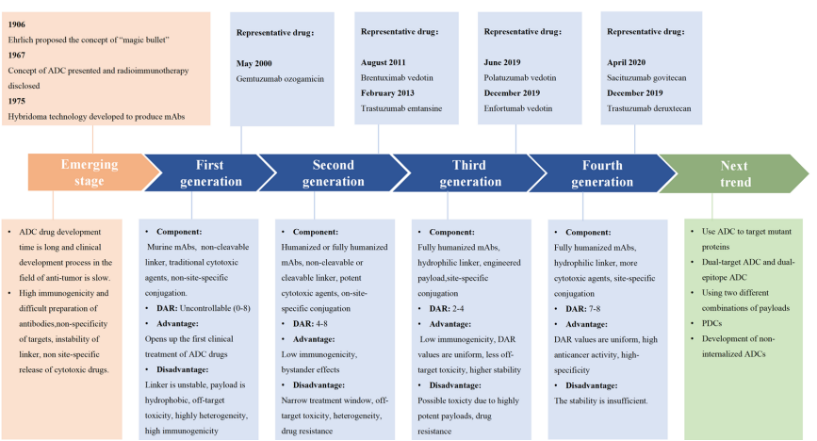
First Generation (2000): Murine antibodies + acid-sensitive hydrazone linkers + calicheamicin (e.g., Gemtuzumab ozogamicin). High immunogenicity and unstable linkers led to withdrawal in 2010, followed by reintroduction in 2017 with a reduced-dose regimen.
-
Second Generation: Humanized/fully human antibodies + cleavable dipeptide linkers (Val-Cit) or non-cleavable thioether linkers + more potent payloads (MMAE, DM1). Representative: Trastuzumab emtansine (T-DM1).
-
Third Generation: Site-specific conjugation technology (DAR 2–4) and hydrophilic PEGylated linkers, reducing aggregation and extending half-life. Representative: Enfortumab vedotin (EV).
-
Fourth Generation: High DAR (7–8) and transmembrane diffusion payloads (DXd, SN-38) enabling bystander effects; bispecific (dual-epitope/dual-target) ADCs entering clinical trials. Representatives: Trastuzumab deruxtecan (T-DXd), ZW49, BL-B01D1.
-
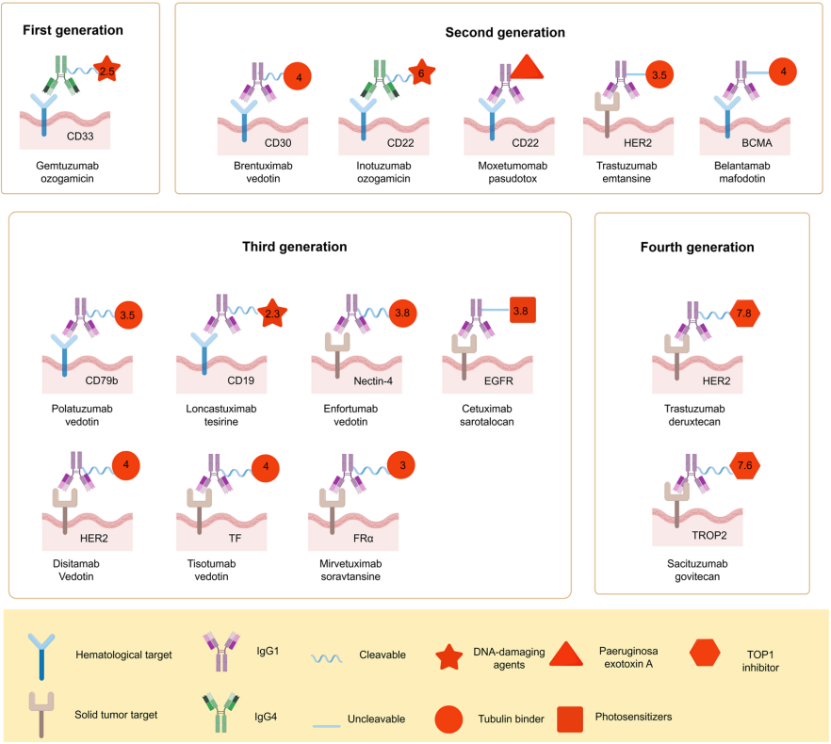
Antibodies: IgG1 accounts for 86.7% of approved products (13/15) due to strong ADCC/CDC activity and long half-life; IgG4 is used in scenarios requiring weak effector functions (e.g., Gemtuzumab ozogamicin).
-
Linkers:
- Cleavable linkers (73.3%, 11/15), with enzyme-cleavable Val-Cit / Gly-Gly-Phe-Gly being the most common;
- Non-cleavable linkers (26.7%), stable in plasma but lacking bystander effects.
-
Payloads:
- Microtubule inhibitors (MMAE/MMAF, DM1/DM4) account for 53.3% of approved ADCs;
- DNA-damaging agents (calicheamicin, PBD) 20%;
- TOP1 inhibitors (DXd, SN-38) 13.3%, with Phase III projects rising to 45.8%;
- Novel payloads: Immune agonists (TLR7/8, STING), RNA polymerase II inhibitors (α-amanitin), photosensitizers (IRDye700DX).
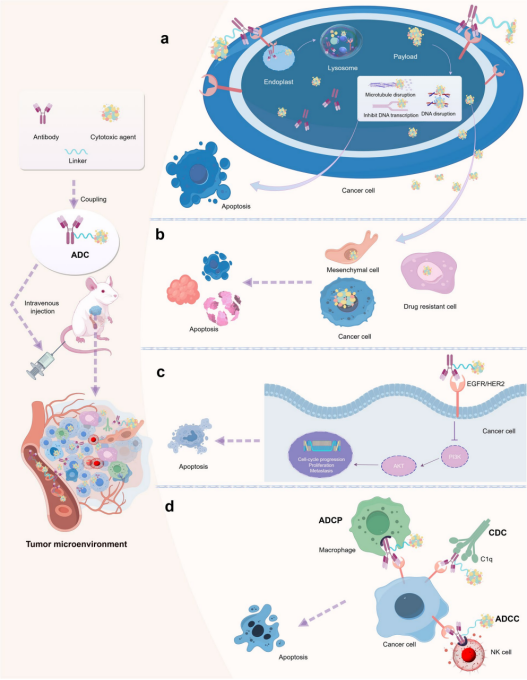
a. Core mechanism of ADCs: The cytotoxic effect of ADCs is achieved through a series of sequential processes—binding to cell surface antigens, internalization of the ADC-antigen complex via endocytosis, lysosomal degradation, release of cytotoxic drugs into the cytoplasm, and ultimately exerting cytotoxic effects on target cells.
b. Bystander effect of ADCs: Some drugs may be released into the extracellular environment and subsequently taken up by neighboring cells (including drug-resistant or non-target cells).
c. Retention of mAb activity in ADCs: The monoclonal antibody (mAb) in ADCs retains its original functions—interfering with target functions, inhibiting downstream signaling pathways, and inducing apoptosis.
d. Anti-tumor immune effects of ADCs: The mAb in ADCs can interact with immune effector cells, triggering antibody-dependent cellular cytotoxicity (ADCC), antibody-dependent cellular phagocytosis (ADCP), and complement-dependent cytotoxicity (CDC).
Hematological tumors: CD33, CD30, CD22, CD79b, BCMA, CD19
Solid tumors: HER2 (3 approved + 8 in Phase III), TROP2, EGFR, Nectin-4, TF, FRα, CD19
Non-internalizing targets (CD20, CAIX, FAP) are under exploration, promising to break through the traditional dependence on internalization.
- Gemtuzumab ozogamicin: A low-dose fractionated regimen significantly prolonged overall survival (OS) in elderly AML patients (AML-19 study).
- Brentuximab vedotin: Combined with AVD as first-line treatment for classical Hodgkin lymphoma (cHL), achieving a 2-year progression-free survival (PFS) of 97.3% vs. 92.6%.
- Inotuzumab ozogamicin: Complete remission (CR) rate of 81% in relapsed/refractory B-cell acute lymphoblastic leukemia (R/R B-ALL), with 1-year PFS of 89% after bridging to transplantation.
- T-DM1: In the KATHERINE trial, 3-year invasive disease-free survival was 88.3% vs. 77% in adjuvant post-surgical treatment.
- T-DXd: In DESTINY-Breast03, median PFS was 16.4 vs. 6.9 months; DESTINY-Breast04 confirmed benefits in the HER2-low population.
- Sacituzumab govitecan: In the Phase III ASCENT study, median PFS was 5.6 vs. 1.7 months, and OS was 12.1 vs. 6.7 months.
- EV-301/302: For metastatic urothelial carcinoma (mUC) previously treated with platinum-based chemotherapy + immunotherapy, first-line EV + pembrolizumab achieved a median OS of 31.5 vs. 16.1 months.
- Mirvetuximab soravtansine: In the SORAYA study, objective response rate (ORR) was 32.4% in FRα-high expressing platinum-resistant ovarian cancer (PROC), with median duration of response (mDOR) of 6.9 months.
- Photoimmunotherapy (Cetuximab sarotalocan): In head and neck squamous cell carcinoma (HNSCC), CR rate was 40% with mDOR of 9.4 months, and it can activate systemic immunity.
- Bispecific/multispecific ADCs: Simultaneously targeting HER2×HER3, EGFR×cMet, etc., to reduce tumor escape.
- Immunostimulatory ADCs: Payloads as TLR or STING agonists to reshape the "cold" tumor immune microenvironment.
- Non-oncological fields: Autoimmunity, chronic infections, Alzheimer’s disease, etc., requiring breakthroughs in blood-brain barrier delivery.
- Personalized strategies: Precision dosing based on target expression levels, gene mutations, and pharmacokinetic models.
ADCs have evolved through four generations of technological innovation, moving from "concept validation" to "clinical cornerstone." Through antibody engineering, linker-payload innovation, conjugation process upgrades, and combination therapy models, ADCs are continuously expanding the boundaries of tumor treatment and extending to non-tumor diseases. Over the next 5–10 years, high DAR precision conjugation, bispecific payloads, and immune synergy strategies are expected to push ADCs into a new era of precise "pan-tumor, pan-disease" therapy.












 Business license (three certificates in one)