I. Pathogenic Basis of Autoimmune Diseases and Abnormal Activation of B Cells
A key feature of autoimmune diseases is the imbalance of the body's immune system, which produces autoantibodies against self-tissue components, with autoreactive B cells being the main source of these autoantibodies.
In the normal development of the immune system, autoreactive B cells are relatively common in the developing B cell repertoire. However, the body maintains immune self-tolerance through precise immune tolerance mechanisms that strictly select or eliminate them in the bone marrow or spleen. Nevertheless, some autoreactive B cells may escape this elimination mechanism, enter the mature cell system, and exhibit functional anergy. Under specific conditions, such as when antigens carry polyclonal activators (e.g., lipopolysaccharides) or there are repeated epitopes stimulating the B cell receptor (BCR, such as bacterial capsular carbohydrates), these anergic B cells may be activated through T cell-independent pathways after encountering cognate antigens in secondary lymphoid tissues.
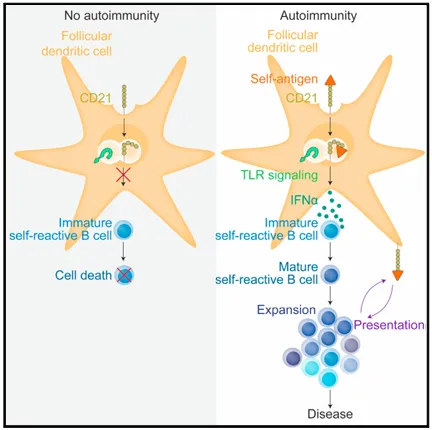
T cell-dependent B cell activation responses mainly proceed through two pathways: extrafollicular responses typically produce short-lived low-affinity plasma cells; while germinal center (GC) reactions are key processes where B cells undergo repeated clonal expansion, somatic hypermutation (SHM), and selection, ultimately generating high-affinity antibodies against specific antigens, and are more important mechanisms in the development of autoimmune diseases. Studies have shown that the normal progression of germinal center reactions is highly dependent on the coordinated regulation of follicular dendritic cells (FDCs), which participate in B cell activation and differentiation through multiple ways such as antigen presentation, cytokine transmission, and structural support.
II. Molecular Characteristics of MFGE8 and Its Basic Role in Immunoregulation
MFGE8 (milk fat globule-epidermal growth factor 8), also known as FDC-M1 or lactadherin, is a secreted glycoprotein that plays an important role in immunoregulation. It is widely expressed in various immune-related cells, especially with high expression levels in follicular dendritic cells (FDCs), providing an important cellular basis for its involvement in maintaining immune tolerance and regulating immune responses.
MFGE8 has unique structural characteristics, containing two epidermal growth factor (EGF)-like domains and an arginine-glycine-aspartic acid (RGD) sequence. This structure enables it to specifically bind to integrin receptors (such as αvβ3 integrin) on the cell surface through the RGD sequence, thereby mediating cell-cell interactions and signal transduction. In the process of immunoregulation, MFGE8 acts as a key molecular bridge, playing an irreplaceable role in clearing apoptotic cells, maintaining immune tolerance, and regulating B cell activation.
III. Core Functions of MFGE8 in Maintaining Immune Tolerance
(I) Mediating the Clearance of Apoptotic B Cells
In the maintenance of immune system homeostasis, the timely clearance of apoptotic cells is an important mechanism to prevent the occurrence of autoimmune reactions. FDCs play a key role in clearing apoptotic B cells by producing MFGE8. As a molecular bridge, MFGE8 can specifically recognize phosphatidylserine exposed on the surface of apoptotic B cells, and at the same time bind to αvβ3 integrin on the surface of phagocytes (such as macrophages) through its RGD sequence, targeting apoptotic cells to phagocytes for phagocytic clearance.
This MFGE8-mediated clearance mechanism of apoptotic B cells can effectively prevent the release of autoantigens from apoptotic cells into the extracellular environment, thereby reducing abnormal stimulation of the immune system by autoantigens and preventing the activation of autoreactive B cells and the production of autoantibodies. Abnormal expression or function of MFGE8 will lead to impaired clearance of apoptotic B cells and exposure of a large number of autoantigens, which in turn induces the occurrence of autoimmune diseases.
(II) Participating in Immunoregulation of Germinal Centers
Germinal centers are key sites for B cells to undergo clonal expansion, somatic hypermutation, and affinity maturation. The maintenance of their normal functions is crucial for the precise regulation of immune tolerance and antibody production. As core supporting cells in germinal centers, FDCs not only provide antigen presentation and cytokine signals for B cells but also participate in germinal center immunoregulation through expressing MFGE8.
During germinal center reactions, B cells undergo intense proliferation and differentiation processes, accompanied by massive cell apoptosis. MFGE8 maintains cellular homeostasis and microenvironmental balance within germinal centers by efficiently clearing these apoptotic B cells. In addition, MFGE8 may affect the selection and differentiation of B cells by regulating interactions between FDCs and B cells, ensuring that only high-affinity B cells against foreign antigens are retained and expanded, while autoreactive B cells are effectively inhibited or eliminated, thereby maintaining immune self-tolerance.
IV. Mechanisms Linking MFGE8 to Autoimmune Diseases
(I) MFGE8 Functional Defects and Autoantibody Production
A large number of studies have shown that abnormal MFGE8 function is closely related to the occurrence and development of autoimmune diseases. Reduced MFGE8 expression or impaired function has been observed in various autoimmune disease models. Due to impaired apoptotic B cell clearance caused by MFGE8 functional defects, a large number of autoantigens are released and captured by antigen-presenting cells, which in turn activate autoreactive T cells and B cells, triggering autoimmune responses.
In germinal center reactions, abnormal MFGE8 function disrupts the normal selection mechanism of B cells, allowing autoreactive B cells to survive and generate high-affinity autoantibodies through somatic hypermutation. These autoantibodies bind to self-tissue components, triggering a series of immune-inflammatory reactions that cause tissue and organ damage, manifesting as clinical symptoms of autoimmune diseases.
(II) Regulatory Role of MFGE8 in Immune Cell Interactions
MFGE8 not only participates in apoptotic cell clearance but also regulates interactions between immune cells, affecting the progression of autoimmune diseases. In the follicular microenvironment, FDCs interact with immune cells such as T cells and B cells through expressing MFGE8, regulating the activation and function of immune cells.
Studies have found that MFGE8 may indirectly regulate B cell activation and antibody production by affecting the differentiation and function of follicular helper T cells (TFH). Abnormal expansion or hyperfunction of TFH cells can support the continuous activation of autoreactive B cells, while MFGE8 may inhibit excessive T cell help signals by maintaining the homeostasis of TFH cells in germinal centers, thereby preventing the occurrence of autoimmune diseases. In addition, MFGE8 may participate in maintaining immune tolerance by regulating the expression of immune inhibitory molecules (such as PD-L1, PD-L2) on the surface of FDCs, further inhibiting the occurrence of autoimmune reactions.
V. Research Significance and Prospects of MFGE8
As an important immunoregulatory molecule, MFGE8 plays a key role in maintaining immune tolerance, clearing apoptotic cells, and regulating germinal center functions. In-depth study of the biological functions of MFGE8 and its mechanism of action in autoimmune diseases has important theoretical significance for revealing the pathogenesis of autoimmune diseases.
From the perspective of clinical application, MFGE8 is expected to become a potential target for the diagnosis and treatment of autoimmune diseases. Detecting the expression level or functional status of MFGE8 in the body can provide important biological markers for the early diagnosis and disease assessment of autoimmune diseases. At the same time, developing targeted therapeutic strategies for MFGE8, such as increasing MFGE8 expression or enhancing its function, may provide new ideas and methods for the treatment of autoimmune diseases. By restoring immune tolerance mechanisms and inhibiting the production of autoantibodies, it can improve disease symptoms and enhance the quality of life of patients. In the future, with the deepening of research, the application value of MFGE8 in the field of autoimmune diseases will be further expanded.












 Business license (three certificates in one)