





- Recent Advances
- Product Information
Q: What is CEACAM5, and why is it gaining attention in cancer research?
CEACAM5, commonly known as Carcinoembryonic Antigen (CEA) and also designated as CD66e, is a extensively studied tumor-associated antigen. It belongs to the CEACAM (Carcinoembryonic Antigen-Related Cell Adhesion Molecule) family and is a glycoprotein anchored to the cell membrane via Glycosylphosphatidylinositol (GPI). Due to its high expression in various malignant tumors and low expression in normal adult tissues, CEA has long been recognized as an important tumor biomarker, particularly widely used in the diagnosis and efficacy monitoring of colorectal cancer. In recent years, with advancements in immunotherapy, CEA has gradually become a hot target for research in CAR-T cell therapy and antibody-based drugs.
Q: Which members are included in the CEACAM family, and what are their common features?
The CEACAM family comprises 12 known members (such as CEACAM1, 3-8, 16, 18-21). Most of these proteins structurally contain immunoglobulin-like domains and are widely expressed in various normal and tumor tissues. They are involved not only in cell recognition and adhesion but also play important roles in inflammatory responses, angiogenesis, and tumor progression and metastasis. Among them, CEACAM1, 5, 6, and 7 have been more deeply studied, showing significant biological and clinical relevance in tumor development and progression.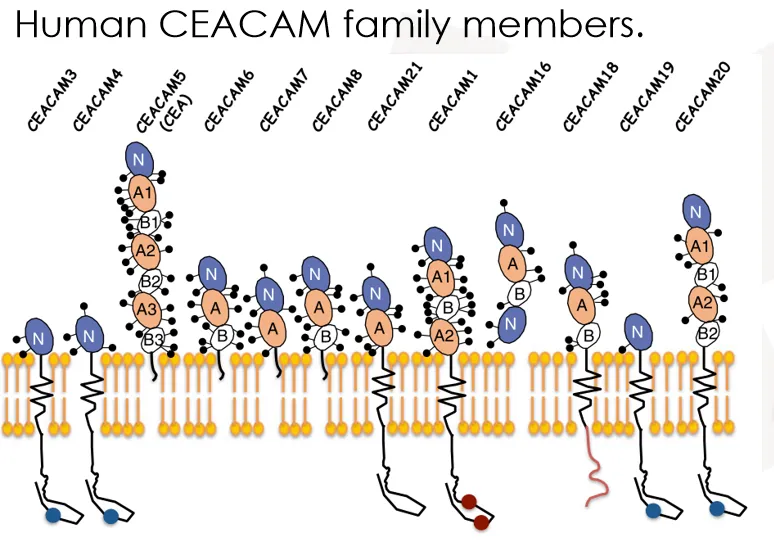
Q: What are the molecular structural characteristics of CEA?
The protein structure of CEA is complex and sophisticated. Its amino terminus (N-terminal) contains an immunoglobulin variable-like domain (IgV), followed by three structurally similar repeating units comprising a total of six immunoglobulin constant-like domains (IgC2), designated A1, B1, A2, B2, A3, and B3. It is noteworthy that CEA is attached to the cell membrane via a GPI anchor, meaning it lacks a transmembrane region itself. This characteristic may influence its signal transduction mechanisms and the design strategies for therapeutic antibodies.
Q: How is CEA expressed in the normal human body?
In normal adult tissues, CEA expression is relatively low and exhibits certain tissue specificity. It is primarily found on the surfaces of mucosal epithelial cells in the colon, stomach, tongue, esophagus, etc., and trace amounts can also be detected in tissues such as the mammary glands and sweat glands. Notably, CEA expression is higher during embryonic development and significantly decreases after birth. The name "carcinoembryonic antigen" originates from its high expression during the embryonic period and its re-expression in certain cancers.
Q: Which tumors highly express CEA, and what is the clinical significance?
CEA is overexpressed in various epithelial-derived tumors, particularly common in colorectal cancer, gastric cancer, pancreatic cancer, non-small cell lung cancer, and breast cancer. Because its serum levels correlate closely with tumor burden, progression, and prognosis, CEA testing is widely used for screening, efficacy evaluation, and recurrence monitoring of colorectal cancer. It is important to note that although CEA is a broad-spectrum tumor marker, elevated levels can also occur in certain benign conditions (such as inflammation and liver cirrhosis). Therefore, clinical interpretation requires comprehensive judgment combining imaging, pathology, and other information.
Q: What is the current progress of CAR-T cell therapy targeting CEA?
In recent years, CEA has become an important research direction for CAR-T therapy in solid tumors. For example, the team at Xiangya Hospital of Central South University reported the successful use of third-generation anti-CEA CAR-T cells to treat patients with advanced lung cancer, demonstrating preliminary safety and antitumor effects. Currently, multiple global clinical studies of CAR-T therapy targeting CEA-positive solid tumors (such as colorectal cancer, gastric cancer, and pancreatic cancer) are in Phase I/II trials. Although the number of cases is still limited and challenges such as suppression by the tumor microenvironment and on-target off-tumor toxicity remain, these early explorations provide valuable clinical evidence for CEA-directed cell therapy.
Q: Besides CEA, what other similar targets are there for solid tumors?
Mesothelin (MSLN) is another widely noted broad-spectrum solid tumor target. It is highly expressed in various tumors such as malignant mesothelioma, pancreatic cancer, ovarian cancer, and lung adenocarcinoma, while its distribution in normal tissues is limited. For instance, CAR-T pioneer Professor Carl June's team conducted clinical research on MSLN-targeted CAR-T therapy for advanced pancreatic cancer, with some patients showing disease stability or even significant reduction in metabolic activity of metastases. Similar to CEA, due to its specific expression pattern in tumors, MSLN has become an ideal target for the development of innovative therapies such as antibody-drug conjugates (ADCs), CAR-T cells, and bispecific antibodies.
Q: What are the future directions for CEA-targeted therapy?
As a long-studied tumor marker, CEA is now gaining renewed momentum in research and development. Future studies will focus more on improving treatment safety (e.g., reducing off-target effects on normal tissues through logic-gated CAR design), overcoming tumor heterogeneity and the immunosuppressive microenvironment, and exploring diversified treatment modalities such as CEA-targeted antibody-drug conjugates (ADCs) and bispecific T-cell engagers (BiTEs). With the accumulation of more clinical data and optimization of treatment strategies, CEA is expected to become a key target in breaking through the bottlenecks of solid tumor immunotherapy.
This article is reviewed and published by the technical expert team of UA
Disclaimer: This article partially utilizes artificial intelligence assistance in its creation. If any content involves copyright or intellectual property issues, please let us know and we promise to verify and remove it as soon as possible.
Purchase recombinant protein, choose Nanjing UA-Bio
UA protein focuses on providing various protein reagents, raw materials, and services required for drug research and development, cell therapy, gene therapy, and basic scientific research, including drug target proteins, immune checkpoint proteins, cytokines, tool enzymes, customized protein expression, and full-length transmembrane protein development. Youai is committed to providing customers with high-quality products and professional services, and building a High-tech Biological Enterprise with International Competitiveness.







 Business license (three certificates in one)