




How do Th17 cells achieve durable anti-tumor immunity through B cell activation?


B cells not only produce specific antibodies but also function as professional antigen-presenting cells and orchestrate immune responses by secreting cytokines.
- Recent Advances
- Product Information
I. What are the Key Challenges in Cancer Immunotherapy?
The rapid advancement of cancer immunotherapy is reshaping the landscape of oncology treatment. Innovative therapies such as immune checkpoint inhibitors and adoptive T cell therapies have demonstrated encouraging, durable efficacy in advanced-stage patients. The US FDA has approved various cell therapies, including CAR-T cells for hematologic malignancies, tumor-infiltrating lymphocytes for melanoma, and T cell receptor therapies for synovial sarcoma. However, the precise molecular mechanisms by which these "living cell" therapies induce tumor regression remain poorly understood, which severely hinders further optimization and broader application of these treatments.
Traditionally, immunotherapy research has primarily focused on the direct cytotoxic functions of CD8⁺ T cells. However, accumulating evidence in recent years indicates that B cells play an indispensable role in anti-tumor immunity. B cells can not only produce specific antibodies but also function as professional antigen-presenting cells and coordinate immune responses via cytokine secretion. Notably, in various tumor types, B cell infiltration and the formation of tertiary lymphoid structures correlate positively with the response to immune checkpoint inhibitor therapy. These findings have prompted researchers to re-evaluate the synergistic role of CD4⁺ T cells and B cells in anti-tumor immunity.
II. Why Do Th17 Cells Stand Out in Adoptive T Cell Therapy?
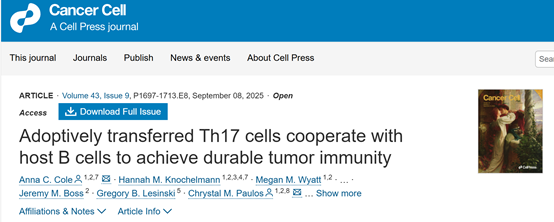
On July 24, 2025, a significant study published in Cancer Cell by Anna C. Cole's team at Emory University systematically compared the anti-tumor efficacy of different CD4⁺ T helper cell subsets. The researchers polarized CD4⁺ T cells expressing a TRP-1-specific TCR into Th0, Th1, Th9, and Th17 subtypes and subsequently transferred them into a B16F10 melanoma mouse model. Strikingly, Th17 cells exhibited significantly superior tumor suppression capability compared to all other subsets, even in the absence of supporting vaccines or exogenous IL-2 administration.
This exceptional anti-tumor effect was not transient. The research team further intravenously challenged mice that had been cured by Th17 therapy with B16F10 tumor cells to assess protection against lung metastasis. The results showed that these mice completely failed to develop lung metastases. More importantly, this protective effect persisted even after depleting host CD4⁺ T cells with antibodies, indicating that the long-lasting immunity induced by Th17 cells does not depend on the continued presence of the effector cells. This finding provides a novel perspective for understanding the long-term benefits of adoptive T cell therapy.
III. How Do Th17 Cells Uniquely Activate Host B Cells?
To elucidate the molecular mechanisms underlying Th17-mediated anti-tumor immunity, the researchers performed comprehensive transcriptomic analysis of tumor tissues and tumor-draining lymph nodes using NanoString technology. The results revealed a significant enhancement of antigen presentation-related genes and interferon signaling pathways within the tumor microenvironment, including key molecules like Cd74, H2-Aa, and Tap1. In the draining lymph nodes, B cell-related genes such as Cd19, Aicda, Cd40l, and Il21 were markedly upregulated, suggesting B cell activation was closely associated with Th17 therapy.
To further test this hypothesis, the team evaluated the efficacy of Th17 cells in T cell-deficient and combined T/B cell-deficient mouse models. In TCRα⁻/⁻ mice, Th17 cells still exerted significant anti-tumor effects; however, this effect was completely abolished in RAG⁻/⁻ mice. Subsequent experiments in B cell-specific deficient and B cell-depleted mouse models confirmed that host B cells are essential for the therapeutic effect of Th17 cells. This series of rigorous experiments definitively established the central role of host B cells in Th17-mediated anti-tumor immunity for the first time.
IV. How Do Th17 Cells Reshape B Cell Functional States?
In-depth flow cytometric analysis of splenic B cell subsets revealed that Th17 therapy significantly increased the proportions of plasma cells and germinal center B cells. Concurrently, the expression of the proliferation marker Ki-67 on B cells was upregulated, and the expression of co-stimulatory molecules like MHC-II, CD40, and CD86 was markedly enhanced, indicating a highly activated state of B cells. These findings reveal the profound impact of Th17 therapy on B cell function at the cellular level.
Histological analysis provided further spatial evidence. Immunofluorescence staining showed that Th17 cells specifically infiltrated B cell follicles, promoted the aggregation of GL7⁺ activated B cells, and increased the number and size of germinal centers. This structural alteration provides an ideal microenvironment for optimal B cell activation and antibody affinity maturation, potentially forming the basis for durable immune memory.

V. What Role Does the CD40/CD40L Pathway Play in Th17-B Cell Dialogue?
The molecular mechanism of this cellular interaction was a key focus of the study. The researchers found that the CD40/CD40L signaling pathway plays a central role in mediating the synergy between Th17 cells and B cells. When this pathway was blocked using an anti-CD40L antibody, the therapeutic efficacy of Th17 cells was significantly impaired, confirming CD40L as a critical molecule for Th17-driven B cell responses.
Deeper analysis revealed an interesting positive feedback loop: B cells not only respond to CD40L signals provided by Th17 cells but can, in turn, enhance the polyfunctionality of Th17 cells. In B cell-deficient environments, Th17 cells tended to maintain a central memory phenotype, and their ability to produce multiple cytokines was markedly reduced, including decreased secretion of important cytokines like IL-21, TNFα, and IL-10. This finding overturns the traditional view of T cells unidirectionally regulating B cells, revealing a complex mechanism of bidirectional crosstalk between immune cells.
VI. How Does IL-21 Coordinate Long-Term Anti-Tumor Immunity?
IL-21, a characteristic cytokine of Th17 cells, has been a focus in understanding its role in anti-tumor immunity. Through elegant experimental design, this study uncovered the unique role of IL-21 in sustaining long-term immunity. When IL-21 signaling was blocked using an anti-IL-21R antibody, or when Th17 therapy was administered in IL-21R⁻/⁻ mice, researchers observed distinct spatiotemporal effects: the initial tumor clearance phase remained largely unaffected, but the long-term immune protection was significantly compromised.
Mechanistic studies indicated that IL-21 primarily acts on B cells rather than affecting Th17 cell function in an autocrine manner. The absence of IL-21 signaling led to impaired B cell proliferation, limited plasma cell differentiation and germinal center formation, consequently affecting the production of high-quality antibodies and the establishment of immune memory. This discovery explains why blocking IL-21 does not impact early efficacy but impairs long-term protection, providing a key molecular explanation for Th17-mediated durable immunity.
VII. What is the Clinical Significance of the Th17-B Cell Axis for Cancer Immunotherapy?
This study systematically elucidates the complete mechanism by which Th17 cells, via IL-21 and CD40L, interact with host B cells to promote B cell activation and antibody production, thereby achieving durable anti-tumor immunity. This discovery not only expands our understanding of the mechanisms of action of adoptive T cell therapy but also provides important insights for optimizing current immunotherapy strategies.
From a translational perspective, these findings suggest we should re-evaluate current adoptive T cell therapy strategies, which are predominantly centered on CD8⁺ T cells. Harnessing the unique advantages of Th17 cells, particularly their synergy with B cells, could open new avenues for treating solid tumors. Simultaneously, precise modulation of the CD40L and IL-21 pathways holds promise for further enhancing the potency and durability of existing therapies.
Furthermore, the results suggest that B cell status could potentially serve as a biomarker for predicting response to Th17 therapy, offering a new basis for patient stratification and personalized treatment. With a deeper understanding of the Th17-B cell interaction mechanisms, we have reason to believe that novel therapeutic strategies based on these scientific insights will bring hope to more cancer patients.
This research not only reveals a novel mechanism of Th17 cells in anti-tumor immunity but, more importantly, establishes the central role of CD4⁺ T cell and B cell synergy in cancer immunotherapy, laying a solid theoretical foundation for the development of next-generation immunotherapeutic technologies.
This article is reviewed and published by the technical expert team of UA
Disclaimer: This article partially utilizes artificial intelligence assistance in its creation. If any content involves copyright or intellectual property issues, please let us know and we promise to verify and remove it as soon as possible.
Purchase recombinant protein, choose Nanjing UA-Bio
UA protein focuses on providing various protein reagents, raw materials, and services required for drug research and development, cell therapy, gene therapy, and basic scientific research, including drug target proteins, immune checkpoint proteins, cytokines, tool enzymes, customized protein expression, and full-length transmembrane protein development. Youai is committed to providing customers with high-quality products and professional services, and building a High-tech Biological Enterprise with International Competitiveness.







 Business license (three certificates in one)