




IL-4R Targeted Therapy: Comprehensive Breakthroughs from Monoclonal Antibodies to Novel Therapeutic Strategies


IL-4Rα as a Key Target for Type 2 Inflammatory Disease Therapy: Mediating IL-4 and IL-13 Signaling to Play a Central Role in the Pathogenesis of Allergic and Inflammatory Diseases
- Recent Advances
- Product Information
IL-4Rα serves as a critical therapeutic target for type 2 inflammatory diseases, playing a central role in the pathogenesis of allergic and inflammatory conditions by mediating IL-4 and IL-13 signaling. In recent years, therapeutic strategies targeting this receptor have diversified, ranging from traditional monoclonal antibodies to emerging PROTAC technology and small molecule inhibitors, providing multi-layered treatment options for moderate-to-severe atopic dermatitis, asthma, and other diseases. This article will explore the interaction between these therapeutic strategies and IL-4R, systematically analyze target and phenotypic screening methods, and comprehensively evaluate their clinical application prospects and development directions.
How Does the IL-4/IL-13 Signaling Pathway Play a Central Regulatory Role in Type 2 Inflammation?
IL-4Rα is a common receptor subunit for both IL-4 and IL-13 signaling pathways and plays a core regulatory role in type 2 inflammatory responses. This receptor is primarily found on the surface of immune cells and epithelial cells, mediating signal transduction through two distinct receptor complexes: Type I receptors, composed of IL-4Rα and the common gamma chain (γc), primarily respond to IL-4 stimulation; Type II receptors, composed of IL-4Rα and IL-13Rα1, can respond to both IL-4 and IL-13 stimulation.
A deep dive into the molecular mechanisms reveals that IL-4 binding to IL-4Rα induces conformational changes in the receptor, promoting its dimerization with the corresponding subunit. These activated receptor complexes rapidly activate JAK family kinases (primarily JAK1 and JAK3), which subsequently phosphorylate the transcription factor STAT6. Phosphorylated STAT6 forms homodimers and translocates into the nucleus, binding to promoter regions of IL-4 and IL-13 response genes to regulate the transcription of downstream target genes. This cascade of molecular events ultimately leads to B cell activation, IgE class switching, eosinophil recruitment and activation, and the differentiation of myeloid and atopic dendritic cells.
In the pathological environment of diseases like atopic dermatitis (AD), IL-4 and IL-13 directly disrupt skin barrier function by downregulating the expression of key differentiation markers such as filaggrin and loricrin, while simultaneously inducing keratinocytes to express skin-homing receptors and stimulating the production of itch-related neurosignaling molecules like nerve growth factor and thymic stromal lymphopoietin. This results in the characteristic chronic pruritus and skin barrier dysfunction of AD. Therefore, the IL-4/IL-13 signaling pathway represents a key target for treating type 2 inflammatory diseases.
How Do Monoclonal Antibody Drugs Precisely Target the IL-4Rα Signaling Pathway?
Mechanism of Action and Clinical Advantages of Dupilumab
Dupilumab, produced by Sanofi, is a fully humanized IgG4 monoclonal antibody that binds with high affinity and specificity to the IL-4Rα subunit, thereby simultaneously blocking signal transduction of both IL-4 and IL-13. This dual blockade mechanism allows Dupilumab to comprehensively inhibit the core pathway of type 2 inflammation.
Studies show that Dupilumab treatment significantly remodels the transcriptomic signature of atopic dermatitis in a dose-dependent manner. At the molecular level, it effectively suppresses the mRNA expression of genes related to T cell activation, dendritic cell maturation, eosinophil chemotaxis, and inflammatory pathways, while also reducing the production of TH2-induced chemokines (such as CCL17, CCL18, CCL26) in skin lesions. Notably, Dupilumab treatment significantly reduces serum levels of CCL17 (Thymus and Activation-Regulated Chemokine) in patients; this chemokine is not only a key regulator of Th2-mediated immunity but also a specific and objective biomarker of AD disease activity.
Innovative Characteristics and R&D Progress of Stapokibart
Stapokibart (CM310), developed by Jiangsu Hengrui Pharmaceuticals, is another humanized IL-4Rα monoclonal antibody with differentiated characteristics. Compared to Dupilumab, Stapokibart exhibits broader species cross-reactivity, binding with high affinity not only to human IL-4Rα but also effectively to cynomolgus monkey and mouse IL-4Rα, a feature that provides unique advantages for its preclinical research.
Mechanistic studies indicate that Stapokibart's binding epitope on IL-4Rα differs from that of Dupilumab, which may explain its superior blocking efficacy in certain contexts. Preclinical data show that Stapokibart effectively inhibits the progression of type 2 inflammation. Pharmacokinetic parameters indicate half-lives of 298-351 hours in cynomolgus monkeys and 55-142 hours in mice, suggesting favorable pharmacokinetic persistence and providing important references for clinical dosing regimen design.
How Do PROTAC and Small Molecule Strategies Expand the IL-4R Targeted Therapy Landscape?
Revolutionary Breakthrough of PROTAC Technology
PROTAC (Proteolysis-Targeting Chimera) technology represents a novel strategy for targeting IL-4R. Unlike traditional antibodies, PROTAC molecules operate via a ternary complex formation mechanism: one end binds IL-4Rα, while the other end recruits an E3 ubiquitin ligase, inducing the ubiquitination and degradation of IL-4Rα. This mechanism not only blocks IL-4Rα signaling but also clears the target protein from the cell, achieving more thorough target inhibition.
PROTAC technology offers several unique advantages for IL-4R targeting: the ability to target receptor intracellular domains that are difficult for traditional antibodies to access; event-driven pharmacology enabling catalytic cycles and sub-stoichiometric efficiency; cell membrane permeability allowing targeting of intracellular signaling nodes; and degradation of the entire receptor protein, potentially avoiding resistance due to functional redundancy. Several research teams are currently developing PROTAC molecules targeting IL-4Rα. While challenges remain in the preclinical phase regarding degradation efficiency, selectivity, and pharmacokinetic optimization, encouraging preliminary results have been achieved.
Advances in Small Molecule Inhibitor Development
Small molecule inhibitors represent another important direction for IL-4R targeted therapy, primarily focusing on interfering with IL-4Rα dimerization or blocking downstream signaling. Design strategies for these inhibitors include: developing competitive antagonists that bind IL-4Rα and prevent its interaction with IL-4 or receptor partners; specific inhibitors targeting key nodes of the JAK-STAT signaling pathway; and small molecule compounds that interfere with receptor trafficking and membrane localization.
Compared to monoclonal antibodies, small molecule inhibitors offer advantages such as convenient oral administration, lower production costs, and the ability to target intracellular domains. However, their development faces unique challenges, including the need to overcome the difficulty of effectively blocking large protein-protein interaction interfaces with small molecules, and achieving sufficient affinity and selectivity. Currently, while no high-affinity small molecule inhibitors targeting IL-4Rα have entered clinical studies, several academic institutions and pharmaceutical companies are actively exploring this field, utilizing advanced techniques like structure-based drug design, fragment-based screening, and virtual screening to identify promising lead compounds.
What Advanced Target and Phenotypic Screening Methods are Used in Drug Development?
Innovations in Target Validation and Screening Strategies
In the development of IL-4R-targeted drugs, researchers employ multi-level, multi-dimensional target validation and screening methods. In vitro binding assays are fundamental for validating molecular interactions with IL-4Rα. Techniques like Surface Plasmon Resonance (SPR) and Bio-Layer Interferometry (BLI) enable precise analysis of binding affinity, kinetics, and epitope.
Signal transduction blockade assays are core methods for assessing functional effects, determining biological activity by measuring the candidate molecule's ability to inhibit downstream signaling molecules of IL-4 and IL-13 (such as STAT6 phosphorylation, gene expression changes). Furthermore, transcriptomic analysis is widely used to evaluate the drug's impact on type 2 inflammatory gene signatures. Studies have shown that Dupilumab treatment significantly alters the gene expression profile in the skin tissue of AD patients, including suppression of inflammation-related genes and promotion of the restored expression of differentiation genes (e.g., LOR, FLG).
Advancements in Phenotypic Screening and Biomarker Analysis
In clinical research stages, various advanced phenotypic screening methods are integrated to comprehensively assess drug efficacy and patient response. High-dimensional flow cytometry enables detailed analysis of changes in peripheral blood immune cell composition and state. Combined with machine learning algorithms, it can identify immune phenotypic characteristics of treatment responders and non-responders. For instance, by detecting memory T cell subsets and activation marker expression patterns, researchers can predict responsiveness to Dupilumab treatment before its initiation.
Skin transcriptome analysis provides another crucial assessment dimension, precisely correlating molecular changes with clinical outcomes by comparing gene expression differences in active lesions and non-lesional skin samples before and after treatment. Additionally, serum biomarker monitoring systems are widely used to evaluate treatment response, including changes in levels of total IgE, TARC/CCL17, and eotaxin-3/CCL26, providing objective basis for efficacy assessment.
Single-cell multi-omics technologies offer an unprecedented perspective for deeply understanding drug mechanisms of action. This technology allows simultaneous analysis of the transcriptome and proteome of individual immune cells, comprehensively depicting immune functional states. Research has found significant differences in the polyfunctionality of Tfh cells (e.g., the ability to co-produce IL-21, IL-2, IFN-γ, TNF-α) among different patients, which may influence treatment response and disease progression.
What Application Prospects Do IL-4R-Targeted Drugs Show in Disease Treatment?
Efficacy Breakthrough in Atopic Dermatitis (AD)
Atopic dermatitis is the most thoroughly researched indication for IL-4R-targeted drugs, with the most substantial evidence-based medical data. Consistent results from multiple Phase III clinical trials (e.g., SOLO1, SOLO2, CHRONOS) demonstrate that Dupilumab significantly improves skin lesions and symptoms in patients with moderate-to-severe AD. After 16 weeks of Dupilumab treatment, 36-38% of patients achieved an Investigator's Global Assessment (IGA) score of 0/1 (clear or almost clear), compared to only 8-10% in the placebo group. Simultaneously, the proportion of patients achieving EASI-75 (75% improvement in Eczema Area and Severity Index) was 44-52% in the treatment group, significantly higher than the placebo group.
Long-term studies further confirm that after 52 weeks of Dupilumab combined with topical corticosteroids, approximately 65% of patients maintained EASI-75 improvement, with significantly reduced AD flares (13-14% in treatment group vs. 41% in placebo group). More importantly, the Dupilumab treatment group showed significant reductions in the use of topical corticosteroids and systemic rescue treatments within the first 16 weeks, indicating its effectiveness in reducing patient reliance on traditional therapies.
Therapeutic Expansion into Asthma and Other Type 2 Inflammatory Diseases
Beyond atopic dermatitis, IL-4R-targeted drugs have also demonstrated remarkable efficacy in asthma treatment. Dupilumab specifically blocks the type II IL-4R/IL-13R signaling pathway, inhibiting the dual activities of IL-4 and IL-13 and STAT6 signal transduction, thereby suppressing the formation of signature molecules involved in the T2 inflammatory response at the source. In clinical trials, Dupilumab significantly reduced the rate of severe asthma exacerbations and improved lung function and quality of life.
In recent years, research has found that Dupilumab is effective in treating a range of other type 2 inflammation-related diseases, including bullous pemphigoid, chronic rhinosinusitis with nasal polyps, eosinophilic esophagitis, and allergic bronchopulmonary aspergillosis. This fully demonstrates the central role of the IL-4/IL-13 signaling pathway in various immune diseases and highlights the broad potential of IL-4R-targeted therapy.
What are the Future Directions for IL-4R-Targeted Therapy?
With the deepening understanding of the IL-4/IL-13 signaling pathway, the R&D of IL-4R-targeted therapies is trending towards diversification and precision. Combination therapy strategies represent an important future direction. Given the complexity and redundancy of immune networks, rationally combining IL-4R-targeted drugs with agents having other mechanisms of action (e.g., JAK inhibitors, IL-31 inhibitors, or TSLP-targeting therapies) may yield synergistic effects, particularly suitable for refractory patient populations.
IL-4R-targeted therapy represents a major breakthrough in the management of type 2 inflammatory diseases. From monoclonal antibodies to PROTACs and small molecule inhibitors, diversified therapeutic strategies provide personalized options for patients with different clinical needs. As the understanding of drug mechanisms of action and disease pathobiology deepens, alongside the development of precision medicine strategies, IL-4R-targeted therapy is poised for even broader prospects, offering new hope to numerous patients worldwide.
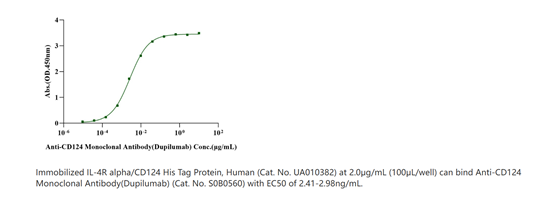
IL-4R target protein serves as an important experimental tool for IL-4R target research. The IL-4R alpha/CD124 His Tag Protein, Human launched by UA Bio provides high-quality experimental materials for related drug development and mechanism studies.
Partial Data Sharing:
IL-4R alpha/CD124 His Tag Protein, Human
Product Code: UA010382

This article is reviewed and published by the technical expert team of UA
Disclaimer: This article partially utilizes artificial intelligence assistance in its creation. If any content involves copyright or intellectual property issues, please let us know and we promise to verify and remove it as soon as possible.
Purchase recombinant protein, choose Nanjing UA-Bio
UA protein focuses on providing various protein reagents, raw materials, and services required for drug research and development, cell therapy, gene therapy, and basic scientific research, including drug target proteins, immune checkpoint proteins, cytokines, tool enzymes, customized protein expression, and full-length transmembrane protein development. Youai is committed to providing customers with high-quality products and professional services, and building a High-tech Biological Enterprise with International Competitiveness.







 Business license (three certificates in one)