




Still struggling with Th2 cell polarization efficiency? UA Biotechnology's "one-stop" reagent kit has the perfect solution for you!


Th2 cells are the core coordinators specifically responsible for the humoral immune response, and they are characterized by secreting cytokines such as IL-4, IL-5, and IL-13. They act as the "chief engineers" of allergic immunity; by precisely regulating antibody class switching and eosinophil responses, they establish a defense network against parasitic infections, while also serving as key driving forces behind allergic diseases.
- Recent Advances
- Product Information
In the sophisticated regulatory network of adaptive immunity, T helper 2 (Th2) cells, another crucial subset of CD4+ T cells, orchestrate the defense against extracellular parasites and are central regulators of allergic diseases. Mastering in vitro Th2 cell polarization technology is essential, whether for researching allergic conditions like asthma and atopic dermatitis, exploring anti-parasitic immune mechanisms, or developing novel immunotherapies!
Part 1: Theoretical Foundation – The Identity File of Th2 Cells
What are Th2 cells?
Th2 cells are specialized core coordinators of the humoral immune response, characteristically secreting cytokines such as IL-4, IL-5, and IL-13. They are the "Chief Engineers" of allergic immunity, establishing a defense network against parasitic infections through the precise regulation of antibody class switching and eosinophil responses. Simultaneously, they serve as key drivers of allergic diseases.
Why perform in vitro Th2 polarization?
-
Mechanistic Decoding: Delve into the core role of the IL-4/STAT6 signaling pathway in Th2 differentiation.
-
Disease Modeling: Obtain functional Th2 cells for constructing models of allergic diseases such as asthma and atopic dermatitis.
-
Therapy Development: Provide an experimental basis for targeted therapies for allergic diseases and immunomodulatory strategies.
Part 2: Core Arsenal – Comprehensive Analysis of Polarizing Factors
The molecular mechanisms of Th2 differentiation have been well-elucidated, and its polarization conditions are based on the precise regulation of key signaling pathways.
"Classic Dual Signal" Pathways:
-
TCR Activation Signal: Provided by anti-CD3/CD28 antibodies, delivering the essential first signal for T cell activation.
-
IL-4/STAT6 Core Pathway: IL-4 induces the expression of the key transcription factor GATA3 by activating STAT6; this is the decisive signal for Th2 differentiation.
Reinforcement Signal Combinations:
-
IL-2 Synergistic Effect: Acts as a T cell growth factor, enhancing cell proliferation and differentiation efficiency.
-
Antibody Blocking Strategy: Use anti-IFN-γ and anti-IL-12 antibodies to eliminate Th1 differentiation interference and ensure polarization purity.
Part 3: Practical Operation – Human Th2 Polarization Protocol
1. Cell Culture
-
Coat a 96-well cell culture plate overnight with 5 µg/ml anti-human CD3 mAb.
-
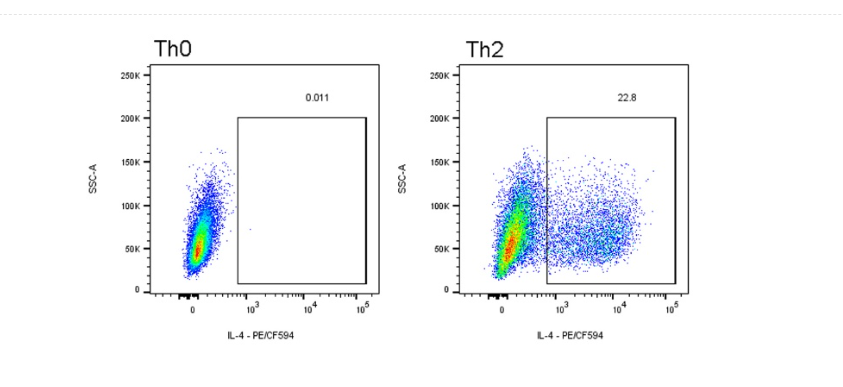
The next day, after washing and blocking the plate, add CD4+ T cells sorted using CD4 Nanobeads, human (SOB5740). Use RPMI-1640 medium supplemented with 200 U/mL IL-2, 30 ng/ml IL-4, 10 µg/mL Anti-Human IFN-γ, 55 µM β-mercaptoethanol, 1 µg/ml anti-human CD28 mAb, and 10% FBS for culture.
-
Starting at 48 hours, monitor cell concentration every 12 hours. If the cell density is high, split the cells into new wells and add the above culture medium for stimulation (without adding CD3 and CD28 antibodies for re-stimulation).
-
After 5 days of culture, collect the cells, adjust the density to 10⁶/ml, and treat with 10 ng/ml PMA, 1 µg/ml Ionomycin, and 10 µg/ml Brefeldin A for 5 hours.
Negative Control Group (Th0 cells):
-
Coat a 96-well cell culture plate overnight with 5 µg/ml anti-human CD3 mAb.
-
The next day, after washing and blocking the plate, add sorted CD4+ T cells. Use RPMI-1640 medium supplemented with 10% FBS, 55 µM β-mercaptoethanol, 10 µg/mL Anti-human IL-4, 10 µg/mL Anti-Human IFN-γ, 200 U/ml IL-2, and 1 µg/ml anti-human CD28 mAb for culture.
-
Starting at 48 hours, monitor cell concentration every 12 hours. If the cell density is high, split the cells into new wells and add the above culture medium (without adding CD3 and CD28 antibodies for re-stimulation). Culture for 5 days.
2. Flow Cytometry Analysis
-
After collecting the cells, stain with flow cytometry antibodies and run on the flow cytometer.
-
Suggested Antibody: 500831 PE/Dazzle™ 594 anti-human IL-4 Antibody
-
Reference Kit: Th2 Polarization Kit, Human (UA090018) - UA BIOSCIENCE Official Website
Disclaimer: The protocols provided in this article are general reference guides. Specific experimental conditions should be optimized based on your own experimental system.
This article is reviewed and published by the technical expert team of UA
Disclaimer: This article partially utilizes artificial intelligence assistance in its creation. If any content involves copyright or intellectual property issues, please let us know and we promise to verify and remove it as soon as possible.
Purchase recombinant protein, choose Nanjing UA-Bio
UA protein focuses on providing various protein reagents, raw materials, and services required for drug research and development, cell therapy, gene therapy, and basic scientific research, including drug target proteins, immune checkpoint proteins, cytokines, tool enzymes, customized protein expression, and full-length transmembrane protein development. Youai is committed to providing customers with high-quality products and professional services, and building a High-tech Biological Enterprise with International Competitiveness.







 Business license (three certificates in one)