

The Enlightenment of Site-Specific Modification Technology on the Development of Total IgG Detection Kits


The quantitative detection of total immunoglobulin G (Total IgG) is a key indicator for assessing humoral immune function, diagnosing immune-related diseases, and monitoring treatment efficacy.
- Recent Advances
- Product Information
I. Research Background
The quantitative detection of total immunoglobulin G (Total IgG) is a critical indicator for evaluating humoral immune function, diagnosing immune-related diseases, and monitoring treatment efficacy. Commercial total IgG detection kits, represented by Assay Pro, rely heavily on the high-specificity recognition and capture of IgG molecules. However, traditional antibody functionalization methods (such as random lysine conjugation) often result in product heterogeneity due to uneven modification sites, which may affect the batch-to-b consistency, sensitivity, and specificity of detection reagents.
In this context, the development of chemical methods that can mimic enzymatic post-translational modifications and achieve site-selective functionalization of IgG molecules is of great significance for improving the quality and performance of total IgG detection kits. A recent study published in JACS successfully developed a site-selective lysine acetylation technology targeting Lys 248 in the Fc region of human IgG, providing an innovative strategy for highly homogeneous and specific antibody functionalization.
II. Technical Core: Peptide-Guided Proximity-Driven Acetylation Strategy
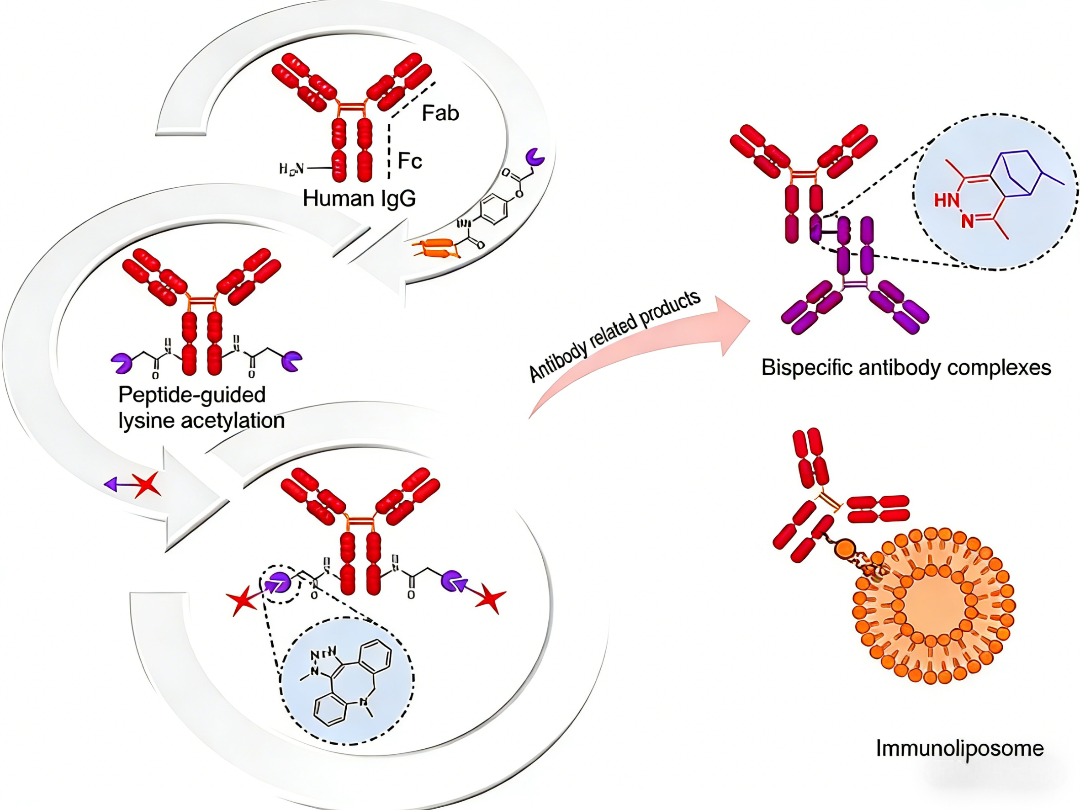
The core of this technology lies in the use of an Fc-III peptide with high affinity for the IgG Fc hinge region as a guiding carrier. Through rational design, a functionalized amino acid carrying an active phenyl ester group is introduced into this peptide. When the functionalized peptide binds to the IgG Fc region, it can precisely deliver the active group to the spatially adjacent specific lysine residue (Lys 248), thereby driving a highly selective acetylation reaction. This strategy requires no additional catalyst, operates under mild conditions, and the rapid hydrolysis of the active phenyl ester under physiological conditions effectively avoids non-specific modifications, ensuring product homogeneity.
III. Methodological Validation and Potential Value in Diagnostic Development
1. High Specificity and Efficiency: This acetylation reaction exhibits remarkable site selectivity for Lys 248 in the IgG Fc region. Mass spectrometry analysis confirms that only the heavy chain undergoes the expected molecular weight increase after modification, with a modification efficiency of up to 80% within 1 hour, without affecting the antigen-binding capacity of the antibody Fab region. This highly selective modification is expected to be used in the development of more homogeneous capture or labeled antibodies for detection, thereby improving the accuracy and stability of total IgG detection kits.
2. Excellent Reaction Kinetics and Adaptability: The reaction can achieve 50% completion within 30 minutes at 37°C and pH 7.4 in PBS buffer, and can proceed stably in different buffer systems and in the presence of free amines, demonstrating good robustness. This characteristic facilitates the development and scale-up of antibody labeling or immobilization processes based on this technology.
IV. Application Expansion: Examples of Functionalized Reagent Construction
The study further demonstrates the potential of site-selective modification technology in constructing advanced functionalized reagents, which provides inspiration for the development of next-generation detection technologies:
1. Construction of Immunoliposomes: By conjugating site-specifically modified antibodies with lipid molecules (DSPE-PEG2000), the study successfully constructed immunoliposomes targeting HER2-positive cells. This provides a feasible technical route for the development of functionalized nanocarriers for targeted detection or drug delivery.
2. Construction of Bispecific Antibody Complexes: Using this acetylation technology, researchers successfully covalently linked two different therapeutic antibodies (such as anti-HER2 and anti-CD3 antibodies) via "click chemistry" to construct structurally defined bispecific antibody complexes. This strategy can inspire the development of bispecific or multispecific recognition elements for multiplex detection, enhancing the detection capability for specific IgG subclasses or antigens in complex samples.
V. Summary and Outlook
The site-selective lysine acetylation method for IgG established in this study achieves precise chemical manipulation of human IgG, the core molecule of total IgG detection. The highly homogeneous and functionally well-defined antibody derivatives produced by this technology provide new possibilities for the development of superior total IgG detection kits (such as Assay Pro) and related diagnostic tools. By leveraging such cutting-edge protein engineering strategies, it is expected to drive comprehensive improvements in the sensitivity, specificity, stability, and batch-to-batch consistency of immunoassay reagents, thereby better serving the needs of precision medicine and clinical diagnostics.
VI. Which Manufacturers Provide Total IgG Kits (Assay Pro)?
Nanjing Uni-Ab Bio offers the Human Total IgG Kit (Assay Pro) (Catalog No.: UA085005), a high-performance detection kit developed based on the double-antibody sandwich method, specifically designed for the accurate and sensitive quantitative detection of human total immunoglobulin G (IgG) levels. This kit is suitable for immunological basic research, biomonitoring, auxiliary diagnosis of autoimmune diseases, and IgG concentration detection in antibody drug development, providing you with stable and reliable standardized detection tools.
Core Product Advantages:
| Advantage | Detailed Description |
|---|---|
| High Sensitivity and Wide Detection Range | Utilizes high-affinity paired antibodies to achieve high-sensitivity detection of total IgG, with a broad quantitative linear range, enabling precise measurement of samples from trace to high concentrations. |
| Excellent Specificity and Comprehensive Recognition | Carefully selected broad-spectrum antibodies recognize all IgG subclasses (IgG1, IgG2, IgG3, IgG4), ensuring complete coverage of human total IgG while minimizing non-specific cross-reactions with other immunoglobulins and serum proteins. |
| Ready-to-Use Pre-Coated Design | Provides 96-well plates pre-coated with capture antibodies, simplifying operational steps and saving experimental preparation time. The complete optimized buffer system, standards, and detection reagents enable a rapid and stable detection process. |
| Outstanding Stability and Batch-to-Batch Consistency | Through strict production processes and quality management systems, the kit components exhibit excellent long-term stability and batch-to-batch consistency, ensuring the reproducibility and comparability of experimental results. |
| Complete Solutions and Professional Support | We provide detailed operation manuals, standard curve examples, and data analysis guidelines, as well as application recommendations and technical support for different sample types (such as serum, plasma, cell culture supernatant, or purified samples). |
Nanjing Uni-Ab Bio is committed to providing high-quality, high-performance detection products and services for immunological research, diagnostic reagent development, and the biopharmaceutical industry. For detailed technical information, performance parameters, or application consultation regarding the Human Total IgG Kit (Assay Pro) (Catalog No.: UA085005), please feel free to contact us.
This article is reviewed and published by the technical expert team of UA
Disclaimer: This article partially utilizes artificial intelligence assistance in its creation. If any content involves copyright or intellectual property issues, please let us know and we promise to verify and remove it as soon as possible.
Purchase recombinant protein, choose 
UA protein focuses on providing various protein reagents, raw materials, and services required for drug research and development, cell therapy, gene therapy, and basic scientific research, including drug target proteins, immune checkpoint proteins, cytokines, tool enzymes, customized protein expression, and full-length transmembrane protein development. Nanjing Univ is committed to providing customers with high-quality products and professional services, and building a High-tech Biological Enterprise with International Competitiveness.







 Business license (three certificates in one)