




The role of BAFF/APRIL in B cell development and autoimmunity and recombinant protein research tools


B-cell activating factor (BAFF, also known as BLyS) and a proliferation-inducing ligand (APRIL) are important members of the tumor necrosis factor ligand superfamily, playing a central role in the survival, maturation, and functional differentiation of B cells.
- Recent Advances
I. Structure and Function of BAFF/APRIL in B Cell Development Regulation
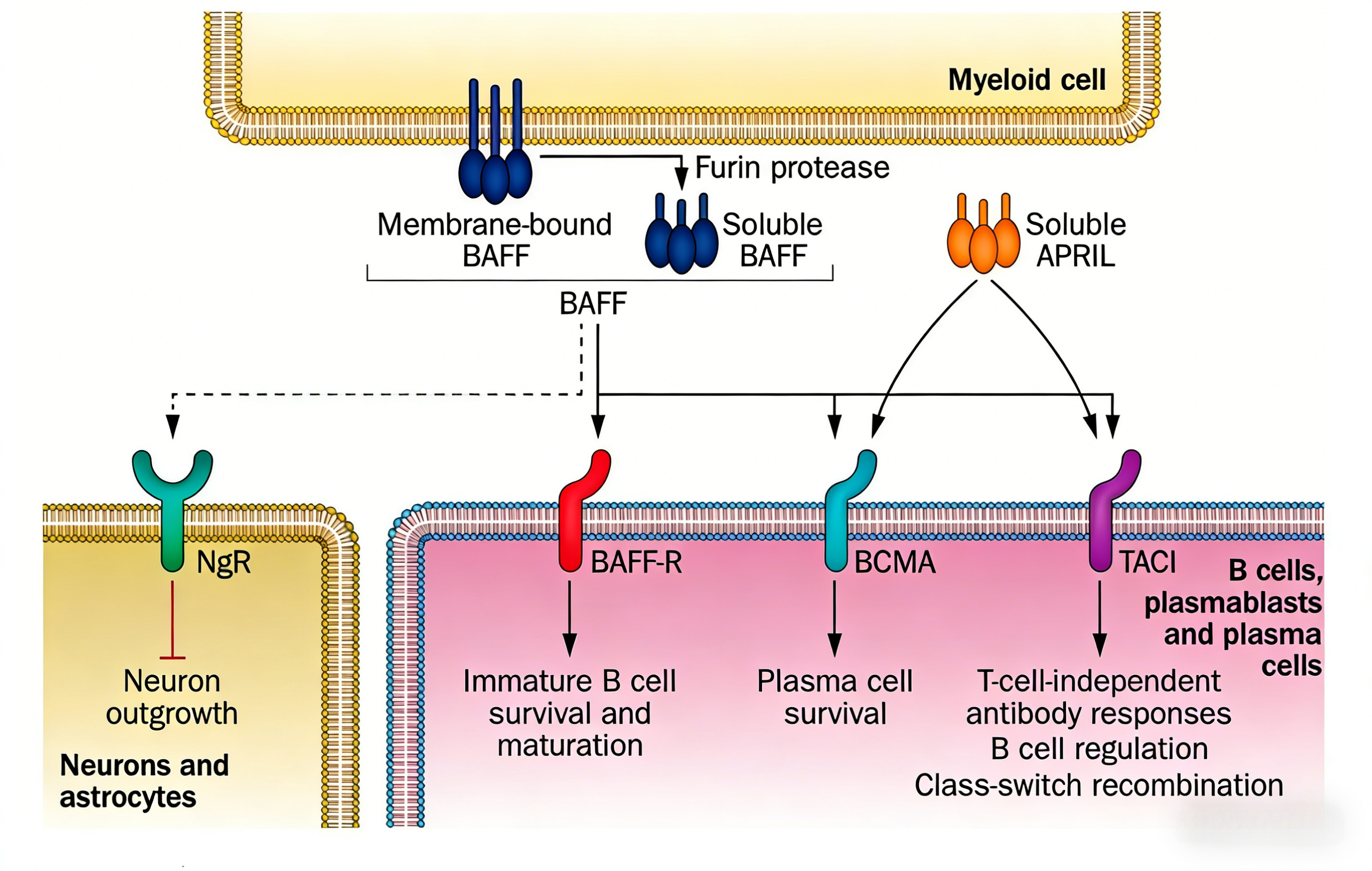
B cell activating factor (BAFF, also known as BLyS) and a proliferation-inducing ligand (APRIL) are important members of the tumor necrosis factor ligand superfamily, playing central roles in B cell survival, maturation, and functional differentiation. BAFF exists as soluble homotrimers or further assembled 60-mers, with the latter exhibiting stronger biological activity. APRIL primarily functions as a trimer. Both share two receptors: transmembrane activator and CAML interactor (TACI) and B cell maturation antigen (BCMA), while BAFF specifically binds to its high-affinity receptor BAFF receptor (BAFFR). These ligand-receptor interactions collectively form a finely regulated signaling network that controls B cell fate.
During B cell development, the differentiation from transitional B cells to mature follicular B cells or marginal zone B cells heavily depends on BAFFR-mediated survival signals. These signals prolong B cell lifespan by stabilizing mitochondrial function and promoting protein synthesis. Particularly in germinal center reactions, BAFF sources (such as follicular helper T cells) are crucial for affinity-based selection of B cell clones after somatic hypermutation, influencing their differentiation into plasma cells or memory B cells.
II. Pathogenic Mechanisms of BAFF/APRIL in Autoimmune Diseases Like Systemic Lupus Erythematosus
In autoimmune diseases such as systemic lupus erythematosus (SLE), dysregulation of the BAFF/APRIL signaling pathway is a core pathological feature. Patients often exhibit significantly elevated BAFF levels, which may result from type I interferon-driven immune activation or impaired clearance of apoptotic cells leading to excessive exposure of autoantigens and activation of innate immunity (e.g., Toll-like receptor signaling). Excessive BAFF transmits survival signals through its receptors (especially BAFFR), enabling the survival, proliferation, and differentiation of autoreactive B cells that would otherwise be eliminated. This leads to excessive production of pathological autoantibodies and drives autoimmune damage. Therefore, targeting the BAFF/APRIL pathway has become an important therapeutic strategy for SLE and related diseases.
III. Research Tool: BAFF&APRIL Heterotrimer His Tag Protein
To deeply investigate the complex biological functions of BAFF/APRIL, receptor interaction mechanisms, and develop related therapies, high-quality and standardized recombinant protein tools are indispensable. The BAFF&APRIL Heterotrimer His Tag Protein, as a meticulously designed recombinant protein complex, offers unique research value:
1. Mimics Native Active Conformation: This protein exists as a heterotrimer, more accurately simulating the potential complex states of BAFF and/or APRIL in vivo, providing an ideal molecular tool for studying their synergistic or competitive effects.
2. High Purity and Convenient Handling: The fused His tag enables efficient, high-purity purification via metal chelate chromatography, ensuring accuracy and reproducibility of experimental results.
3. Key Applications:
- Receptor Binding and Competition Studies: Used to analyze the binding affinity and specificity of the heterotrimer with BAFFR, TACI, and BCMA receptors, or to evaluate the blocking efficacy of therapeutic antibodies (e.g., BAFF-targeting monoclonal antibodies) on these interactions.
- In Vitro B Cell Functional Studies: In cell culture systems, used to stimulate B cells at different developmental stages to study their effects on cell survival, proliferation, differentiation, and antibody class switching, with comparisons to the effects of single ligands.
- Signaling Pathway Mechanism Analysis: Used to investigate the efficiency and kinetic characteristics of the heterotrimer in activating downstream non-canonical NF-κB2 pathways (dependent on NIK stabilization and p100 processing to p52) and other related signaling pathways.
- Drug Screening and Evaluation Platform: Serves as a standard antigen for screening and evaluating novel inhibitors, antibodies, or decoy receptors targeting the BAFF/APRIL pathway.
IV. Therapeutic Strategies Targeting the BAFF/APRIL Pathway and Future Perspectives
Based on the understanding of the critical role of the BAFF/APRIL pathway in autoimmune diseases, biologics targeting this pathway have been successfully applied in clinical practice. For example, belimumab, a humanized monoclonal antibody, specifically binds soluble BAFF trimers and prevents their assembly into more active 60-mers, thereby blocking BAFF-receptor interactions and effectively reducing disease activity in SLE patients. Structural biology studies of its mechanism clearly reveal how the antibody neutralizes BAFF by occupying its receptor-binding sites and interfering with trimer interactions.
Future research on the functions of BAFF/APRIL heterotrimers and other complex forms, along with a deeper understanding of the fine regulation of receptors like TACI and BCMA, may lead to the development of more selective and effective next-generation therapies. The BAFF&APRIL Heterotrimer His Tag Protein, as a core tool for studying these complex interactions, will continue to advance progress from basic research to clinical translation, offering more possibilities for precision medicine in autoimmune diseases, B cell lymphomas, and other conditions.
V. Which Manufacturers Provide BAFF&APRIL Heterotrimer His Tag Protein?
Nanjing YouAi Protein has independently developed the BAFF&APRIL Heterotrimer His Tag Protein, Human (Catalog No.: UA011338), a high-purity, high-activity human BAFF-APRIL heterotrimer complex recombinant protein. This product is formed by co-expressing and purifying BAFF (TNFSF13B) and APRIL (TNFSF13) proteins, resulting in a functional complex with native conformation and physiological activity, and includes a C-terminal His tag for easy purification and detection. This heterotrimer is a key signaling form in the B cell activating factor system, essential for studying B cell homeostasis, autoimmune diseases, tumor immunology, and antibody drug development.
| Core Advantages of the Product |
|---|
| Native Heterotrimer Complex: This product is not a simple monomer or homomultimer but a heterotrimer formed non-covalently by BAFF and APRIL molecules. This structure mimics the natural active form in vivo, and its binding characteristics and signaling capabilities with receptors (e.g., BCMA, TACI) differ from those of BAFF or APRIL homotrimers, more accurately reflecting the complex physiological signaling environment. |
| High Purity and Intact Biological Activity: Produced using a mammalian expression system for co-expression and co-purification, the heterotrimer complex is obtained through multiple chromatography steps (including affinity chromatography and size-exclusion chromatography) with high purity (>95%) and consistent component ratios. Cell activity validation confirms its efficient activation of downstream signaling pathways. |
| His Tag for Convenient Handling: The C-terminal His tag supports efficient affinity purification via nickel columns and can be used for His tag-based detection or immobilization, facilitating subsequent functional and interaction studies. |
| Excellent Stability and Batch-to-Batch Consistency: The strictly controlled co-expression and co-purification process ensures consistent assembly ratios and activity of BAFF and APRIL across different batches, providing reliable support for long-term and continuous research. |
| Clear and Critical Research Applications: |
| - Mechanistic Studies: Used for precise analysis of the specific binding affinity (KD) and signaling characteristics of the BAFF-APRIL heterotrimer with receptors BCMA/TACI. |
| - Drug Development: As a key target protein, used to screen and evaluate therapeutic antibodies (e.g., bispecific antibodies) or small-molecule inhibitors that can block the heterotrimer-receptor interaction, which is particularly important in drug development for multiple myeloma and autoimmune diseases. |
| - Functional Analysis: Used to study its unique regulatory effects on B cell survival, proliferation, antibody class switching, and other functions. |
Nanjing YouAi Protein is committed to providing structurally precise and functionally defined high-end protein tools for immunology, B cell-related diseases, and innovative drug development. For detailed technical parameters (such as SEC profiles confirming trimer status), binding activity data, or specific drug screening protocols related to the BAFF&APRIL Heterotrimer His Tag Protein, Human (Catalog No.: UA011338), please feel free to contact us.
Disclaimer: This article partially utilizes artificial intelligence assistance in its creation. If any content involves copyright or intellectual property issues, please let us know and we promise to verify and remove it as soon as possible.
Purchase recombinant protein, choose Nanjing UA-Bio
UA protein focuses on providing various protein reagents, raw materials, and services required for drug research and development, cell therapy, gene therapy, and basic scientific research, including drug target proteins, immune checkpoint proteins, cytokines, tool enzymes, customized protein expression, and full-length transmembrane protein development. Youai is committed to providing customers with high-quality products and professional services, and building a High-tech Biological Enterprise with International Competitiveness.







 Business license (three certificates in one)