




A case report and mechanism exploration of co-mutation of KRAS G13D and Q61H in colorectal cancer


Colorectal cancer is the second most common malignant tumor globally and the fourth leading cause of cancer-related deaths.
- Recent Advances
I. Introduction
Colorectal cancer (CRC) is the second most common malignancy globally and the fourth leading cause of cancer-related deaths. Epidemiological statistics indicate approximately 1.2 million new CRC cases annually worldwide, with disease burden showing a sustained upward trend. By 2040, new cases are projected to increase to 3.2 million, with 1.6 million deaths. Advances in molecular pathology have highlighted the role of driver gene mutations in CRC pathogenesis. Among these, KRAS—the most frequently mutated oncogene—has become a critical molecular biomarker for guiding clinical decisions and prognostic evaluation.
KRAS mutations occur in ~40% of CRC cases, exhibiting significant diversity (e.g., G12C, G12D, G12V, G13D). Different subtypes variably impact tumor biology and treatment sensitivity. Studies suggest KRAS codon 13 (G13) mutations correlate with higher mortality risk, whereas codon 12 (G12) mutations, though prognostic, exert less severe effects. Thus, precise identification of KRAS mutation subtypes is essential for optimizing personalized therapy.
II. Case Report
A 72-year-old male presented with hematochezia and altered bowel habits. Colonoscopy revealed an 8 cm anal-rectal mass, pathologically confirmed as adenocarcinoma. Molecular profiling was performed to guide treatment.
Amplification-refractory mutation system PCR (ARMS-PCR) initially detected KRAS abnormalities. Subsequent next-generation sequencing (NGS) identified two exon mutations: Q61H (Exon 3, 21.09% variant allele frequency [VAF]) and G13D (Exon 2, 6.06% VAF). MET copy number gain (5.65) was also observed. No pathogenic mutations were detected in EGFR, BRAF, NRAS, or PIK3CA.
III. Discussion
(1) Rarity and Clinical Implications of KRAS Dual-Exon Co-Mutations
KRAS mutations are typically mutually exclusive; co-occurrence in multiple exons is exceptionally rare. Few reports describe concurrent Exon 2 (G13D) and Exon 3 (Q61H) mutations. This case provides novel evidence of CRC molecular heterogeneity.
The higher VAF of Q61H (21.09% vs. G13D’s 6.06%) suggests it as the primary driver, with G13D potentially being a subclonal or passenger mutation. Co-existence may synergistically enhance tumor proliferation, survival, and metastatic potential. MET amplification may further exacerbate malignant phenotypes via bypass activation.
(2) Dual Mutations and Anti-EGFR Therapy Resistance
KRAS mutations predict resistance to anti-EGFR monoclonal antibodies (e.g., cetuximab/panitumumab). While G13D was initially hypothesized to retain sensitivity, large-scale studies refuted this; current guidelines classify it as resistance-conferring.
Q61H disrupts switch-II region GTP hydrolysis, locking KRAS in GTP-bound active state. Co-existing G13D and Q61H may synergistically hyperactivate KRAS signaling, compounding intrinsic resistance. MET amplification could further drive acquired resistance via PI3K/AKT bypass.
IV. Application of KRAS G13D & cRAF Binding Assay Kits
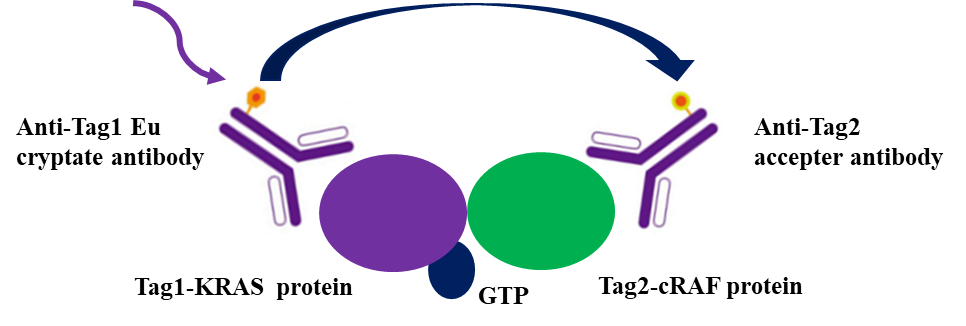
The Human KRAS G13D & cRAF Binding Kit (HTRF-based) quantifies mutant KRAS G13D’s interaction with cRAF, enabling functional validation, compound screening, and mechanistic studies of co-mutations. For this case, comparative analysis of G13D/Q61H single vs. dual mutants could elucidate synergistic mechanisms.
V. Manufacturers Offering KRAS G13D & cRAF Binding Kits
Nanjing UA-Bio’s UniOne® TR-FRET Human KRAS G13D & cRAF Binding Kit is a high-performance platform for studying KRAS G13D-cRAF interactions. Utilizing time-resolved FRET (TR-FRET), it enables precise evaluation of binding kinetics for drug discovery and mechanistic research.
| Key Advantages |
|---|
| High Purity & Bioactivity: Components are rigorously validated for native conformation and functional integrity, ensuring physiologically relevant data. |
| Batch Consistency & Stability: Standardized production and QC guarantee reliability for long-term studies. |
| Ready-to-Use HTS Platform: Homogeneous TR-FRET format enables "mix-read" workflows in 96/384-well plates for screening and affinity assays. |
| Comprehensive Support: Includes optimized protocols, reference curves, and expert technical consultation. |
UA-Bio specializes in cutting-edge reagents for immunology and drug development. For details on UniOne® TR-FRET Human KRAS G13D & cRAF Binding Kit (Cat# UA086031), contact our team.
This article is reviewed and published by the technical expert team of UA
Disclaimer: This article partially utilizes artificial intelligence assistance in its creation. If any content involves copyright or intellectual property issues, please let us know and we promise to verify and remove it as soon as possible.
Purchase recombinant protein, choose Nanjing UA-Bio
UA protein focuses on providing various protein reagents, raw materials, and services required for drug research and development, cell therapy, gene therapy, and basic scientific research, including drug target proteins, immune checkpoint proteins, cytokines, tool enzymes, customized protein expression, and full-length transmembrane protein development. Youai is committed to providing customers with high-quality products and professional services, and building a High-tech Biological Enterprise with International Competitiveness.







 Business license (three certificates in one)