




Research Progress of PCSK9 Inhibitors in the Prevention and Treatment of Ischemic Stroke


Proprotein convertase subtilisin/kexin type 9, as a key molecule regulating cholesterol metabolism, has garnered significant attention in recent years.
- Recent Advances
- Product Information
I. Introduction
Proprotein convertase subtilisin/kexin type 9 (PCSK9), as a key molecule regulating cholesterol metabolism, has garnered widespread attention in recent years. With the increasing clinical application of PCSK9 inhibitors, their value in the prevention and treatment of atherosclerotic cardiovascular diseases has been well established. Emerging research indicates that PCSK9 not only influences the progression of atherosclerosis through lipid metabolism regulation but also directly participates in pathological processes such as platelet activation, thrombosis, and vascular aging. These findings provide a theoretical basis for extending PCSK9 inhibitors to the treatment of ischemic stroke. This article systematically elucidates the molecular mechanisms by which PCSK9 increases the risk of ischemic stroke and evaluates the efficacy and safety of PCSK9 inhibitors in treating ischemic stroke based on clinical research evidence.
II. Biological Functions of PCSK9 and Mechanisms of Ischemic Stroke Risk
(1) Role of PCSK9 in Lipid Metabolism Regulation
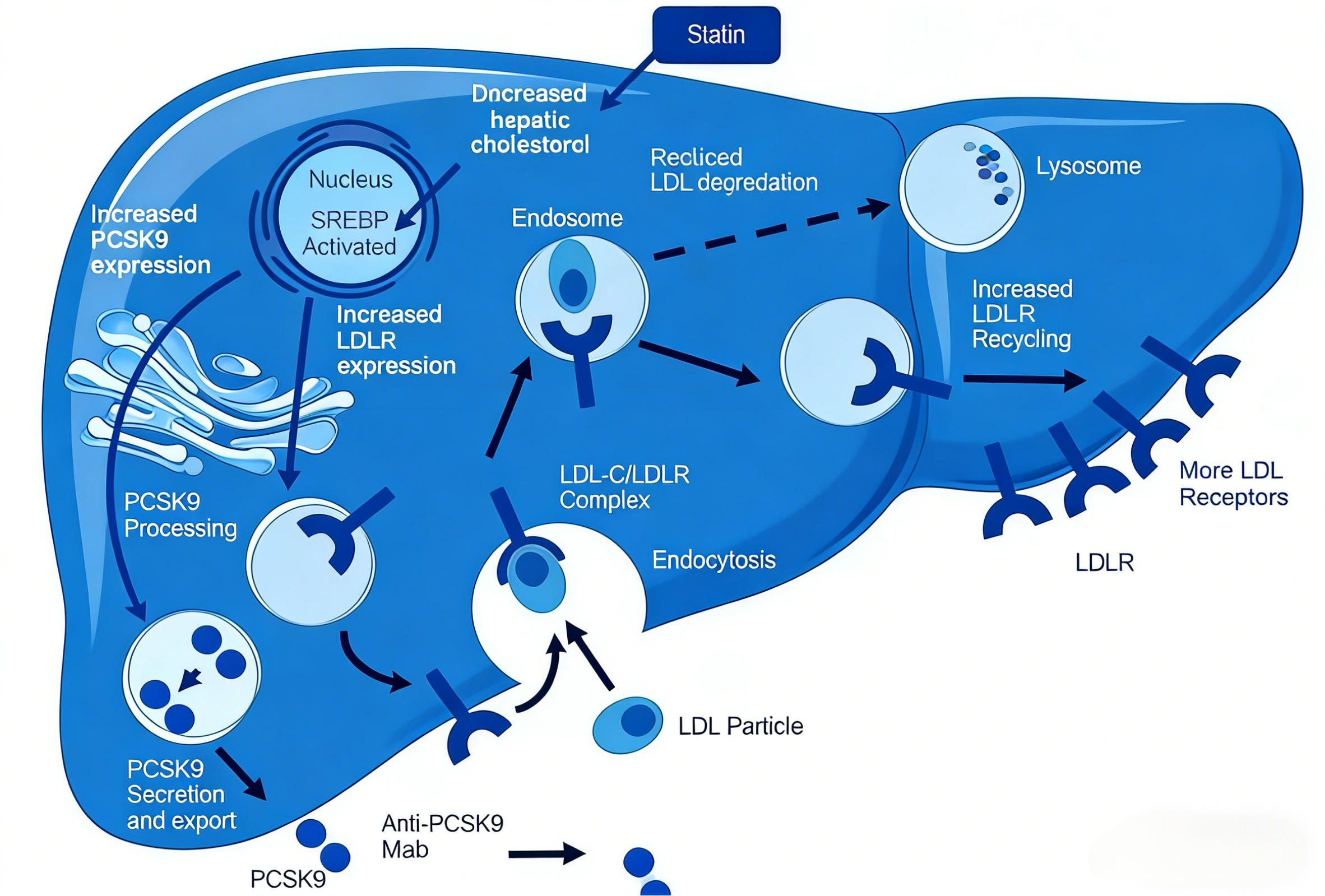
PCSK9 is primarily synthesized and secreted by hepatocytes and serves as a key regulator of cholesterol homeostasis. Its core function involves binding to the low-density lipoprotein receptor (LDLR) on the surface of hepatocytes, forming a PCSK9/LDLR complex that internalizes into the cell and undergoes lysosomal degradation. This process reduces the number of LDLRs on the hepatocyte surface, weakening the liver's ability to clear plasma LDL-C and ultimately leading to elevated circulating LDL-C levels. Beyond LDLR, PCSK9 can also promote the degradation of low-density lipoprotein receptor-related protein 1 (LRP1), very-low-density lipoprotein receptor (VLDLR), and apolipoprotein E receptor 2 (ApoER2). Through apolipoprotein E (ApoE) and related pathways, PCSK9 affects hepatic lipid synthesis and secretion, participating in lipid metabolism regulation at multiple levels.
(2) Role of PCSK9 in Atherosclerosis
Atherosclerosis is the primary pathological basis of ischemic stroke. PCSK9 promotes the initiation and progression of atherosclerosis through various mechanisms. On one hand, PCSK9 elevates plasma LDL-C levels, increasing lipid deposition in arterial walls. On the other hand, PCSK9 directly acts on vascular wall cells, inducing endothelial cell apoptosis via the JNK/p38 MAPK signaling pathway and exacerbating oxidized low-density lipoprotein (ox-LDL)-mediated endothelial injury. In the microenvironment of atherosclerotic plaques, ApoE secreted by macrophages and smooth muscle cells binds to ApoER2, exerting protective effects such as anti-inflammatory and anti-foam cell formation. PCSK9 downregulates ApoER2 expression, weakening this protective mechanism and further promoting plaque progression and instability.
(3) Role of PCSK9 in Platelet Activation and Thrombosis
Thromboembolism is the most common direct cause of ischemic stroke. PCSK9, as an independent risk factor for platelet activation, promotes thrombosis through dual mechanisms. First, elevated circulating PCSK9 indirectly activates platelets by reducing lipid clearance. Second, PCSK9 can directly bind to the CD36 receptor on platelet surfaces, triggering platelet activation signals independently of the LDLR pathway, enhancing platelet aggregation, and thereby increasing thrombosis risk.
III. Clinical Research Evidence on PCSK9 Inhibitors
(1) Evidence for Stroke Prevention with PCSK9 Monoclonal Antibodies
Currently, the most widely used PCSK9 inhibitors in clinical practice include fully human monoclonal antibodies (such as evolocumab and alirocumab). The large-scale randomized controlled FOURIER trial enrolled 27,564 patients with atherosclerotic cardiovascular disease. After a median follow-up of 2.2 years, PCSK9 inhibitor treatment reduced the risk of major adverse cardiovascular events (MACE) by 15%, with a 20% reduction in ischemic stroke risk. The ODYSSEY OUTCOMES trial included 18,924 patients with acute coronary syndrome. Subgroup analysis focusing on patients with a history of ischemic stroke showed that PCSK9 inhibitor treatment for 78 weeks significantly reduced the risk of recurrent ischemic stroke without increasing the risk of hemorrhagic stroke, providing direct evidence for secondary prevention.
(2) Impact of PCSK9 Inhibitors on Atherosclerotic Plaques
Beyond reducing clinical events, PCSK9 inhibitors can directly improve the morphology and stability of atherosclerotic plaques. Imaging studies indicate that PCSK9 inhibitors combined with statin therapy increase early fibrous cap thickness, reduce lipid-rich necrotic cores, and promote plaque transition to a stable phenotype. The GLAGOV study used intravascular ultrasound (IVUS) to assess coronary atherosclerotic burden. Results showed that after 76 weeks of combined statin and PCSK9 inhibitor treatment, 64% of patients achieved atherosclerotic plaque regression, providing imaging-level support for the anti-atherosclerotic effects of PCSK9 inhibitors.
(3) Current Research Status of Small Interfering RNA Drugs
Small interfering RNA (siRNA) drugs targeting PCSK9 (such as inclisiran) achieve long-term lipid-lowering effects by inhibiting PCSK9 protein synthesis. Preclinical studies show that these drugs can prevent or delay atherosclerotic plaque formation. However, there is currently a lack of clinical research data directly evaluating their use in ischemic stroke prevention and treatment, warranting further exploration in this field.
IV. Technical Tools for Detecting PCSK9-LDLR Interactions
In the development and mechanistic research of PCSK9-targeted drugs, accurately assessing the interaction between PCSK9 and LDLR is a critical step. The Human PCSK9-LDLR TR-FRET Assay Kit, based on time-resolved fluorescence resonance energy transfer (TR-FRET) technology, provides a standardized platform for quantitatively detecting PCSK9-LDLR binding activity. This kit uses PCSK9 and LDLR proteins labeled with donor and acceptor fluorophores, respectively. When the two specifically bind, energy transfer occurs, generating quantifiable fluorescence signals. This technology offers high sensitivity, simple operation, and suitability for high-throughput screening, making it useful for active screening of PCSK9 inhibitor candidates, mechanism validation, and selectivity evaluation, providing an important tool for the development of novel PCSK9-targeted drugs.
V. Which Manufacturers Provide the Human PCSK9-LDLR TR-FRET Assay Kit?
Nanjing UA-Bio Technology Co., Ltd. (UA-Bio) has independently developed the "UniOne® TR-FRET Human PCSK9-LDLR Assay Kit", a high-performance analysis platform specifically designed for studying the interaction between proprotein convertase subtilisin/kexin type 9 (PCSK9) and low-density lipoprotein receptor (LDLR). This kit, based on time-resolved fluorescence resonance energy transfer (TR-FRET) technology, aims to accurately and efficiently assess the binding activity of human PCSK9 protein and LDLR, providing a stable and reliable standardized solution for cardiovascular disease drug development, PCSK9 inhibitor screening, and cholesterol metabolism mechanism research.
| Core Product Advantages |
|---|
| High Purity and Intact Biological Activity: The core components of the kit utilize high-purity, high-biological-activity human PCSK9 and LDLR proteins validated through multidimensional quality control. Both proteins maintain correct native conformations and intact binding functions, accurately simulating the specific interaction between PCSK9 and LDLR under physiological conditions, ensuring experimental data accuracy, reproducibility, and functional relevance. |
| Exceptional Batch-to-Batch Consistency and Stability: Leveraging an internationally leading recombinant protein expression platform and highly standardized purification processes, combined with a rigorous quality control release system, the product exhibits outstanding long-term stability and excellent batch-to-batch consistency, providing solid and reliable quality assurance for long-term, continuous drug screening and mechanism research. |
| Ready-to-Use Flexible Experimental Platform: This kit, based on homogeneous TR-FRET technology, employs a simple "add-incubate-read" operation mode without cumbersome washing steps. Its optimized formulation system is compatible with multi-well plate (96/384-well) automation platforms, flexibly applicable to various research needs such as high-throughput screening of PCSK9 inhibitors, affinity determination, competitive binding assays, and biosimilar drug activity analysis. |
| Comprehensive Solutions and Professional Support: We provide fully validated standard experimental protocols, typical dose-response curves, and detailed result interpretation guides to help you quickly establish stable and reproducible experimental workflows. Nanjing UA-Bio's professional technical team offers comprehensive technical consultation and support for your research design, experimental optimization, and data analysis. |
Nanjing UA-Bio Technology Co., Ltd. remains committed to providing cutting-edge, high-quality core reagents and tools for immunology, cell therapy, and innovative drug development. For detailed technical parameters, validation data, or specific application inquiries regarding the "UniOne® TR-FRET Human PCSK9-LDLR Assay Kit" (Catalog No.: UA086058), please feel free to contact us.
This article is reviewed and published by the technical expert team of UA
Disclaimer: This article partially utilizes artificial intelligence assistance in its creation. If any content involves copyright or intellectual property issues, please let us know and we promise to verify and remove it as soon as possible.
Purchase recombinant protein, choose Nanjing UA-Bio
UA protein focuses on providing various protein reagents, raw materials, and services required for drug research and development, cell therapy, gene therapy, and basic scientific research, including drug target proteins, immune checkpoint proteins, cytokines, tool enzymes, customized protein expression, and full-length transmembrane protein development. Youai is committed to providing customers with high-quality products and professional services, and building a High-tech Biological Enterprise with International Competitiveness.







 Business license (three certificates in one)