




Research progress on direct KRAS G12D inhibitors


Pancreatic ductal adenocarcinoma, known as the "king of cancers," is notorious for its high malignancy and extremely poor prognosis. The KRAS gene mutation occurs in up to 93% of pancreatic cancer cases, with KRAS G12D being the most common mutation subtype.
- Recent Advances
I. Introduction
Pancreatic ductal adenocarcinoma (PDAC), known as the "king of cancers," is characterized by its high malignancy and extremely poor prognosis. KRAS gene mutations occur in up to 93% of pancreatic cancer cases, with KRAS G12D being the most common mutation subtype, accounting for approximately 42% of all KRAS mutations. Despite the urgent clinical need for targeting KRAS G12D mutations, no targeted drugs for this specific subtype have been approved for market use. In recent years, with a deeper understanding of KRAS protein structure and function, as well as advancements in drug chemistry technologies, significant breakthroughs have been made in the development of small-molecule inhibitors directly targeting KRAS G12D, making it a hotspot in the field of precision cancer therapy.
II. Overview of KRAS G12D-Targeted Therapeutic Strategies
The KRAS protein serves as a critical node in intracellular signal transduction, switching between inactive and active states by binding GDP or GTP under physiological conditions. When the G12D oncogenic mutation occurs, the GTP hydrolysis process of the KRAS protein is impaired, causing it to remain persistently in the GTP-bound activated conformation. This aberrantly activates downstream signaling pathways such as RAF/MEK/ERK and PI3K/AKT/mTOR, driving tumor cell proliferation and survival.
Therapeutic strategies targeting KRAS G12D mutations can be broadly categorized as follows: first, downregulating KRAS G12D gene expression through siRNA interference; second, inhibiting post-translational modifications of the KRAS protein or its downstream effector molecules; and third, developing small-molecule inhibitors that directly target the KRAS G12D protein. Among these, the strategy of directly targeting the KRAS protein has garnered the most attention due to its high specificity.
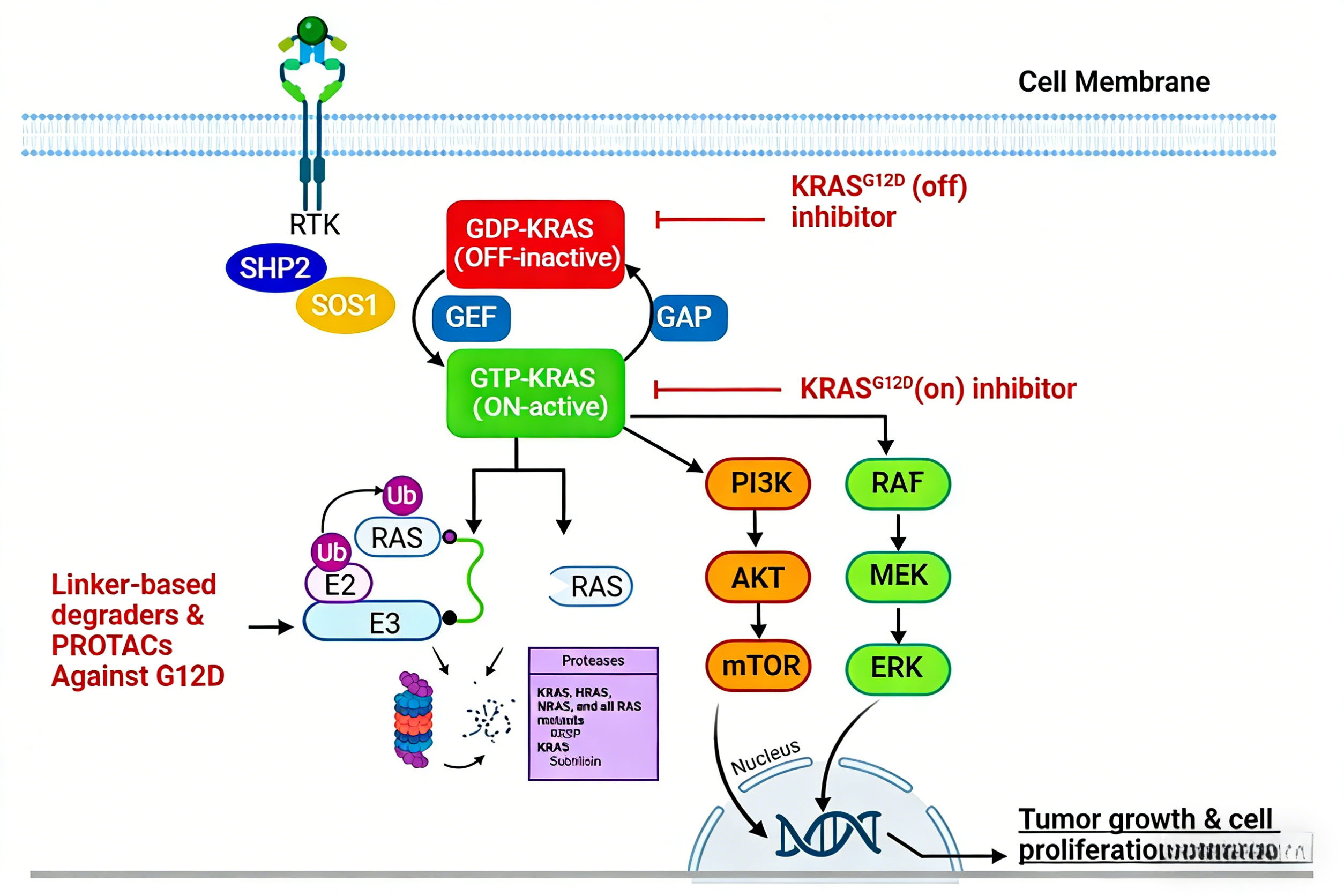
III. Development Strategies for Small-Molecule Inhibitors Directly Targeting KRAS G12D
The development of small-molecule inhibitors directly targeting KRAS G12D primarily revolves around the following directions:
(1) Inhibitors Targeting the Activated State of KRAS G12D
The GTP-bound activated state of the KRAS protein is the functional form for signal transduction. Inhibitors targeting the activated state bind to specific pockets in the activated conformation, blocking its interaction with downstream effector molecules (e.g., cRAF). Such inhibitors include covalent and non-covalent types. Covalent inhibitors form irreversible chemical bonds with the mutated amino acid residues to achieve sustained inhibition, while non-covalent inhibitors function through high-affinity reversible binding.
(2) Inhibitors Targeting the Inactive State of KRAS G12D
The GDP-bound inactive state of the KRAS protein, while not directly transmitting signals, is a critical step in the transition to the activated state. Inhibitors targeting the inactive state lock KRAS in the inactive conformation, preventing its binding to GTP and thereby interrupting signal pathway activation. This strategy has been successfully applied in the development of KRAS G12C inhibitors.
(3) Development of Pan-KRAS Inhibitors
Pan-KRAS inhibitors aim to simultaneously target multiple KRAS mutation subtypes, even covering HRAS and NRAS. These drugs typically act on common functional regions of the KRAS protein but face selectivity challenges.
(4) Development of KRAS Protein Degraders
Proteolysis-targeting chimeras (PROTACs) recruit KRAS protein to E3 ubiquitin ligase complexes (e.g., CRBN, VHL) to achieve ubiquitination and proteasomal degradation. This strategy completely eliminates the oncogenic function of KRAS and is expected to overcome resistance issues that traditional inhibitors struggle to address. Currently, specific degraders for KRAS G12D and broad-spectrum RAS degraders are in preclinical research stages.
IV. Research Progress on KRAS G12D-Targeted Inhibitors
In recent years, several small-molecule inhibitors directly targeting KRAS G12D have entered preclinical or early clinical research stages. Among these, non-covalent small-molecule inhibitors (e.g., MRTX1133) are the most advanced. By binding to specific pockets on the surface of the KRAS G12D protein, these inhibitors selectively inhibit the function of the mutated protein. Preclinical studies show that such inhibitors effectively suppress the proliferation of KRAS G12D-mutated tumor cells and induce significant tumor regression in animal models. Additionally, covalent inhibitors and protein degraders targeting KRAS G12D are rapidly advancing, with some candidate molecules demonstrating promising target activity and selectivity.
V. Application of KRAS G12D & CRBN Binding Kit in Drug Development
In the development of KRAS G12D-targeted degraders, accurately assessing the interaction between the target protein and E3 ligase is a critical step. The Human KRAS G12D & CRBN Binding Kit (GDP load) provides a standardized detection tool for this research. Based on the conformational features of the KRAS G12D protein in the GDP-bound state, this kit simulates the process where protein degraders simultaneously bind the target protein and CRBN ligase. Using time-resolved fluorescence resonance energy transfer (TR-FRET) technology, it quantitatively measures the binding activity between KRAS G12D and CRBN, thereby evaluating the synergistic recruitment efficiency of candidate degrader molecules. This kit is suitable for high-throughput screening, structural optimization, and mechanism validation of PROTAC molecules, serving as an important tool to accelerate the development of KRAS G12D-targeted degraders.
VI. Outlook
As one of the most critical driver mutations in pancreatic cancer and other solid tumors, KRAS G12D-targeted drug development carries significant clinical expectations. With deepening insights into KRAS protein structural biology and innovations in drug chemistry strategies, direct targeting of KRAS G12D has transitioned from "undruggable" to clinical translation. Future research directions include further optimizing the selectivity and pharmacokinetic properties of existing inhibitors, exploring combination therapy strategies to delay resistance, and developing novel protein degraders for more complete target inhibition. Tools such as the Human KRAS G12D & CRBN Binding Kit (GDP load) will provide strong support for this progress. As research advances, KRAS G12D-targeted drugs are expected to offer new treatment options for patients with refractory tumors like pancreatic cancer.
This article is reviewed and published by the technical expert team of UA
Disclaimer: This article partially utilizes artificial intelligence assistance in its creation. If any content involves copyright or intellectual property issues, please let us know and we promise to verify and remove it as soon as possible.
Purchase recombinant protein, choose Nanjing UA-Bio
UA protein focuses on providing various protein reagents, raw materials, and services required for drug research and development, cell therapy, gene therapy, and basic scientific research, including drug target proteins, immune checkpoint proteins, cytokines, tool enzymes, customized protein expression, and full-length transmembrane protein development. Youai is committed to providing customers with high-quality products and professional services, and building a High-tech Biological Enterprise with International Competitiveness.







 Business license (three certificates in one)