




Advances and Prospects in Targeted Therapy for KRAS G12C-Mutated Non-Small Cell Lung Cancer


The KRAS G12C mutation is one of the key driver gene alterations in non-small cell lung cancer, accounting for approximately 4% of NSCLC patients in Asia. Due to its unique molecular structural characteristics, KRAS G12C has long been considered an "undruggable" target, posing significant challenges in clinical treatment.
- Recent Advances
I. Introduction
The KRAS G12C mutation is one of the key driver gene alterations in non-small cell lung cancer (NSCLC), accounting for approximately 4% of Asian NSCLC patients. Due to its unique molecular structural characteristics, KRAS G12C has long been considered an "undruggable" target, posing significant challenges in clinical treatment. In recent years, breakthroughs in targeted drug development have led to the emergence of KRAS G12C inhibitors, markedly improving outcomes for these patients. With expanded insurance coverage, drug accessibility has further increased, driving profound changes in the diagnostic and treatment landscape for KRAS G12C-mutated lung cancer. This article systematically reviews the core clinical challenges, advances in the clinical application of targeted therapies, the impact of insurance policies, the prospects of frontline combination therapies, and future challenges and breakthroughs in the management of KRAS G12C-mutated advanced NSCLC, aiming to provide insights for precision clinical practice.
II. Clinical Challenges in KRAS G12C-Mutated Advanced NSCLC
The KRAS G12C target has long faced difficulties in drug development due to its unique structural features. The KRAS protein has a smooth surface with dynamic conformational changes and lacks obvious binding sites. Additionally, KRAS exhibits extremely high affinity for endogenous ligands GDP/GTP, making it difficult for small-molecule drugs to compete for binding, further complicating drug development. Before the advent of KRAS G12C-targeted drugs, treatment strategies for these patients largely mirrored those for driver gene-negative populations, primarily relying on chemotherapy and immunotherapy, with generally suboptimal outcomes. Chemotherapy regimens typically achieved objective response rates (ORR) below 20%, with median progression-free survival (PFS) of only 4–6 months. Even immunotherapy combined with chemotherapy offered limited benefits, failing to meet clinical needs.
Moreover, KRAS G12C-mutated advanced NSCLC patients often exhibit high rates of liver metastases, brain metastases, and co-mutations in STK11/KEAP1, posing significant treatment challenges and a lack of targeted interventions. Liver metastases, with their rich blood supply and complex microenvironment, are difficult to control with conventional therapies. Brain metastasis patients face limitations due to the blood-brain barrier, which restricts drug penetration. Patients with STK11/KEAP1 co-mutations exhibit strong tumor heterogeneity and poor prognosis, further reducing the efficacy of chemotherapy combined with immunotherapy. Although KRAS G12C inhibitors have significantly improved patient outcomes, their efficacy as monotherapy remains notably inferior to targeted therapies for other driver gene-positive lung cancers (e.g., EGFR, ALK), necessitating exploration of combination strategies to enhance treatment effectiveness.
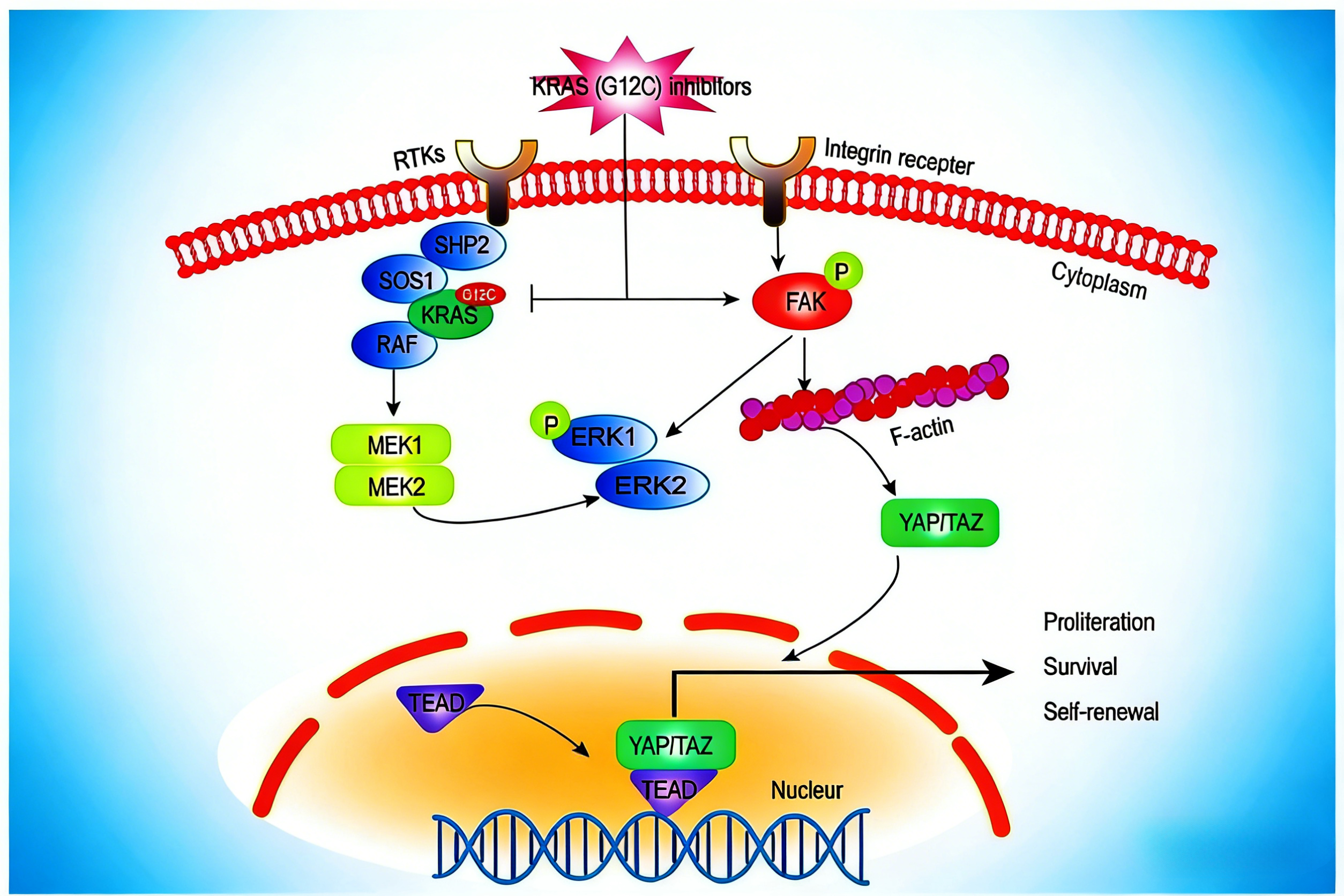
III. Molecular Mechanisms and Clinical Advantages of KRAS G12C Inhibitors
Novel KRAS G12C inhibitors (e.g., sotorasib, adagrasib) selectively target the SWITCH II pocket of the KRAS G12C mutant protein, stabilizing it in the GDP-bound inactive state and preventing its transition to the GTP-bound active conformation, thereby inhibiting aberrant activation of downstream signaling pathways. The dimethyl-substituted piperazine structure in their molecular design enhances binding affinity to the mutant protein while forming a low-energy stable conformation, prolonging drug action and improving binding stability.
Clinical trial data show that in previously treated KRAS G12C-mutated advanced NSCLC patients, these inhibitors achieved an ORR of 52%, median PFS exceeding 9 months, and median overall survival (OS) of 14.1 months. For patients with liver or brain metastases, ORRs reached 65.2% and 61.1%, respectively, addressing the unmet need for precision therapy in these refractory populations. Safety-wise, the drugs exhibit low binding affinity to wild-type KRAS protein, minimizing damage to normal cells, with hematologic toxicity being rare. Adverse events are mostly grade 1–2, with no cases of permanent discontinuation due to toxicity.
Notably, the phase II registration study prospectively enrolled patients who had failed chemotherapy and immunotherapy, with nearly 20% having received three or more prior lines of therapy—a baseline profile reflecting real-world challenges in heavily pretreated populations. Even in this context, the drugs achieved an ORR of 52% and median OS of 14.1 months. Furthermore, consistent efficacy benefits were observed across subgroups, with ORRs of 43.8% in STK11 co-mutation subgroups and 40% in KEAP1 co-mutation subgroups, overcoming limitations seen with other drugs in co-mutated populations.
IV. Application of KRAS G12C & CRBN Binding Assay Kits in Resistance Mechanism Research
As KRAS G12C inhibitors gain broader clinical use, resistance issues are emerging. Acquired resistance mechanisms include secondary KRAS mutations (e.g., G12D, G12V, G13D), bypass pathway activation (e.g., MET amplification, EGFR activation), and histological transformation. In resistance mechanism studies, accurately assessing the interaction between KRAS G12C protein and E3 ubiquitin ligases is critical for understanding degradation pathway-mediated resistance reversal.
The human KRAS G12C & CRBN Binding Assay Kit (GTP load) provides a standardized tool for such research. Based on the conformational features of KRAS G12C protein in the GTP-bound state, the kit simulates the recruitment of target proteins to CRBN ligase during targeted degradation or endogenous degradation pathways. Using time-resolved fluorescence resonance energy transfer (TR-FRET) technology, it quantifies the binding activity between KRAS G12C and CRBN, enabling evaluation of whether candidate compounds induce KRAS degradation via the ubiquitin-proteasome pathway. In resistance studies, the kit can verify whether secondary KRAS mutations affect interactions with E3 ligases or screen novel degradation molecules capable of overcoming resistance.
V. Conclusion
KRAS G12C mutations long faced the "undruggable" challenge, but recent breakthroughs in targeted drug development have enabled a shift from later-line to frontline therapy. Comprehensive insurance coverage has significantly improved drug accessibility, benefiting more patients. Future efforts should focus on biomarker-based stratification studies, optimizing holistic management models, and exploring combination strategies (e.g., with SHP2 inhibitors, PD-1 inhibitors, or chemotherapy) to overcome resistance, ultimately achieving precision treatment and long-term survival benefits for KRAS G12C-mutated lung cancer patients.
This article is reviewed and published by the technical expert team of UA
Disclaimer: This article partially utilizes artificial intelligence assistance in its creation. If any content involves copyright or intellectual property issues, please let us know and we promise to verify and remove it as soon as possible.
Purchase recombinant protein, choose Nanjing UA-Bio
UA protein focuses on providing various protein reagents, raw materials, and services required for drug research and development, cell therapy, gene therapy, and basic scientific research, including drug target proteins, immune checkpoint proteins, cytokines, tool enzymes, customized protein expression, and full-length transmembrane protein development. Youai is committed to providing customers with high-quality products and professional services, and building a High-tech Biological Enterprise with International Competitiveness.







 Business license (three certificates in one)