




Molecular mechanism of KRAS G13D mutation colorectal cancer sensitivity to cetuximab


Colorectal cancer is one of the most prevalent malignant tumors in China. With the advancement of precision medicine, its treatment strategies increasingly rely on in-depth analysis of the tumor's molecular characteristics.
- Recent Advances
I. Introduction
Colorectal cancer is one of the most prevalent malignancies in China. With the advancement of precision medicine, its treatment strategies increasingly rely on in-depth analysis of tumor molecular characteristics. The KRAS gene, as a key effector molecule downstream of the EGFR signaling pathway, plays a pivotal role in guiding anti-EGFR monoclonal antibody therapy. Clinical practice and guideline consensus indicate that patients with wild-type KRAS can benefit from EGFR-targeted drugs such as cetuximab, while most patients with KRAS mutations exhibit primary resistance to EGFR inhibitors due to constitutive activation of KRAS protein. However, the KRAS G13D mutation stands as an exception, with some clinical evidence suggesting that patients with this subtype may respond to cetuximab. The underlying molecular mechanism has long remained unclear. Recent studies, integrating computational biology and experimental validation, have for the first time revealed the mechanism behind the sensitivity of KRAS G13D-mutant tumors to cetuximab, providing new theoretical foundations for precision subtyping and personalized treatment of colorectal cancer.
II. General Principles of KRAS Mutations and Resistance to Anti-EGFR Therapy
The KRAS gene encodes a protein that serves as a central node in EGFR downstream signaling, dynamically balancing between inactive and active states through GDP/GTP binding switching under physiological conditions. When KRAS mutations occur, the GTPase-activating protein (GAP)-mediated GTP hydrolysis process is impaired, leading to persistent activation of KRAS protein in the GTP-bound conformation. This aberrantly activates downstream MAPK and PI3K signaling pathways, driving tumor cell proliferation and survival. Even when upstream EGFR signaling is blocked by antibody drugs, mutant KRAS can independently sustain pathway activation, thereby mediating resistance to cetuximab and panitumumab. Based on this mechanism, both domestic and international clinical guidelines recommend the use of anti-EGFR monoclonal antibodies only in patients with metastatic colorectal cancer harboring wild-type KRAS.
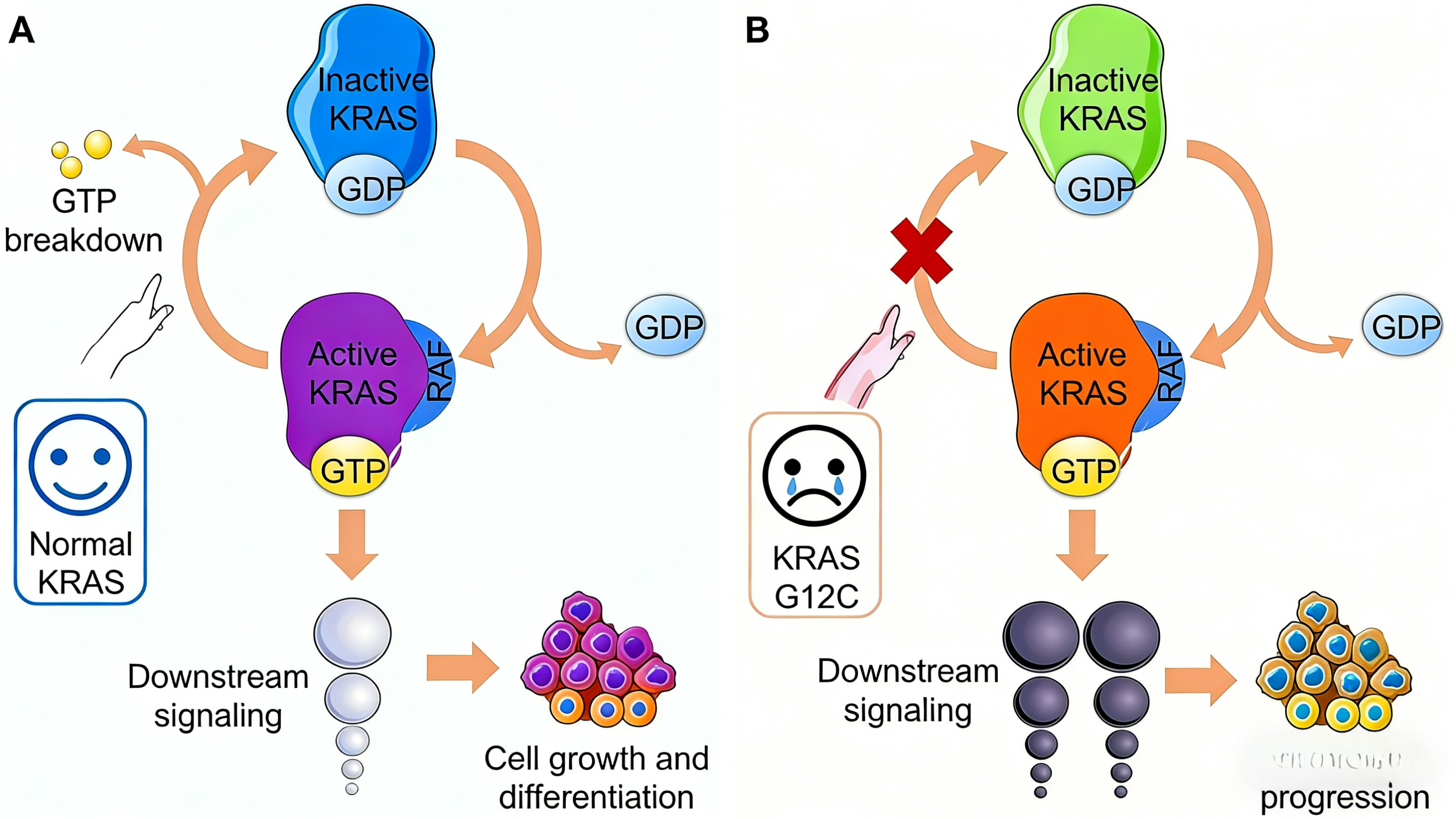
III. Unique Clinical Behavior of KRAS G13D Mutation
Although most KRAS mutations are associated with resistance to anti-EGFR therapy, clinical observations have revealed that the KRAS G13D mutation subtype may exhibit distinct behavioral patterns. Some retrospective analyses and clinical studies suggest that colorectal cancer patients with KRAS G13D mutations who receive cetuximab treatment show objective response rates (ORR) and survival benefits superior to other KRAS mutation subtypes, even approaching the efficacy levels observed in wild-type patients. This phenomenon implies that KRAS G13D may differ mechanistically from other common mutations such as G12C, G12D, and G12V. However, the underlying biological basis remains unclear, hindering the precision of clinical decision-making.
IV. Molecular Mechanism of KRAS G13D Sensitivity to Cetuximab
To elucidate the reasons behind the sensitivity of KRAS G13D-mutant tumors to cetuximab, researchers employed a strategy combining computational biology and experimental validation. First, based on biochemical understanding of the KRAS signaling pathway and prior clinical trial data, computational models were constructed to simulate the dynamic interactions between KRAS and regulatory factors under different mutation states, identifying functional differences between wild-type and mutant genes. Model predictions suggested that the KRAS G13D mutation might exhibit unique features in its interaction with the tumor suppressor neurofibromin (NF1).
Further experimental validation was conducted in multiple colorectal cancer cell lines with different genetic backgrounds. Results revealed that in wild-type KRAS cells, NF1 acts as a critical negative regulator, maintaining KRAS protein in an inactive state by promoting GTP hydrolysis. In cells expressing most KRAS mutants, the mutant proteins are hyperactivated and insensitive to NF1 regulation, leading to sustained signaling output. In contrast, in KRAS G13D-mutant cells, NF1 can still partially bind and regulate the mutant protein, but this occurs at the expense of its ability to regulate wild-type KRAS. When cetuximab blocks upstream EGFR signaling, the activity of the G13D mutant is further suppressed, restoring partial drug sensitivity to tumor cells. This mechanism explains the molecular basis for the observed responsiveness of KRAS G13D mutations to anti-EGFR therapy under specific conditions.
V. Application of KRAS G13D & CRBN Binding Kit in Mechanism Studies
In-depth investigation of KRAS G13D mutant protein function and its interactions with regulatory factors requires accurate assessment of the mutant protein's conformational state and its binding with E3 ubiquitin ligases. The Human KRAS G13D & CRBN Binding Kit (GTP load) provides a standardized detection tool for this research. This kit leverages the conformational characteristics of KRAS G13D protein in its GTP-bound active state, employing time-resolved fluorescence resonance energy transfer (TR-FRET) technology to quantitatively measure the binding activity between KRAS G13D and CRBN ligase.
In studies of KRAS G13D mechanisms, this kit can be applied in the following ways: (1) assessing whether the G13D mutation affects KRAS protein interaction with E3 ligases, thereby influencing protein stability; (2) screening for novel PROTAC molecules capable of inducing KRAS G13D protein degradation, exploring potential synergistic effects with anti-EGFR therapy; and (3) verifying whether secondary mutations affecting CRBN binding emerge post-treatment, providing mechanistic insights into acquired resistance. The application of this kit will enhance understanding of KRAS G13D's biological properties and advance the development of precision treatment strategies targeting this unique mutation subtype.
VI. Summary and Future Perspectives
As a special subtype within the KRAS mutation family, the partial sensitivity of KRAS G13D to cetuximab highlights the importance of functional heterogeneity among KRAS mutations. This study, through a combined strategy of computational modeling and experimental validation, elucidated the mechanism by which NF1 regulatory imbalance influences drug response in G13D-mutant cells, providing a scientific basis for treatment decisions in colorectal cancer patients with KRAS G13D mutations. This discovery suggests that future precision therapies for colorectal cancer should not treat "KRAS mutation" as a uniform label but instead further subdivide mutation subtypes and integrate functional mechanism studies to develop individualized strategies. With the widespread application of research tools such as the Human KRAS G13D & CRBN Binding Kit (GTP load), our understanding of the biological characteristics of different KRAS mutation subtypes will deepen, laying the groundwork for developing novel targeted drugs and optimizing existing treatment regimens.
This article is reviewed and published by the technical expert team of UA
Disclaimer: This article partially utilizes artificial intelligence assistance in its creation. If any content involves copyright or intellectual property issues, please let us know and we promise to verify and remove it as soon as possible.
Purchase recombinant protein, choose Nanjing UA-Bio
UA protein focuses on providing various protein reagents, raw materials, and services required for drug research and development, cell therapy, gene therapy, and basic scientific research, including drug target proteins, immune checkpoint proteins, cytokines, tool enzymes, customized protein expression, and full-length transmembrane protein development. Youai is committed to providing customers with high-quality products and professional services, and building a High-tech Biological Enterprise with International Competitiveness.







 Business license (three certificates in one)