




Technical Principles and Applications of AMP Detection Kit


Adenosine monophosphate, as a key molecule in intracellular energy metabolism and signal transduction, plays a central role in various physiological and pathological processes.
- Recent Advances
- Product Information
I. Introduction
Adenosine monophosphate (AMP), as a key molecule in cellular energy metabolism and signal transduction, plays a central role in various physiological and pathological processes. Accurate detection of AMP levels is crucial for studying cellular energy status, metabolic regulation, and related disease mechanisms. Traditional detection methods suffer from limitations such as low sensitivity and complex operations, while modern AMP detection kits based on biotechnology provide standardized solutions. This article systematically elaborates on the biological functions of AMP, the principles of detection methodologies, and the technical features and application value of AMP detection kits.
II. Biological Functions of AMP
AMP is an important member of the adenine nucleotide family, composed of adenosine and a monophosphate group. Within cells, AMP participates in multiple core biological processes. As a key indicator of energy metabolism, AMP levels, together with ATP and ADP, reflect the cell's energy status. When cellular energy consumption increases or energy supply is insufficient, ATP hydrolysis produces ADP and AMP, leading to elevated AMP concentrations. This activates AMP-activated protein kinase (AMPK), which regulates metabolic pathways to maintain energy homeostasis.
Additionally, AMP serves as a signaling molecule in purinergic signal transduction. Extracellular AMP can be hydrolyzed to produce adenosine, which activates adenosine receptors to modulate inflammatory responses, neural conduction, and vascular function. Under pathological conditions, changes in AMP levels are closely associated with ischemia-reperfusion injury, metabolic diseases, and inflammatory responses.
III. Traditional Methods for AMP Detection
Traditional AMP detection methods primarily include high-performance liquid chromatography (HPLC) and enzyme-linked immunosorbent assay (ELISA). HPLC separates nucleotides via chromatography columns and quantifies them using ultraviolet detectors. While it offers high resolution and the ability to detect multiple nucleotides simultaneously, it requires expensive equipment and specialized operators, involves complex sample preparation, and has low throughput, making it unsuitable for large-scale sample analysis.
ELISA is based on the principle of specific antigen-antibody binding, with quantification achieved through enzyme-catalyzed colorimetric reactions. This method is relatively simple and suitable for routine laboratory use. However, antibody specificity for AMP may be interfered with by other nucleotides such as ATP and ADP, and the method has limited sensitivity and a narrow linear range.
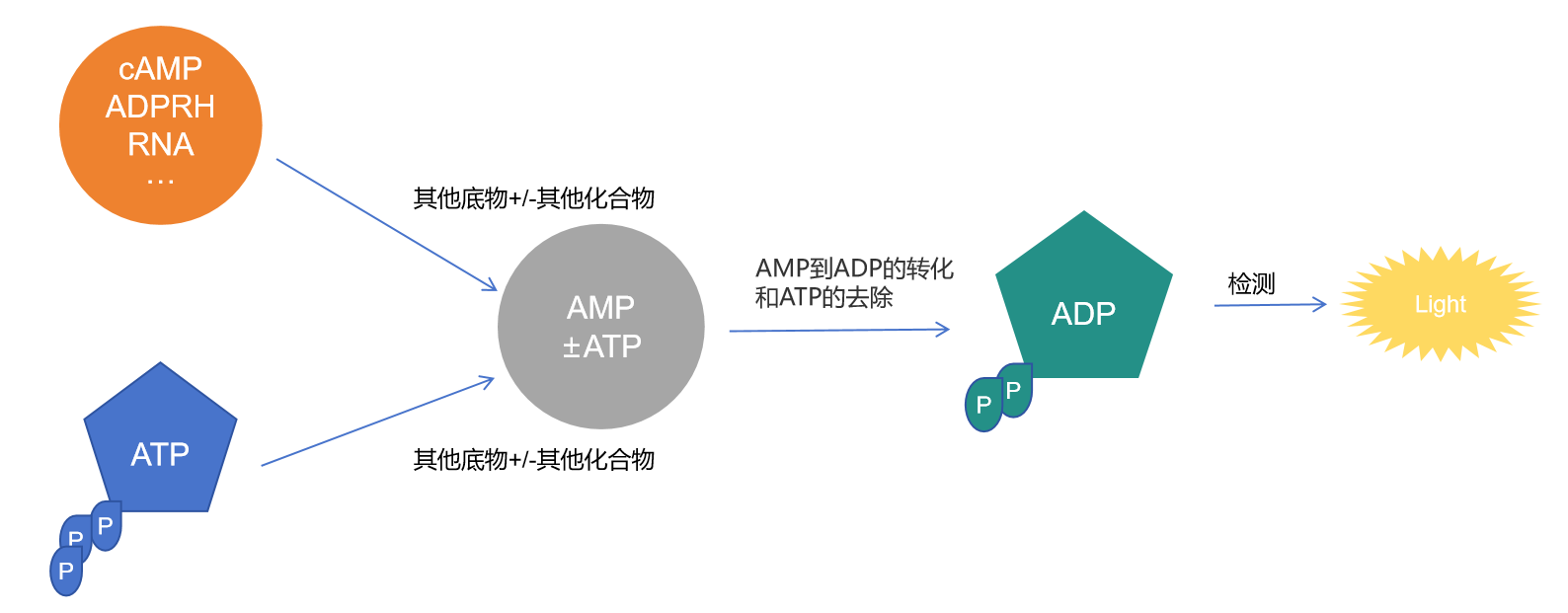
IV. Technical Principles of AMP Detection Kits
Modern AMP detection kits are designed based on biosensing or enzymatic reaction principles, overcoming many limitations of traditional methods. The most widely used method is bioluminescence based on the luciferase-luciferin reaction. This method involves the conversion of AMP into ATP through coupled enzyme reactions, followed by the detection of luminescence signals generated by the reaction of luciferase-catalyzed luciferin with ATP, thereby indirectly quantifying AMP.
Specifically, the kit includes two core enzyme systems: first, the AMP conversion system, which uses pyruvate phosphate dikinase (PPDK) or adenylate kinase to convert AMP into ATP in the presence of specific substrates; second, the ATP detection system, which uses luciferase to catalyze the reaction between luciferin and ATP to produce photons. The luminescence intensity is proportional to the AMP concentration, enabling accurate quantification via a standard curve.
Some kits employ fluorescence resonance energy transfer (FRET) or electrochemiluminescence technology to further enhance detection sensitivity and specificity. These technologies couple AMP recognition elements with signal transduction elements, enabling real-time, high-sensitivity detection.
V. Core Components and Workflow of AMP Detection Kits
A typical AMP detection kit includes the following core components: AMP conversion enzymes (e.g., pyruvate phosphate dikinase), luciferase, luciferin substrate, ATP elimination system (to remove interference from endogenous ATP in samples), reaction buffer, AMP standards, and microplates.
The workflow typically involves: sample preparation (cell or tissue lysis, deproteinization), ATP clearance (to eliminate endogenous ATP), AMP conversion reaction (converting AMP into ATP), luminescence detection (adding luciferase substrate and reading luminescence values), and data analysis (calculating AMP concentration based on the standard curve). The entire process can be completed in 96-well or 384-well microplates, making it suitable for high-throughput automated detection.
VI. Applications of AMP Detection Kits
AMP detection kits are widely used in basic research and preclinical studies. In the field of energy metabolism research, they can be used to assess cellular energy status and evaluate the effects of drugs or environmental factors on cellular metabolism. By measuring the AMP/ATP ratio, researchers can assess cellular energy stress levels and survival status.
In disease mechanism research, AMP detection can be used to explore pathological processes in metabolic diseases, cardiovascular diseases, and neurodegenerative diseases. For example, in ischemia-reperfusion injury models, tissue AMP levels can be used to assess the extent of energy metabolism disorders; in diabetes research, changes in AMP levels can reflect energy imbalances under insulin resistance.
In drug screening, AMP detection kits can be used to evaluate the effects of candidate compounds on cellular energy metabolism and to screen for active molecules that modulate the AMPK pathway. Additionally, in food safety testing and environmental monitoring, AMP levels can serve as indirect indicators of microbial contamination.
VII. Manufacturers Providing AMP Detection Kits
Nanjing UA-Bio Technology Co., Ltd. (UA-Bio) has independently developed the "UA-Glo® AMP Assay Kit", a high-performance biochemical analysis platform specifically designed for monitoring adenosine monophosphate (AMP) level changes. Based on bioluminescence detection principles, this kit enables accurate and efficient quantification of AMP concentrations in samples, providing a stable and reliable standardized solution for research in energy metabolism regulation, kinase activity analysis, nucleotide metabolism mechanisms, and drug screening.
| Core Advantages of the Product |
|---|
| High Sensitivity and Broad Dynamic Range: The kit employs an optimized enzyme-coupled luminescence system to specifically convert AMP concentrations into bioluminescence signals, offering exceptional detection sensitivity and a wide linear range. It enables precise quantification of AMP changes from low baseline levels to high accumulation levels, meeting the stringent requirements of various applications such as energy metabolism, enzyme kinetics, and high-throughput screening. |
| Excellent Inter-Batch Consistency and Stability: Leveraging an internationally advanced luminescence detection technology platform and standardized production processes, combined with a rigorous quality control system, the kit ensures high purity, superior long-term stability, and outstanding inter-batch consistency. This provides a solid foundation for long-term and continuous experimental research. |
| Homogeneous, Wash-Free, and Flexible Experimental Mode: The kit features a simple "add-incubate-read" homogeneous operation mode, eliminating the need for tedious separation or washing steps. This significantly shortens the workflow and reduces operational errors. Its optimized formulation is compatible with multi-well (96/384-well) automated platforms, making it suitable for various experimental needs such as AMP steady-state analysis, metabolic pathway research, and compound screening. |
| Comprehensive Solutions and Professional Support: We provide fully validated standard protocols, typical dose-response curves, and detailed result interpretation guidelines to help you quickly establish stable and reproducible experimental workflows. Nanjing UA-Bio's professional technical team offers comprehensive support for research design, experimental optimization, and data analysis. |
Nanjing UA-Bio Technology Co., Ltd. is committed to providing cutting-edge, high-quality core reagents and tools for immunology, cell therapy, and innovative drug development. For detailed technical parameters, validation data, or specific application inquiries regarding the "UA-Glo® AMP Assay Kit" (Catalog No.: UA079024), please feel free to contact us.
This article is reviewed and published by the technical expert team of UA
Disclaimer: This article partially utilizes artificial intelligence assistance in its creation. If any content involves copyright or intellectual property issues, please let us know and we promise to verify and remove it as soon as possible.
Purchase recombinant protein, choose Nanjing UA-Bio
UA protein focuses on providing various protein reagents, raw materials, and services required for drug research and development, cell therapy, gene therapy, and basic scientific research, including drug target proteins, immune checkpoint proteins, cytokines, tool enzymes, customized protein expression, and full-length transmembrane protein development. Youai is committed to providing customers with high-quality products and professional services, and building a High-tech Biological Enterprise with International Competitiveness.







 Business license (three certificates in one)