




HICA Homogeneous Chemiluminescence Technology: Principles and Application Advances


Chemiluminescence immunoassay is an analytical technique that combines highly sensitive chemiluminescence detection with highly specific immune reactions, widely used for the quantitative detection of antigens, antibodies, small molecules, and drugs.
- Recent Advances
I. Introduction
Chemiluminescence immunoassay (CLIA) is an analytical technique that combines highly sensitive chemiluminescence detection with highly specific immune reactions, widely used for quantitative detection of antigens, antibodies, small molecules, and drugs. Based on the presence or absence of separation and washing steps, chemiluminescence can be divided into heterogeneous and homogeneous methods. Currently, mainstream clinical testing platforms predominantly use heterogeneous chemiluminescence technology, which relies on physical separation and washing steps, resulting in limitations such as complex instrumentation, time-consuming detection, and cumbersome operations. Homogeneous chemiluminescence technology eliminates the need for separation and washing, enabling direct detection in the liquid phase, offering a new approach to simplify operational workflows and achieve rapid testing. This article systematically elaborates on the technical principles, classification characteristics, and clinical application advancements of homogeneous chemiluminescence.
II. Classification of Chemiluminescence Techniques
Chemiluminescence immunoassay can be classified according to different criteria. Based on separation and washing steps, it is divided into heterogeneous chemiluminescence and homogeneous chemiluminescence. Heterogeneous methods rely on the physical separation of antigen-antibody complexes from free components, typically immobilizing reactants on solid-phase carriers and removing unbound components through magnetic separation, filtration, or washing, thus involving multiple detection steps, complex instrument structures, and longer processing times. Homogeneous methods eliminate the need for separation and washing, enabling direct detection in the liquid phase, offering advantages such as simplified operations, rapid detection, and portable instrumentation.
Based on different luminescence systems, chemiluminescence can be categorized into indirect chemiluminescence, direct chemiluminescence, electrochemiluminescence, and light-initiated chemiluminescence. Indirect chemiluminescence uses enzyme-labeled antibodies to generate luminescence through enzyme-catalyzed substrates; direct chemiluminescence employs labels such as acridinium esters to emit light directly under oxidant action; electrochemiluminescence triggers luminescence through electrode reactions; light-initiated chemiluminescence requires external light sources to excite singlet oxygen-mediated energy transfer.
III. Technical Principles of Homogeneous Chemiluminescence
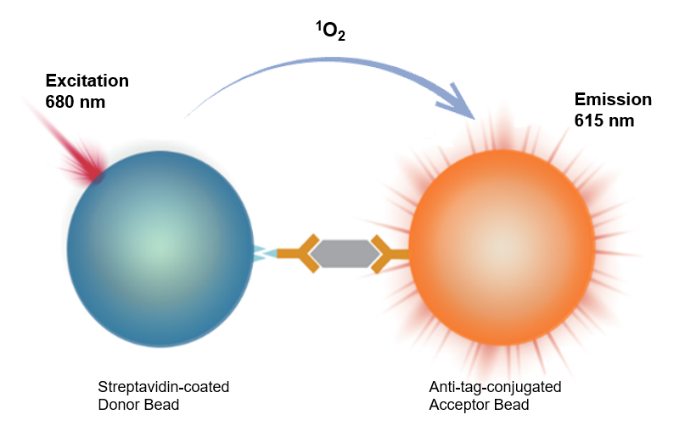
The core of homogeneous chemiluminescence technology lies in coupling immune reactions with signal generation in the liquid phase without physical separation steps. The most representative example is the Luminescent Oxygen Channeling Immunoassay (LOCI) technology based on oxygen channels. This technology employs two functionalized microspheres: sensitizer beads coated with streptavidin and containing photosensitizing dyes, and chemibeads coated with detection antibodies and containing luminescent dyes. During detection, the target antigen in the sample forms a sandwich complex with biotinylated antibodies and chemibeads, followed by the addition of sensitizer beads, which form immune complex aggregates through biotin-streptavidin binding. Under 680nm excitation light, the photosensitizing dyes in the sensitizer beads generate singlet oxygen, which diffuses to the chemibeads, triggering the luminescent dyes to produce a 612nm chemiluminescence signal. The luminescence intensity is proportional to the antigen concentration.
The core innovation of this technology lies in utilizing the short-lived diffusion characteristics of singlet oxygen to achieve energy transfer, where detectable signals are generated only when the two microspheres are in close proximity, thereby enabling specific detection in the liquid phase. This mechanism entirely eliminates separation and washing steps, achieving true homogeneous detection.
IV. Technical Advantages of Homogeneous Chemiluminescence
Compared to heterogeneous chemiluminescence, homogeneous technology offers significant advantages. First, it eliminates the need for separation and washing steps, simplifying the operational workflow and reducing detection time, with single-sample detection completed within 15-30 minutes. Second, it simplifies instrument structures, eliminating complex fluidic systems and magnetic separation modules, reducing equipment costs and failure rates, making it more suitable for point-of-care testing (POCT) scenarios. Third, the liquid-phase reaction environment is closer to physiological conditions, avoiding conformational changes that may be introduced by solid-phase immobilization, thereby preserving antigen-antibody binding activity. Fourth, the closed reaction system reduces contamination risks during operations, enhancing the reliability of detection results.
V. Clinical Applications of Homogeneous Chemiluminescence
Homogeneous chemiluminescence technology has broad application prospects in clinical testing. In infectious disease screening, it can be used for rapid detection of markers such as hepatitis B, hepatitis C, and HIV; in tumor marker detection, it can be applied to quantitative analysis of alpha-fetoprotein (AFP), carcinoembryonic antigen (CEA), etc.; in cardiac marker detection, it is suitable for point-of-care rapid testing of troponin, myoglobin, etc.; in therapeutic drug monitoring (TDM), it can be used for blood concentration monitoring of immunosuppressants, antibiotics, etc.
This technology is particularly suitable for primary healthcare and emergency scenarios, where its simplified operations and rapid detection capabilities can significantly improve service efficiency. With technological advancements, detection sensitivity and linear ranges continue to improve, meeting the testing needs of mainstream clinical applications.
VI. Technical Challenges of Homogeneous Chemiluminescence
Despite its clear advantages, homogeneous chemiluminescence technology still faces several challenges. The generation and transfer of singlet oxygen are sensitive to environmental factors, and quenchers in samples may interfere with signal detection. The stability and batch-to-batch consistency of the two microspheres impose higher requirements on reagent quality control. The design of excitation light sources and detection optical systems requires precise optical setups, increasing the complexity of instrument development. Additionally, compared to traditional heterogeneous platforms, the project coverage of homogeneous technology still needs expansion.
VII. Outlook
As in vitro diagnostic (IVD) technology moves toward rapid, portable, and intelligent development, homogeneous chemiluminescence technology faces important opportunities for growth. Future technological breakthroughs will focus on the development of new luminescent probes, optimization of signal amplification strategies, expansion of multiplex detection capabilities, and integration with microfluidic technology. The maturation of domestic homogeneous chemiluminescence platforms will provide better solutions for primary healthcare and emergency treatment, driving the high-quality development of China's IVD industry. With continuous technological improvements and deeper clinical applications, homogeneous chemiluminescence is expected to play a greater role in the POCT field.
This article is reviewed and published by the technical expert team of UA
Disclaimer: This article partially utilizes artificial intelligence assistance in its creation. If any content involves copyright or intellectual property issues, please let us know and we promise to verify and remove it as soon as possible.
Purchase recombinant protein, choose Nanjing UA-Bio
UA protein focuses on providing various protein reagents, raw materials, and services required for drug research and development, cell therapy, gene therapy, and basic scientific research, including drug target proteins, immune checkpoint proteins, cytokines, tool enzymes, customized protein expression, and full-length transmembrane protein development. Youai is committed to providing customers with high-quality products and professional services, and building a High-tech Biological Enterprise with International Competitiveness.







 Business license (three certificates in one)