




Technical Analysis of Kinase ADP Assay Kit


Kinases play a central role in cellular signal transduction, metabolic regulation, and the development of various diseases. Research on the regulatory mechanisms of kinase activity and the screening of inhibitors are key aspects of modern drug development.
- Recent Advances
- Product Information
I. Introduction
Kinases play a central role in cellular signal transduction, metabolic regulation, and various disease pathogenesis. Research on kinase activity regulation mechanisms and inhibitor screening constitutes a critical segment in modern drug development. Accurate and efficient measurement of kinase activity is essential for deciphering complex signaling networks and identifying potential therapeutic targets. Bioluminescence-based detection methods, renowned for their high sensitivity, operational simplicity, and compatibility with high-throughput screening, have emerged as mainstream technologies in this field.
II. Detection Principle and Methodological Basis
The UA-Glo® Kinase ADP Detection Kit provides a homogeneous, sensitive, and reliable solution for quantitative kinase activity analysis. Its core principle involves the specific and quantitative measurement of adenosine diphosphate (ADP) production—the primary product of kinase reactions—to directly reflect catalytic activity. The accumulated ADP amount exhibits a strict positive correlation with kinase activity, enabling precise evaluation of kinase functional states.
The method's design ensures compatibility with diverse kinase reaction conditions. The reaction system accommodates ATP concentrations ranging up to 1 mM, covering a broad spectrum from physiological to common screening concentrations. Furthermore, the kit's application scope isn't limited to specific kinases or substrate types—it effectively detects reactions involving peptides, intact proteins, lipids, or carbohydrates as substrates. Its utility also extends to any enzymatic reaction generating ADP, such as ATPase activity assays.
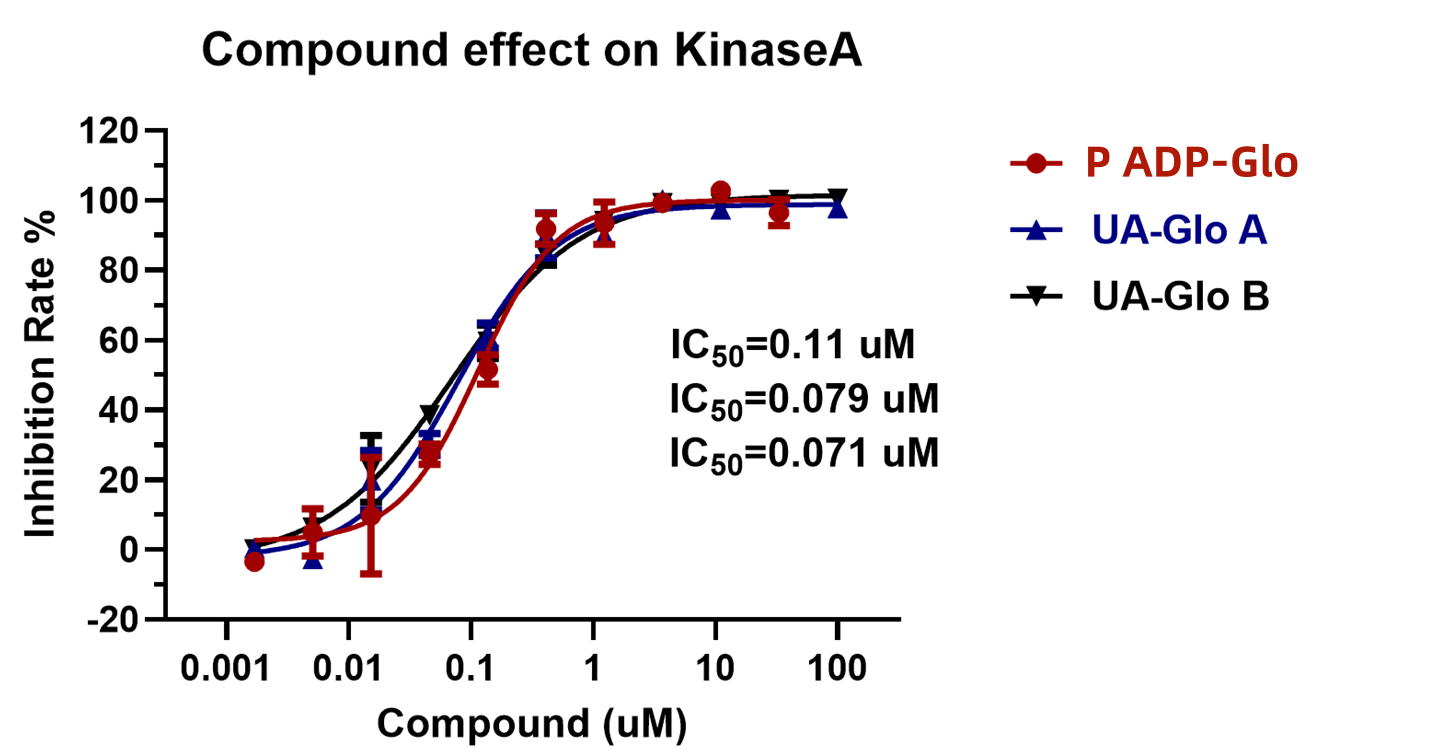
III. Core Performance Characteristics
1. Broad ATP Concentration Adaptability
A standout advantage of this detection system is its tolerance toward initial ATP concentrations. The kit delivers reliable results across an ATP range of 1 μM to 1 mM. This feature not only meets optimal reaction conditions for different kinases but more importantly, by systematically varying ATP concentrations and observing inhibitor potency changes, provides robust experimental evidence for distinguishing inhibitor mechanisms—ATP-competitive versus non-competitive inhibition.
2. Exceptional Detection Sensitivity and Dynamic Range
The kit exhibits ultrahigh sensitivity, consistently detecting as little as 0.25 pmol of ADP. Combined with its wide dynamic range, researchers can perform assays under broader experimental conditions while significantly reducing kinase quantities per experiment. This conserves precious biological samples (especially for kinases difficult to express/purify) and offers greater flexibility and convenience for high-throughput screening optimization.
3. Optimized Signal Stability and Anti-Interference Capacity
The glow-type signal demonstrates remarkable stability, maintaining a linear relationship between luminescence intensity and ADP concentration for 0.5 to 12 hours. This prolonged stability effectively eliminates intra-batch variations caused by plate reader speed limitations, enabling large-scale multi-well plate detection in a single run. Additionally, its proprietary reagent formulation significantly reduces interference from common compound library substances, ensuring data reliability and accuracy in high-throughput screening.
IV. Experimental Operation and Process Optimization
From an operational perspective, the kit's design emphasizes efficiency and convenience through its homogeneous detection mode. After kinase reactions, simply adding an equal volume of ADP detection reagent suffices—no transfer, washing, or separation steps are required. This "add-mix-read" streamlined process minimizes pipetting errors from multi-step operations while drastically reducing preparation and operation time, making it particularly suitable for automated high-throughput compound screening platforms.
V. Storage and Stability
To preserve biological activity and detection performance, the product must be transported on dry ice and stored at -20°C or below, protected from light. Under recommended storage conditions, its 12-month shelf life ensures continuity and reproducibility for long-term experimental plans.
VI. Conclusion
In summary, the UA-Glo® Kinase ADP Detection Kit represents an advanced analytical tool integrating sensitivity, stability, convenience, and informational richness. It not only meets fundamental research needs for precise kinase activity measurement but also, through its superior performance parameters and simplified homogeneous workflow, provides powerful technical support for large-scale kinase-targeted drug screening, inhibitor kinetic characterization, and mechanistic classification studies.
VII. Which Manufacturers Provide the UA-Glo® Kinase ADP Detection Kit?
Nanjing UA-Bio Technology Co., Ltd. has independently developed the "UA-Glo® Kinase ADP Assay"—a high-performance bioluminescence platform specifically designed for protein kinase activity analysis and inhibitor screening. Based on quantitative ADP detection, this kit enables accurate and efficient evaluation of kinase reaction activity, delivering stable and reliable standardized solutions for kinase signaling pathway research, drug screening, and efficacy evaluation.
| Core Product Advantages |
|---|
| High Sensitivity and Broad Dynamic Range: The kit employs an optimized enzyme-coupled luminescence system that specifically converts ADP generated in kinase reactions into bioluminescent signals, featuring ultrahigh detection sensitivity and wide linear range. It precisely quantifies kinase activity variations from basal to high levels, meeting stringent requirements for enzyme kinetics studies, high-throughput screening, and IC50 determination of inhibitors. |
| Exceptional Batch Consistency and Stability: Leveraging an internationally leading luminescence detection platform and standardized production processes combined with rigorous release QC systems, all kit components exhibit high purity, excellent long-term stability, and outstanding batch-to-batch consistency. This provides solid quality assurance for continuous, long-term drug screening and mechanistic research. |
| Homogeneous, No-Wash, Flexible and Efficient Workflow: The kit adopts a simple "add-incubate-read" homogeneous operation mode, eliminating tedious separation, washing, or quenching steps to significantly shorten workflows and reduce operational errors. Its optimized formulation is compatible with multi-well (96/384) automated platforms, flexibly applicable to various protein/lipid kinase activity analyses and compound inhibitor screening. |
| Comprehensive Solutions and Professional Support: We provide thoroughly validated standard protocols, typical dose-response curves, and detailed result interpretation guides to facilitate rapid establishment of stable, reproducible workflows. Nanjing UA-Bio's expert technical team offers full-process professional consultation and support for research design, experimental optimization, and data analysis. |
Nanjing UA-Bio Technology Co., Ltd. remains committed to providing cutting-edge, high-quality core reagents and tools for immunology, cell therapy, and innovative drug development. For detailed technical parameters, validation data, or specific application inquiries regarding "UA-Glo® Kinase ADP Assay" (Catalog #: UA070101), please feel free to contact us.
This article is reviewed and published by the technical expert team of UA
Disclaimer: This article partially utilizes artificial intelligence assistance in its creation. If any content involves copyright or intellectual property issues, please let us know and we promise to verify and remove it as soon as possible.
Purchase recombinant protein, choose Nanjing UA-Bio
UA protein focuses on providing various protein reagents, raw materials, and services required for drug research and development, cell therapy, gene therapy, and basic scientific research, including drug target proteins, immune checkpoint proteins, cytokines, tool enzymes, customized protein expression, and full-length transmembrane protein development. Youai is committed to providing customers with high-quality products and professional services, and building a High-tech Biological Enterprise with International Competitiveness.







 Business license (three certificates in one)