




Study on the mechanism of IFN-α 2a protein delivering antiviral effects through exosomes


Chronic hepatitis caused by hepatitis B virus infection remains a major global health issue, as chronic infection can progress to liver cirrhosis or even liver cancer.
- Recent Advances
- Product Information
I. Research Background and Scientific Questions
Chronic hepatitis caused by hepatitis B virus (HBV) infection remains a major threat to human health, as it can progress to liver cirrhosis and even hepatocellular carcinoma. IFN-α protein is one of the primary clinical treatments for hepatitis B, with its direct antiviral effects and indirect immunomodulatory actions forming the foundation of anti-HBV therapy. Previous studies have found that liver non-parenchymal cells, such as macrophages, can transmit IFN-α-induced antiviral effects to HBV-replicating hepatocytes via exosomes, effectively suppressing viral replication within hepatocytes. However, the mechanism by which exosomes enter hepatocytes to deliver IFN-α 2a protein-induced antiviral effects remains to be fully elucidated.
II. Mechanism of Exosome Entry into Hepatocytes via Viral Receptors
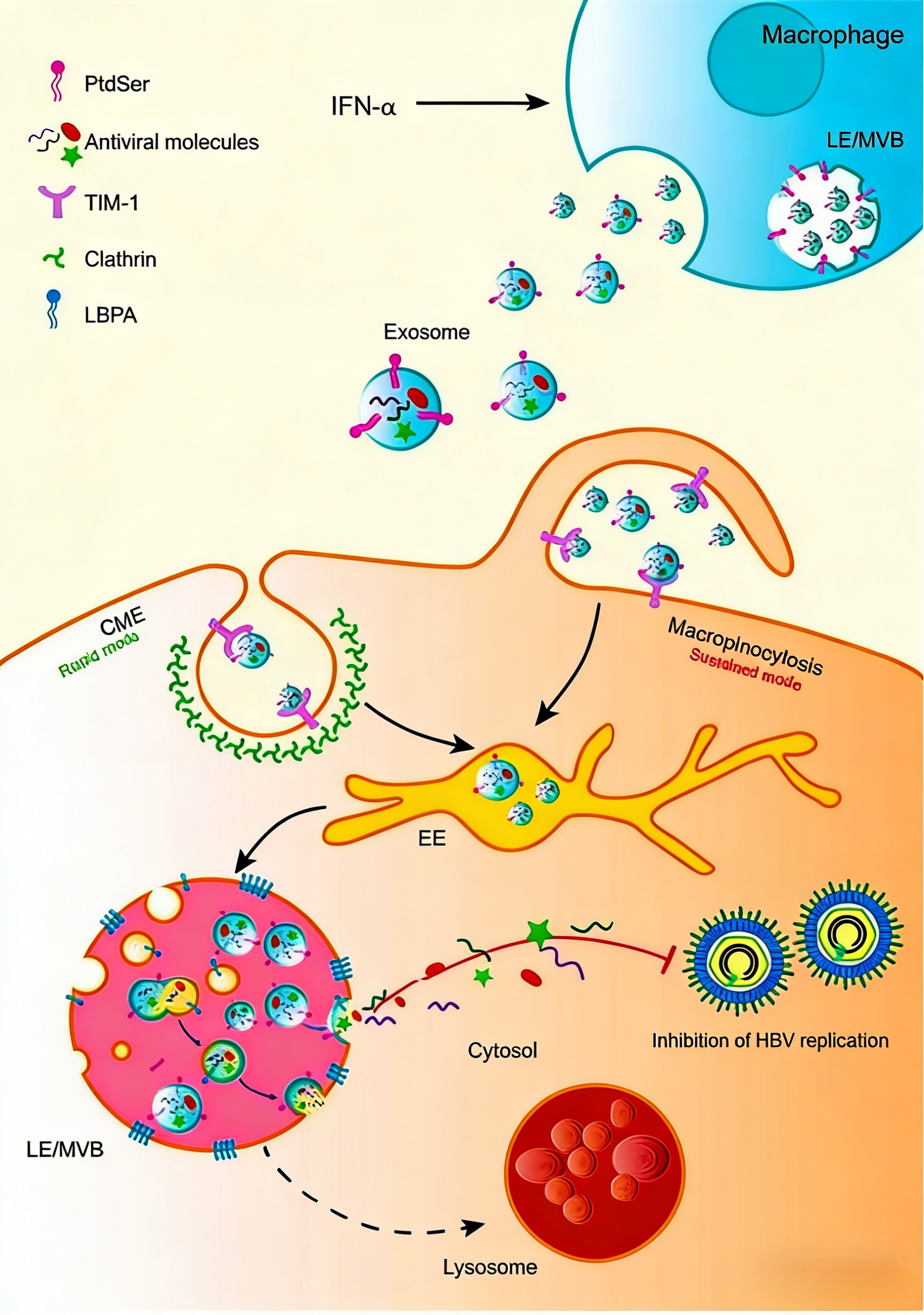
Researchers discovered that macrophage-derived exosomes can enter hepatocytes by mimicking viral entry mechanisms. These exosomes expose phosphatidylserine, an apoptosis marker, on their surface, utilizing the hepatitis A virus receptor TIM-1 to enter hepatocytes through a process resembling viral "apoptotic mimicry." TIM-1 plays a critical role in mediating exosome entry and the transmission of antiviral activity. Suppressing TIM-1 expression in HBV-replicating cell lines significantly hinders the delivery of IFN-α 2a protein-induced antiviral effects by exosomes. This finding highlights the similarity between exosomes and viruses at the receptor level, providing important insights into the intercellular transmission of IFN-α-induced antiviral effects.
III. Endocytic Pathways of Exosome Entry into Hepatocytes
Studies indicate that clathrin-mediated endocytosis and macropinocytosis, both closely associated with viral entry, are the primary pathways for macrophage exosome entry into hepatocytes. Applying clathrin-mediated endocytosis inhibitors or knocking down clathrin heavy chain expression in hepatocytes effectively suppresses exosome entry. Additionally, co-incubation of exosomes with hepatocytes stimulates fluid-phase endocytosis in hepatocytes, a hallmark of macropinocytosis. Classic macropinocytosis inhibitors and kinase inhibitors targeting macropinocytosis significantly reduce exosome entry. Notably, exosomes may enter hepatocytes via an atypical macropinocytosis pathway independent of Rac1 and Cdc42. Inhibition of these endocytic pathways markedly weakens the ability of macrophage exosomes to deliver IFN-α 2a protein-induced antiviral effects.
IV. Mechanism of Endosomal Escape for Exosome Cargo
Further research reveals that internalized macrophage exosomes fuse with endosomal membranes to release their cargo, thereby escaping lysosomal degradation—a process similar to viral endosomal penetration. Live-cell imaging shows that membrane fusion probes labeled on exosomes emit fluorescence signals upon entering hepatocytes, colocalizing with late endosome marker RAB7 and multivesicular body marker CD63. The lipid LBPA, crucial for viral endosomal penetration, plays a key role in exosome membrane fusion. Blocking LBPA in hepatocytes with specific antibodies significantly inhibits exosome membrane fusion, promoting cargo trafficking to lysosomes. This mechanism ensures that IFN-α 2a protein-induced antiviral molecules carried by exosomes are effectively released into the cytoplasm of target cells to suppress viral replication.
V. Complete Pathway of Antiviral Effect Transmission by Exosomes
This study systematically elucidates the complete pathway by which macrophage exosomes deliver IFN-α 2a protein-induced antiviral effects into hepatocytes. Exosomes first bind to the viral receptor TIM-1 on hepatocyte surfaces via exposed phosphatidylserine, then enter cells through clathrin-mediated endocytosis and atypical macropinocytosis, and finally release their cargo via endosomal membrane fusion, achieving intercellular transmission of IFN-α-induced antiviral effects. This process shares similarities with viral entry mechanisms at multiple stages—receptor recognition, endocytic pathways, and endosomal escape—demonstrating that exosomes "mimic" viral strategies to efficiently deliver IFN-α 2a protein-induced antiviral molecules to target cells.
VI. Research Significance and Application Prospects
This study provides an in-depth understanding of the molecular mechanisms by which IFN-α 2a protein-induced antiviral effects are transmitted between cells via exosomes, highlighting the multiple similarities between exosome and viral entry mechanisms. It demonstrates that macrophage exosomes can deliver IFN-α-induced anti-HBV activity through viral receptors, commonly used viral endocytic pathways, and viral endosomal penetration mechanisms. These findings not only deepen our understanding of interferon's antiviral mechanisms and clarify the critical role of exosomes in amplifying and disseminating interferon signals but also offer a theoretical foundation for engineering exosomes as efficient therapeutic carriers for antiviral molecules. The unique mechanisms by which exosomes, as natural intercellular communication vehicles, transmit IFN-α 2a protein-related antiviral effects provide new insights for developing novel antiviral therapeutic strategies.
VII. Which Manufacturers Provide IFN-α 2a Protein?
Nanjing UA-Bio Technology Co., Ltd. (UA-Bio) has independently developed "IFN-α 2a Protein, Human," a high-quality recombinant protein reagent designed for antiviral immunity, tumor immunity, and immunomodulation research. This protein, human interferon alpha-2a (IFN-α 2a), belongs to the type I interferon family and efficiently activates the JAK-STAT signaling pathway, inducing an antiviral state, enhancing immune cell activity, and inhibiting tumor cell proliferation. It serves as a stable and reliable standardized tool for antiviral research, tumor therapy, and immune regulation mechanism exploration.
| Core Product Advantages |
|---|
| High Purity and Full Biological Activity: The product employs internationally leading recombinant expression systems and highly standardized purification processes, validated through multidimensional quality control to ensure >95% purity, correct native conformation, and full biological functionality. The protein efficiently binds to type I interferon receptors (IFNAR), faithfully mimicking the antiviral response, immune activation, and cell cycle regulation signals mediated by IFN-α 2a under physiological conditions. |
| Excellent Batch Consistency and Stability: Strict management from gene construction, protein expression to purification quality control, combined with a comprehensive release testing system, ensures stable biological activity, consistent purity, and superior long-term stability across batches. This provides solid and reliable quality assurance for long-term and continuous antiviral and tumor immunity research. |
| Ideal Tool for Multiple Applications: The protein performs exceptionally well in antiviral activity assays, tumor cell proliferation inhibition experiments, immune cell activation studies, signaling pathway analysis, and drug activity evaluation. It is widely applicable to antiviral drug screening, tumor immunotherapy research, interferon signaling mechanism exploration, and biosimilar activity assessment. |
| Low Endotoxin and High Batch Consistency: The product undergoes multi-step chromatography purification and endotoxin removal processes, with extremely low endotoxin levels (<0.1 EU/μg), meeting stringent requirements for cell culture and functional experiments. A rigorous quality control system ensures high consistency in protein activity and purity across batches. |
| Complete Solutions and Professional Support: We provide thoroughly validated standard experimental protocols, typical biological activity data, and detailed product analysis certificates to help you quickly establish stable and reproducible experimental workflows. Nanjing UA-Bio's professional technical team offers comprehensive consultation and support for research design, experimental optimization, and data analysis. |
Nanjing UA-Bio Technology Co., Ltd. is committed to providing cutting-edge, high-quality core reagents and tools for immunology, cell therapy, and innovative drug development. For detailed technical parameters, validation data, or specific application inquiries regarding "IFN-α 2a Protein, Human" (Catalog No.: UA040038), please feel free to contact us.
This article is reviewed and published by the technical expert team of UA
Disclaimer: This article partially utilizes artificial intelligence assistance in its creation. If any content involves copyright or intellectual property issues, please let us know and we promise to verify and remove it as soon as possible.
Purchase recombinant protein, choose Nanjing UA-Bio
UA protein focuses on providing various protein reagents, raw materials, and services required for drug research and development, cell therapy, gene therapy, and basic scientific research, including drug target proteins, immune checkpoint proteins, cytokines, tool enzymes, customized protein expression, and full-length transmembrane protein development. Youai is committed to providing customers with high-quality products and professional services, and building a High-tech Biological Enterprise with International Competitiveness.







 Business license (three certificates in one)