




Study on the dual role mechanism of IFN-γ protein in tumor immunity


IFN-γ protein is the sole member of the type II interferon family, primarily produced by activated T cells, natural killer cells, and NKT cells. This protein binds to the receptor complex composed of IFNGR1 and IFNGR2 subunits on the cell surface, activating the JAK-STAT signaling pathway and regulating the expression of multiple genes.
- Recent Advances
- Product Information
1. Biological Characteristics of IFN-γ Protein
IFN-γ protein is the sole member of the type II interferon family, primarily produced by activated T cells, natural killer cells, and NKT cells. This protein binds to the receptor complex composed of IFNGR1 and IFNGR2 subunits on the cell surface, activating the JAK-STAT signaling pathway and regulating the expression of multiple genes. IFN-γ protein plays a central role in antiviral immunity, antitumor immunity, and immune regulation, but its functions exhibit significant context dependency, showing dual effects of promoting or inhibiting tumors in different cell types and pathological conditions.
2. Regulatory Role of IFN-γ Protein on Effector T Cells
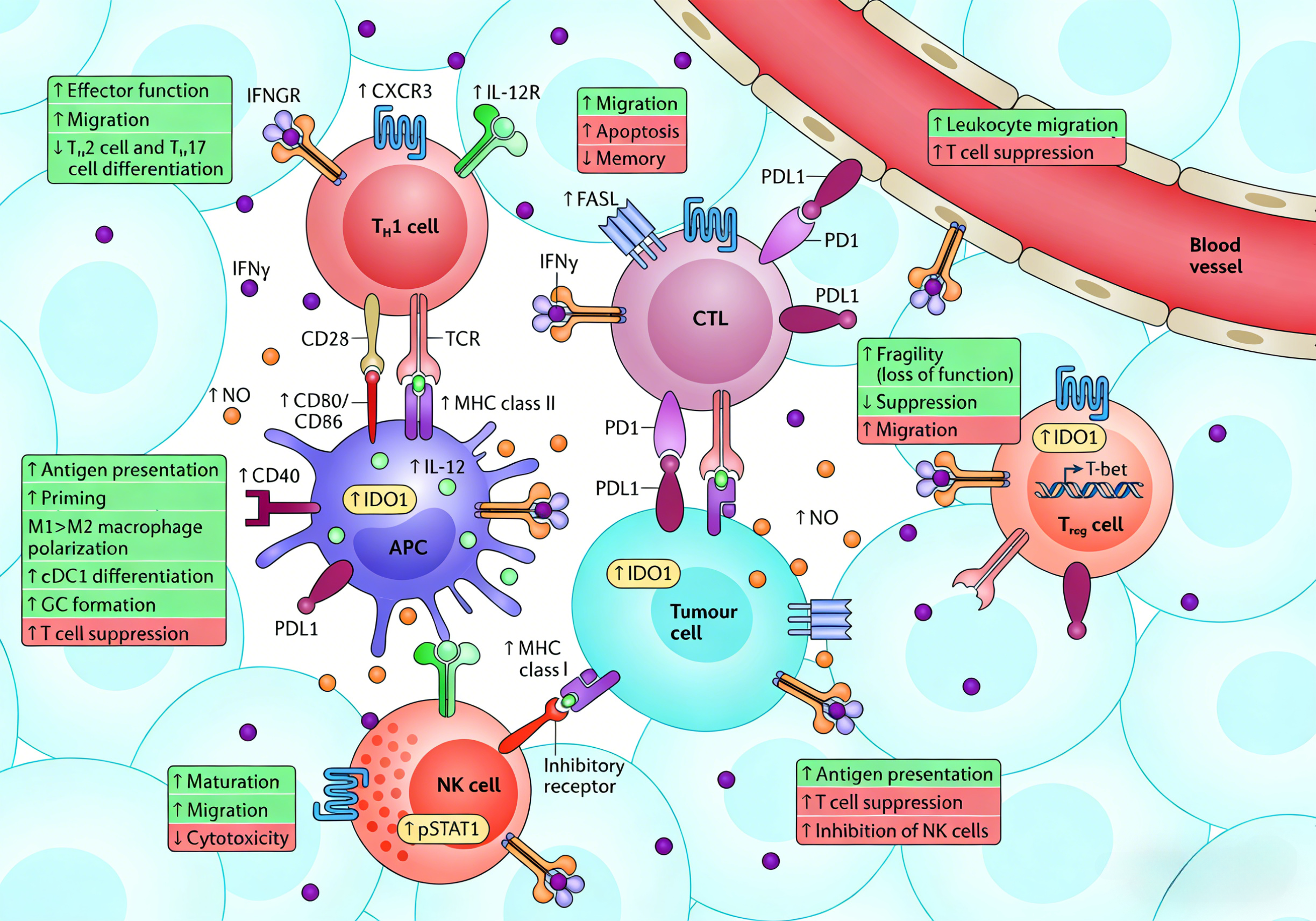
In cytotoxic T cells, IFN-γ protein participates in the regulation of the contraction phase of immune responses through Fas-FasL and BIM-mediated apoptosis pathways. During the clonal expansion phase, high levels of IFN-γ can inhibit IL-7Rα expression via the AKT-FOXO1 pathway, reducing pro-survival signals and limiting the size of the memory T cell pool. In low tumor burden models, IFN-γ induced by immune checkpoint inhibitors can lead to activation-induced cell death, limiting the formation of effector memory cells and promoting tumor escape. In CD4-positive effector T cells, IFN-γ promotes TH1 cell differentiation and inhibits TH2 and TH17 polarization through T-bet, enhancing antitumor effects. TH1 cells reduce IFNGR2 expression after differentiation, improving survival rates and thereby exerting antitumor effects in the tumor microenvironment. Simultaneously, IFN-γ can also promote apoptosis of effector CD4-positive T cells by reducing BCL-2 expression and upregulating Fas and FasL. This bidirectional regulation suggests that T cell responses to IFN-γ are influenced by the microenvironment.
3. Regulatory Role of IFN-γ Protein on Myeloid Cells
IFN-γ protein was initially known as a macrophage-activating factor, driving macrophages toward the classically activated M1 phenotype, promoting pro-inflammatory and antitumor functions. In dendritic cells, IFN-γ induces the expression of CD80, CD86, and MHC molecules, promotes cDC1 differentiation, enhances antigen presentation capacity, and facilitates TH1 cell differentiation and CD8-positive T cell activation. However, IFN-γ can also induce myeloid cells to express inhibitory molecules such as IDO and PD-L1, promoting tumor progression through metabolic regulation and immunosuppressive signals. IDO can stimulate TGF-β production, further inducing the differentiation and proliferation of regulatory T cells. IFN-γ also promotes iNOS expression in myeloid cells, breaking down L-arginine to produce nitric oxide, which at high concentrations induces apoptosis to exert antitumor effects, while at low concentrations it may promote angiogenesis and genomic instability.
4. Direct Effects of IFN-γ Protein on Tumor Cells
Tumor cells are important responders to IFN-γ in the tumor microenvironment. In terms of antitumor effects, IFN-γ can induce MHC class I molecule expression in tumor cells, enhancing antigen presentation and promoting T cell recognition. Simultaneously, IFN-γ can directly induce tumor cell apoptosis through IFNGR signaling. In terms of pro-tumor effects, IFN-γ can induce tumor cells to express molecules such as PD-L1, IDO1, and iNOS, mediating immune escape. FasL expression by tumor cells can induce apoptosis of immune effector cells, while Fas expression makes tumor cells sensitive to apoptosis. MHC class I molecule expression on tumor cells has dual roles: promoting antigen presentation while also serving as inhibitory receptor ligands that bind to NK cell inhibitory receptors, preventing killing. Immunosuppressive tumors often downregulate MHC class I expression to evade immune surveillance.
5. Effects of IFN-γ Protein on Regulatory T Cells and Natural Killer Cells
In the tumor microenvironment, IFN-γ can drive regulatory T cells toward a fragile phenotype, causing them to lose inhibitory activity while maintaining FOXP3 expression, thereby weakening their pro-tumor functions. Regulatory T cells with low Nrp1 expression are associated with favorable prognosis in patients with metastatic melanoma and head and neck squamous cell carcinoma. Regarding natural killer cells, IFN-γ can activate their antitumor functions and promote tumor infiltration by inducing CXCR3 expression. Bystander T cell-produced IFN-γ acts on natural killer cells through TRAIL, promoting their maturation and tumor-killing functions, while IFN-γ-induced IRF1 can enhance TRAIL expression.
6. Effects of IFN-γ Protein on Blood and Lymphatic Vessels
IFN-γ plays a complex role in the regulation of tumor blood and lymphatic vessels. This protein can inhibit lymphatic vessel growth by downregulating the expression of lymphatic endothelial hyaluronan receptor 1, podoplanin, and prospero homeobox protein 1, hindering sustained lymphatic vessel formation and leading to reduced lymphatic density, which affects immune cell exchange. Simultaneously, IFN-γ can induce lymphatic vessels to express PD-L1, limiting the accumulation of CD8-positive T cells in the tumor microenvironment. IFN-γ can also indirectly promote neovascularization in the tumor microenvironment by inducing CXCL9, CXCL10, and IDO1 expression. While CXCL9 and CXCL10 enhance the functions of TH1 and TH17 effector cells, they also participate in angiogenesis regulation. Lymphatic vessels have recently been shown to be not merely passive conduits for immune cell exchange but also important regulators of inflammation and immunity.
7. Which Manufacturers Provide IFN-γ Protein?
Nanjing UA-Bio Technology Co., Ltd. (UA-Bio) has independently developed "IFN-γ Protein, Human", a high-quality recombinant protein reagent specifically designed for Th1-type immune responses, macrophage activation, and tumor immunity research. This protein is human interferon-γ (IFN-γ), belonging to the type II interferon family, and can efficiently activate the JAK-STAT signaling pathway, induce immune cell activation, enhance antigen presentation, and inhibit viral replication, providing you with a stable and reliable standardized tool for research in anti-infective immunity, tumor immunotherapy, and autoimmune diseases.
| Core Product Advantages |
|---|
| High Purity and Complete Biological Activity: The product utilizes internationally leading recombinant expression systems and highly standardized purification processes, validated through multi-dimensional quality control to ensure >95% high purity, correct native homodimer conformation, and complete biological functions. The protein efficiently binds to the IFN-γ receptor complex, faithfully simulating IFN-γ-mediated macrophage activation, Th1 cell differentiation, and enhanced antigen presentation signals under physiological conditions. |
| Exceptional Batch Consistency and Stability: From gene construction, protein expression to purification and quality control, the entire process is strictly managed, combined with a comprehensive release testing system, ensuring each batch of product has stable biological activity, consistent purity, and excellent long-term stability. This provides solid and reliable quality assurance for your long-term, continuous immunological research. |
| Ideal Tool for Multiple Applications: This protein performs excellently in various application systems, including macrophage activation experiments, Th1 cell differentiation induction, tumor cell proliferation inhibition studies, signaling pathway analysis, and drug activity evaluation. It can be widely used for exploring immune regulation mechanisms, antitumor drug screening, autoimmune disease research, and biosimilar drug activity evaluation. |
| Low Endotoxin and High Batch Consistency: The product undergoes multi-step chromatographic purification and endotoxin removal processes, with extremely low endotoxin levels (<0.1 EU/μg), meeting the stringent requirements for cell culture and functional experiments. The rigorous quality control system ensures high consistency in protein activity and purity across different batches. |
| Complete Solutions and Professional Support: We provide thoroughly validated standard experimental protocols, typical biological activity data, and detailed product analysis certificates to help you quickly establish stable and reproducible experimental workflows. Nanjing UA-Bio's professional technical team offers comprehensive and professional technical consultation and support for your research design, experimental optimization, and data analysis. |
Nanjing UA-Bio Technology Co., Ltd. is committed to providing cutting-edge, high-quality core reagents and tools for immunology, cell therapy, and innovative drug development. For detailed technical parameters, validation data, or specific application inquiries regarding "IFN-γ Protein, Human" (Catalog No.: UA040053), please feel free to contact us.
This article is reviewed and published by the technical expert team of UA
Disclaimer: This article partially utilizes artificial intelligence assistance in its creation. If any content involves copyright or intellectual property issues, please let us know and we promise to verify and remove it as soon as possible.
Purchase recombinant protein, choose Nanjing UA-Bio
UA protein focuses on providing various protein reagents, raw materials, and services required for drug research and development, cell therapy, gene therapy, and basic scientific research, including drug target proteins, immune checkpoint proteins, cytokines, tool enzymes, customized protein expression, and full-length transmembrane protein development. Youai is committed to providing customers with high-quality products and professional services, and building a High-tech Biological Enterprise with International Competitiveness.







 Business license (three certificates in one)