




Biological Characteristics and Clinical Applications of IL-2 Protein


The IL-2 protein is a type I four α-helix bundle cytokine, primarily produced by conventional T cells following engagement of the T cell receptor and the co-stimulatory molecule CD28.
- Recent Advances
- Product Information
1. Molecular Structure and Biological Characteristics of IL-2 Protein
IL-2 protein is a type I four α-helix bundle cytokine primarily produced by conventional T cells following engagement of the T cell receptor and costimulatory molecule CD28. Activated CD4-positive T cells, CD8-positive T cells, natural killer cells, and natural killer T cells can all produce IL-2 protein, with CD4-positive T cells exhibiting the highest production levels. The FOXP3 transcription factor suppresses IL-2 protein expression in regulatory T cells, rendering them incapable of producing IL-2 and completely dependent on exogenous IL-2 supply for survival and function. This protein binds to cell surface IL-2 receptors, initiating downstream signal transduction to regulate immune cell activation, differentiation, and proliferation.
2. Structure of IL-2 Receptor and Signal Transduction Mechanism
The IL-2 receptor consists of three subunits: α chain, β chain, and γ chain. It exists in three variant forms: monomeric, dimeric, and trimeric, with progressively increasing affinity for IL-2 protein. Upon IL-2 binding, the receptor β and γ chains undergo heterodimerization, activating tyrosine kinases JAK1 and JAK3 respectively, which phosphorylate tyrosine residues in the β chain and recruit downstream signaling molecules. The primary signaling pathways activated by IL-2 include: the JAK-STAT pathway (accounting for over 90% of signals), PI3K-AKT-mTOR pathway, and MAPK pathway. Activation of these pathways leads to nuclear translocation of transcription factors and ultimately regulates target gene expression, inducing cell activation, differentiation, and proliferation.
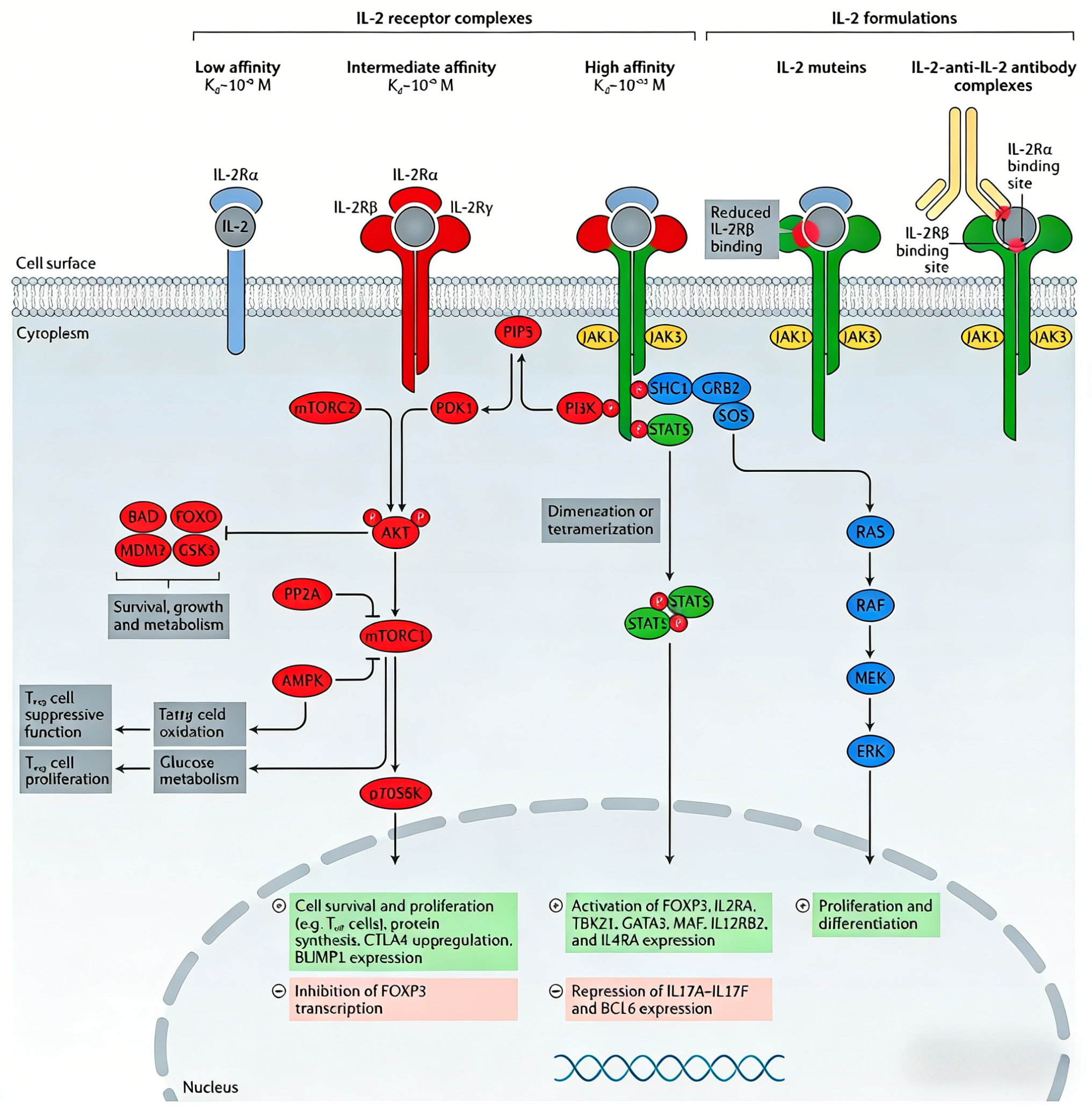
3. Regulatory Role of IL-2 Protein in Regulatory T Cells
IL-2 protein is essential for the differentiation, immunosuppressive function, homeostasis, and survival of regulatory T cells. By controlling inflammatory responses, regulatory T cells play a central role in maintaining immune tolerance and preventing autoimmunity. In inflamed tissues, regulatory T cells exhibit reduced functional efficiency and may even become unstable due to loss of FOXP3 expression, converting to phenotypes resembling conventional CD4-positive T cells. IL-2 maintains regulatory T cell numbers and function, ensuring appropriate control of immune responses. In various autoimmune diseases, particularly during inflammation, reduced numbers or impaired function of regulatory T cells lead to uncontrolled immune responses and organ damage.
4. Inhibitory Effect of IL-2 Protein on TH17 Cell Differentiation
IL-2 protein suppresses TH17 cell differentiation through multiple mechanisms. While TH17 cells are crucial for host defense against pathogens and protecting intestinal mucosa from inflammatory damage, they also contribute to the pathogenesis of autoimmune diseases like systemic lupus erythematosus and psoriasis. IL-2 protein is not only vital for regulatory T cell activity (indirectly regulating conventional T cell function) but also directly inhibits TH17 cell differentiation. This dual regulatory role makes IL-2 protein critical for maintaining immune homeostasis. The "IL-2 paradox"—where IL-2 or IL-2 receptor knockout mice exhibit severe autoimmune phenotypes rather than expected immunodeficiency—can be explained by regulatory T cell deficiency.
5. Clinical Applications of IL-2 Protein in Autoimmune Diseases
Clinical use of IL-2 protein began in 1984, initially at high doses to stimulate conventional T cell activity against tumor cells for treating metastatic renal cell carcinoma and metastatic melanoma. Subsequent research revealed IL-2's important regulatory role in autoimmunity. In 2006, researchers proposed that regulatory T cells constitutively express high-affinity IL-2 receptors, suggesting that low-dose IL-2 in human autoimmune diseases might preferentially stimulate regulatory T cells without activating effector T cells. Clinical studies confirmed that within specific dose ranges, IL-2 primarily stimulates regulatory T cells with good tolerability. Given that regulatory T cell dysfunction is central to most autoimmune diseases, IL-2 regulation holds broad clinical potential.
6. Therapeutic Prospects of IL-2 Protein in Autoimmune Diseases
In various autoimmune diseases including systemic lupus erythematosus and rheumatoid arthritis, low-dose IL-2 therapy has shown clinical efficacy in early trials by restoring regulatory T cell fitness and/or expanding their numbers. By driving regulatory T cell survival and function, IL-2 protein effectively controls excessive immune responses, alleviating autoimmunity and organ damage. Detection and regulation of IL-2 levels may offer significant therapeutic potential across numerous clinical applications. Current research is exploring low-dose IL-2 strategies in multiple autoimmune diseases, including seropositive rheumatoid arthritis, systemic lupus erythematosus, and type 1 diabetes. This approach selectively enhances regulatory T cell function to reestablish immune tolerance, offering new directions for autoimmune disease treatment.
7. Which Manufacturers Provide IL-2 Protein?
Nanjing UA-Bio Technology Co., Ltd. has independently developed "IL-2 Protein, Mouse", a high-quality recombinant protein reagent specifically designed for mouse T cell expansion, immune regulation, and preclinical efficacy studies. This mouse-derived interleukin-2 (IL-2) is a key cytokine for T cell activation and proliferation, effectively activating IL-2 receptor signaling pathways to promote T cell proliferation, regulatory T cell (Treg) function, and immune response balance. It provides a stable, reliable standardized tool for research in tumor immunology, autoimmune disease models, and cell therapy.
| Core Product Advantages |
|---|
| High Purity and Full Biological Activity: Utilizing internationally leading recombinant expression systems and highly standardized purification processes, the product undergoes multidimensional quality control to ensure >95% purity, correct native conformation, and complete biological function. The protein efficiently binds mouse IL-2 receptor complexes (IL-2Rα/β/γ), faithfully simulating physiological IL-2-mediated T cell proliferation, activation signals, and immune homeostasis regulation. |
| Excellent Batch-to-Batch Consistency and Stability: Rigorous management from gene construction to protein expression and purification, combined with comprehensive release testing, ensures stable biological activity, consistent purity, and superior long-term stability across batches. This provides reliable quality assurance for continuous mouse immunology research. |
| Ideal Tool for Multiple Applications: The protein performs excellently in various applications including mouse T cell expansion in vitro, regulatory T cell (Treg) induction, cytotoxic T lymphocyte (CTL) culture, signaling pathway analysis, and preclinical efficacy evaluation. It is widely applicable to immune cell therapy research, tumor immunology mechanism exploration, autoimmune disease model construction, and drug activity assessment. |
| Complete Solutions and Professional Support: We provide thoroughly validated standard protocols, representative biological activity data, and detailed product analysis certificates to help establish stable, reproducible experimental workflows. Nanjing UA-Bio's technical team offers comprehensive professional consultation and support for research design, experimental optimization, and data analysis. |
Nanjing UA-Bio Technology Co., Ltd. remains committed to providing cutting-edge, high-quality core reagents and tools for immunology, cell therapy, and innovative drug development. For detailed technical parameters, validation data, or specific application inquiries regarding "IL-2 Protein, Mouse" (Catalog No.: UA040171), please feel free to contact us.
This article is reviewed and published by the technical expert team of UA
Disclaimer: This article partially utilizes artificial intelligence assistance in its creation. If any content involves copyright or intellectual property issues, please let us know and we promise to verify and remove it as soon as possible.
Purchase recombinant protein, choose Nanjing UA-Bio
UA protein focuses on providing various protein reagents, raw materials, and services required for drug research and development, cell therapy, gene therapy, and basic scientific research, including drug target proteins, immune checkpoint proteins, cytokines, tool enzymes, customized protein expression, and full-length transmembrane protein development. Youai is committed to providing customers with high-quality products and professional services, and building a High-tech Biological Enterprise with International Competitiveness.







 Business license (three certificates in one)