




Biological characteristics and clinical significance of IL-18 protein in inflammatory diseases


The IL-18 protein belongs to the IL-1 family of cytokines and possesses the ability to induce interferon-γ production. Billions of years of evolution have shaped the diversity, complexity, and adaptability of immune responses, and the unique biological characteristics of the IL-18 protein in barrier maintenance, danger signal transmission, and immune response amplification are a manifestation of this evolutionary process.
- Recent Advances
- Product Information
I. Molecular Characteristics and Biological Uniqueness of IL-18 Protein
IL-18 protein belongs to the IL-1 family of cytokines and has the ability to induce interferon-γ production. Billions of years of evolution have shaped the diversity, complexity, and adaptability of immune responses, and the unique biological features of IL-18 protein in barrier maintenance, danger signal transmission, and immune response amplification are a manifestation of this evolutionary process. This protein exhibits complex cell-type-specific induction, requires intracellular enzymatic activation and active release through simultaneously assembled pores, and must evade or overcome IL-18 binding protein to bind to its receptor. The IL-18 receptor is expressed by a limited array of immune cells, and its signaling primarily amplifies ongoing inflammatory programs. This complex biological profile contributes to its role in various systemic and organ-specific disease states.
II. Activation and Secretion Mechanisms of IL-18 Protein
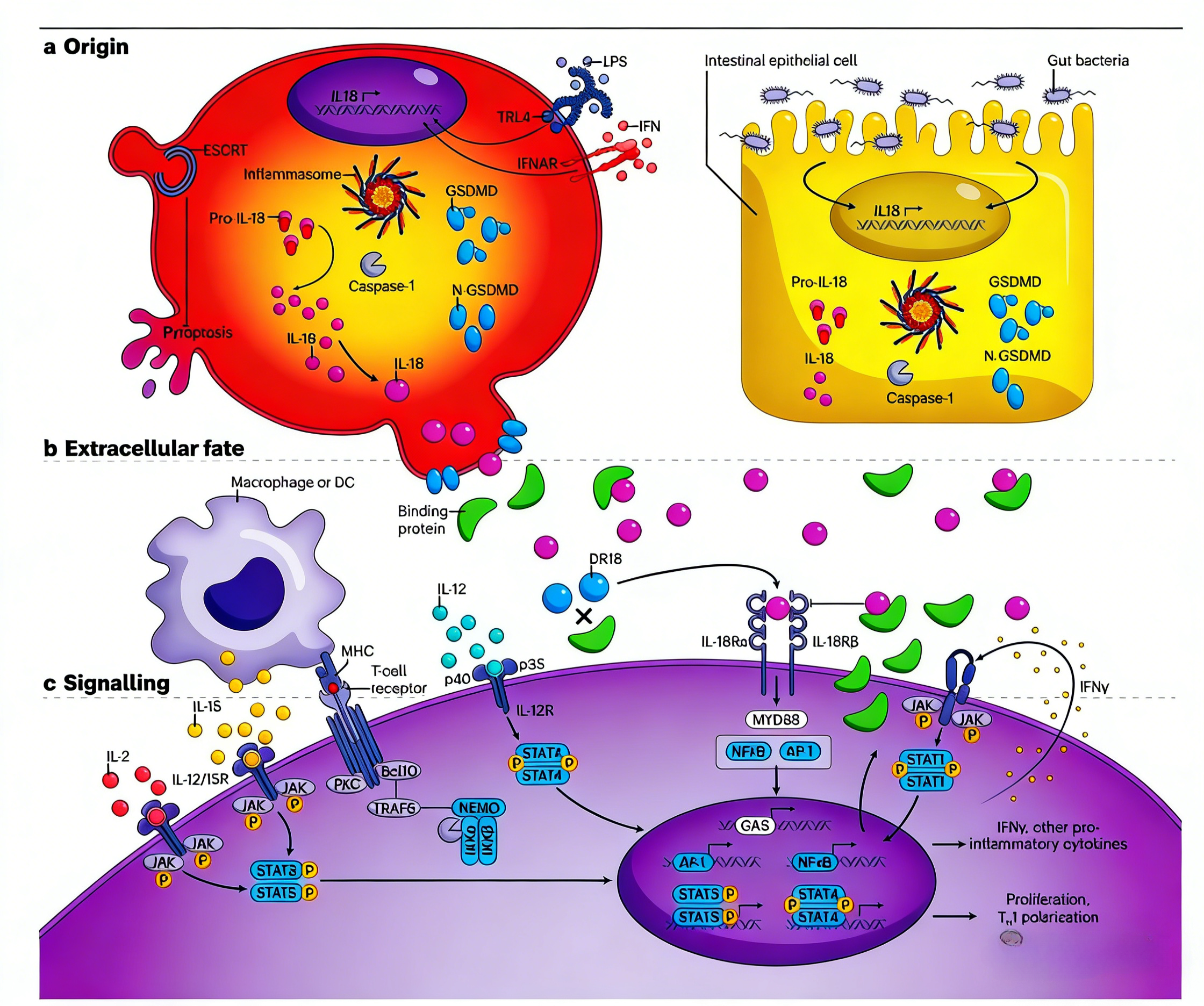
IL-18 protein is constitutively produced as an inactive precursor in epithelial cells and certain tissue macrophages, or its expression is induced by complex stimuli such as lipopolysaccharides and interferons. Precursor IL-18 protein is cleaved by enzymes such as caspase-1, caspase-8, granzyme B, proteinase-3, or chymase to become active and exits the cell through inflammasome-dependent gasdermin D pores. Cells can prevent pyroptosis caused by gasdermin D pores via the ESCRT pathway. Once released, IL-18 protein is typically bound and neutralized by IL-18 binding protein, which itself is produced by most cell types in response to interferon-γ. Unbound or "decoy-resistant" IL-18 protein transmits signals through the IL-18 receptor heterodimer, often in synergy with other signals.
III. Signal Transduction and Functional Diversity of IL-18 Protein
The IL-18 receptor transmits signals through the traditional IL-1 family/MyD88-dependent pathway, driving NF-κB and MAPK signaling pathways to promote proliferation, pro-inflammatory cytokine expression, and cytotoxic effector programs. The diverse effects of IL-18 protein depend on the type and state of the target cells, as well as the presence of other signals such as T cell receptor, IL-2, myeloid-derived IL-15, IL-12, and interferon-γ, which collectively form positive feedback loops. In pathogenic mechanisms, human and animal studies have found that CD8-positive T cells are preferentially activated over other IL-18-responsive lymphocytes.
IV. Pathological Manifestations of IL-18 Protein-Related Diseases
Dysregulation of IL-18 protein can lead to a group of autoinflammatory diseases, referred to as "IL-18 proteinopathies." Systemic inflammatory signs are present in all IL-18-related diseases, with distinct clinical manifestations resulting from various genetic mutations. Severe patients with NLRC4 hyperactivation or XIAP deficiency may develop enterocolitis and inflammatory bowel disease, as the epithelial cells of the large and small intestines produce large amounts of precursor IL-18 protein under steady-state conditions. Patients with macrophage activation syndrome of any cause may exhibit hepatitis, hepatosplenomegaly, and hemophagocytosis, as hepatic Kupffer cells and splenic red pulp macrophages can produce substantial amounts of precursor IL-18 protein. Cutaneous manifestations may include various rashes, as keratinocytes and Langerhans cells produce large amounts of precursor IL-18 protein under steady-state conditions. Pulmonary alveolar proteinosis has been observed in systemic juvenile idiopathic arthritis-associated lung disease, as respiratory epithelial cells and alveolar macrophages produce large amounts of precursor IL-18 protein under steady-state conditions. Tumors can secrete significant amounts of IL-18 binding protein, preventing IL-18 protein from promoting anti-tumor immunity.
V. Clinical Significance of IL-18 Protein as a Biomarker
Blood biomarker studies have revealed a cytokine whose significant elevation correlates with detectable "free IL-18," defining a group of autoinflammatory diseases. The specificity of total IL-18 protein for these "IL-18 diseases" holds unique value among inflammatory biomarkers. This specificity may accelerate diagnosis and identify patients suitable for therapeutic IL-18 blockade. With more routine measurements of IL-18 binding protein and free IL-18, diagnostic accuracy is expected to further improve. The presence or absence of macrophage activation syndrome can categorize IL-18-related diseases into two groups, requiring comparative experiments to elucidate the mechanisms behind this distinction.
VI. Therapeutic Strategies Targeting IL-18 Protein
The complexity and breadth of IL-18 protein induction make blocking its synthesis a less feasible therapeutic strategy. However, inhibiting its activation and release, mimicking IL-18 binding protein, neutralizing free IL-18, blocking the IL-18 receptor, or targeting downstream effector cytokines such as interferon-γ are promising approaches. Strong biomarker correlations provide clear evidence for this strategy. IL-18 agonist therapy leverages the production of endogenous IL-18 inhibitors or subverts their sites, potentially enhancing immune responses against cancer. Research is ongoing to exploit IL-18 protein's remarkable ability to amplify effector T cell responses to circumvent immune suppression in cancer and chronic infections. The unique aspects of IL-18 protein biology are making clinical impacts in the precise diagnosis, disease monitoring, and targeted treatment of inflammatory and malignant diseases.
VII. Which Companies Provide IL-18 Protein?
Nanjing UA-Bio Technology Co., Ltd. (UA-Bio) has independently developed "IL-18 Protein, Human," a high-quality recombinant protein reagent specifically designed for inflammation research, innate immune regulation, and autoimmune disease studies. This protein is human interleukin-18 (IL-18), a key effector molecule of inflammasome activation that efficiently activates the IL-18 receptor signaling pathway, induces IFN-γ production, promotes Th1-type immune responses, and enhances the cytotoxicity of NK cells and T cells. It provides a stable and reliable standardized tool for exploring inflammatory mechanisms, constructing autoimmune disease models, and developing immunotherapies.
| Core Product Advantages |
|---|
| High Purity and Intact Biological Activity: The product utilizes internationally leading recombinant expression systems and highly standardized purification processes, validated through multi-dimensional quality control to ensure >95% purity, correct native conformation, and full biological functionality. The protein efficiently binds to the human IL-18 receptor complex (IL-18Rα/IL-18Rβ), accurately mimicking the physiological signals mediated by IL-18, including IFN-γ induction, NK cell activation, and Th1 cell differentiation. |
| Excellent Batch-to-Batch Consistency and Stability: Rigorous management from gene construction, protein expression to purification and quality control, combined with a comprehensive release testing system, ensures stable biological activity, consistent purity, and outstanding long-term stability across batches. This provides solid and reliable quality assurance for long-term and continuous inflammation and immune research. |
| Ideal Tool for Multiple Applications: This protein performs excellently in various application systems, including NK cell activation and expansion, Th1 cell differentiation induction, macrophage activation studies, inflammatory cytokine induction analysis, and signaling pathway research. It is widely applicable to autoimmune disease mechanism exploration, infection immunity research, tumor immunotherapy, and drug activity evaluation. |
| Complete Solutions and Professional Support: We provide thoroughly validated standard experimental protocols, typical biological activity data, and detailed product analysis certificates to help you quickly establish stable and reproducible experimental workflows. Nanjing UA-Bio's professional technical team offers comprehensive, expert technical consultation and support for your research design, experimental optimization, and data analysis. |
Nanjing UA-Bio Technology Co., Ltd. is dedicated to providing cutting-edge, high-quality core reagents and tools for immunology, cell therapy, and innovative drug development. For detailed technical parameters, validation data, or specific application inquiries regarding "IL-18 Protein, Human" (Catalog No.: UA040111), please feel free to contact us.
This article is reviewed and published by the technical expert team of UA
Disclaimer: This article partially utilizes artificial intelligence assistance in its creation. If any content involves copyright or intellectual property issues, please let us know and we promise to verify and remove it as soon as possible.
Purchase recombinant protein, choose Nanjing UA-Bio
UA protein focuses on providing various protein reagents, raw materials, and services required for drug research and development, cell therapy, gene therapy, and basic scientific research, including drug target proteins, immune checkpoint proteins, cytokines, tool enzymes, customized protein expression, and full-length transmembrane protein development. Youai is committed to providing customers with high-quality products and professional services, and building a High-tech Biological Enterprise with International Competitiveness.







 Business license (three certificates in one)