





IL-6 protein is a crucial member of the interleukin family, exhibiting dual functions as both a pro-inflammatory cytokine and an anti-inflammatory myokine. Encoded by the IL-6 gene, this protein is expressed in various cell types. Osteoblasts secrete IL-6 protein to stimulate osteoclast formation, while vascular smooth muscle cells produce IL-6 as a pro-inflammatory cytokine. Adipocytes also generate IL-6 protein, which is considered responsible for the elevated endogenous CRP levels in obese individuals. The anti-inflammatory myokine effects of IL-6 are mediated through inhibition of TNF-α and IL-1, along with activation of IL-1 receptor antagonists and IL-10. The TR-FRET IL-6/IL-6R kit can be used to quantitatively measure the binding activity between IL-6 and its receptors, providing a technical tool for studying this signaling pathway.
IL-6 protein plays multiple roles in physiological regulation. As a key mediator of fever and acute-phase responses, it can cross the blood-brain barrier and initiate PGE2 synthesis in the hypothalamus, thereby altering the body's temperature set point. In muscle and adipose tissues, IL-6 stimulates energy flux, leading to increased body temperature. Macrophages secrete IL-6 protein in response to specific microbial molecules known as pathogen-associated molecular patterns (PAMPs). These PAMPs bind to pattern recognition receptors of the innate immune system, including Toll-like receptors, triggering intracellular signaling cascades that induce the production of inflammatory cytokines. Additionally, IL-6 protein promotes acute-phase protein synthesis, neutrophil production in bone marrow, B-cell growth support, and antagonistic effects on regulatory T cells. Psychological stress can also trigger IL-6 release into circulation through stress hormones. Inhibitors of IL-6, such as estrogen, are used to treat postmenopausal osteoporosis.
IL-6 protein signals through a cell surface type I cytokine receptor complex consisting of a ligand-binding IL-6 receptor α-chain (CD126) and a signal-transducing component, gp130. Gp130 serves as a common signal transducer for several cytokines, including leukemia inhibitory factor, ciliary neurotrophic factor, oncostatin M, IL-11, and cardiotrophin-1, and is ubiquitously expressed in most tissues. In contrast, CD126 expression is tissue-restricted. When IL-6 interacts with its receptor, it triggers the formation of a complex between gp130 and IL-6 receptor proteins, thereby activating the receptor. These complexes initiate signal transduction cascades, including Janus kinases (JAKs) and signal transducer and activator of transcription (STAT) proteins, by clustering the intracellular domains of gp130. The TR-FRET IL-6/IL-6R kit can be used to study the binding patterns between IL-6 and receptor subunits and evaluate dynamic changes in receptor-ligand interactions under different conditions.
IL-6 protein is the most representative member of cytokines that signal through gp130-containing receptors. Other cytokines in this family include IL-11, IL-27, ciliary neurotrophic factor, cardiotrophin-1, cardiotrophin-like cytokine, leukemia inhibitory factor, oncostatin M, and viral IL-6. These cytokines are often referred to as IL-6-like cytokines or the gp130-utilizing cytokine family. They share structural and functional similarities with IL-6, including common signal-transducing components, but exhibit tissue specificity and functional diversity. TR-FRET technology can be applied to screen molecules that modulate IL-6 binding to gp130, providing quantitative analysis tools for studying signal transduction within this cytokine family.
In addition to membrane-bound receptors, soluble forms of IL-6 receptor have been purified from human serum and urine. Many neural cells do not respond to IL-6 alone, but neuronal differentiation and survival can be mediated through the action of soluble IL-6 receptors. The complex formed by soluble IL-6 receptor and IL-6 stimulates axonal outgrowth and promotes neuronal survival, suggesting that soluble IL-6 receptor-mediated signaling plays a critical role in remyelination and neural regeneration. This discovery expands the biological functions of IL-6 signaling and reveals its unique mechanisms in the nervous system. The TR-FRET IL-6/IL-6R kit can be used to measure the binding affinity between soluble IL-6 receptor and IL-6 and evaluate functional differences from membrane-bound receptors.
Upon binding to its receptor, IL-6 exerts biological effects by activating the JAK-STAT signaling pathway. Phosphorylation of JAK kinases leads to activation of STAT transcription factors, which dimerize and translocate to the nucleus to regulate target gene expression. This signaling pathway participates in cell proliferation, differentiation, survival, and inflammatory responses. IL-6 signaling also involves activation of MAPK and PI3K-AKT pathways, which collaborate with the JAK-STAT pathway to form a complex signaling network. The intensity and duration of IL-6 signaling are regulated by multiple factors, including receptor expression levels, presence of soluble receptors, and induction of negative feedback regulators such as SOCS proteins. TR-FRET technology can be applied to study conformational changes in IL-6-receptor complexes and the impact of mutations on pathway activation.
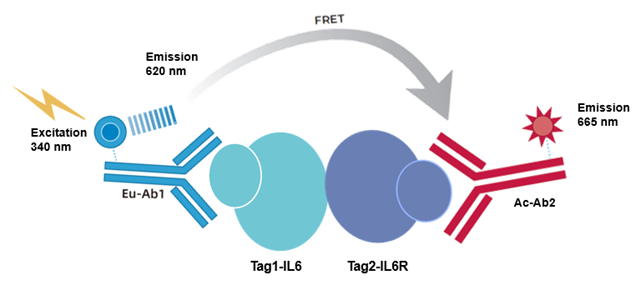
The "UniOne® TR-FRET Human IL6/IL6R Binding Kit" (Catalog No.: UA086013), independently developed by Nanjing UA-BioTech Co., Ltd. (UA-Bio), is a high-performance analytical platform specifically designed for studying the interaction between interleukin-6 (IL-6) and its receptor complex composed of IL-6Rα (CD126) and gp130 (CD130) subunits. Based on time-resolved fluorescence resonance energy transfer (TR-FRET) technology, this kit enables precise and efficient evaluation of the binding activity between human IL-6 and IL-6R, providing a stable and reliable standardized solution for research in inflammatory disease mechanisms, autoimmune drug screening, and cancer therapy development.
| Core Advantages | Detailed Parameters / Functional Description |
|---|---|
| High Purity & Full Biological Activity | The kit's core components include rigorously quality-controlled, high-purity human IL-6 protein and its receptor IL-6Rα (or IL-6Rα/gp130 complex) with full biological activity. All proteins maintain native conformation and intact binding functionality, accurately simulating the high-affinity interaction between IL-6 and its receptor complex under physiological conditions, ensuring experimental accuracy, reproducibility, and functional relevance. |
| Exceptional Lot-to-Lot Consistency & Stability | Supported by an internationally advanced protein expression platform and highly standardized production processes, combined with a stringent quality control system, the product demonstrates outstanding long-term stability and excellent batch-to-batch consistency, providing reliable quality assurance for long-term drug screening and mechanistic studies. |
| Ready-to-Use Flexible Platform | This TR-FRET-based kit features a simple "add-mix-read" workflow without cumbersome washing steps. Its optimized formulation is compatible with automated multiwell plate (96/384-well) platforms, making it suitable for various applications such as anti-IL-6 antibody/antagonist screening (e.g., tocilizumab biosimilar evaluation), receptor blocker assessment, competitive binding assays, affinity analysis, and signaling pathway research. |
| Complete Solution & Professional Support | We provide fully validated standard protocols, typical dose-response curves, and detailed data interpretation guidelines to help establish stable and reproducible workflows. Nanjing UA-Bio's technical team offers comprehensive support for experimental design, optimization, and data analysis. |
Nanjing UA-BioTech Co., Ltd. is committed to providing cutting-edge, high-quality reagents and tools for immunology, cell therapy, and innovative drug development. For detailed technical parameters, validation data, or application consultations regarding the "UniOne® TR-FRET Human IL6/IL6R Binding Kit" (Catalog No.: UA086013), please feel free to contact us.








