





In 1993, researchers first cloned cytotoxic T lymphocyte-associated antigen 8 from an activated mouse T lymphocyte cDNA library, later named IL-17A. The IL-17A gene showed no homology with other known cytokine families at the time but exhibited 57% homology with the T-cell-tropic herpesvirus gene 13. Through homologous gene screening, IL-17B, IL-17C, IL-17D, IL-17E, and IL-17F were discovered, forming the IL-17 cytokine family together with IL-17A. Human and mouse IL-17 family members share 63% to 88% homology. Except for IL-17D, other members can form homodimers via disulfide bonds, with IL-17A and IL-17F sharing 50% homology and capable of forming heterodimers. The TR-FRET IL-17A/IL-17RA Kit can quantitatively detect the binding activity between IL-17A and its receptor, providing a technical tool for studying this signaling pathway.
In 1995, the IL-17A receptor protein was discovered and named IL-17RA. In 2003, four other homologous receptors were identified through gene sequence similarity searches, forming the IL-17 receptor family together with IL-17RA. These family members are single-transmembrane proteins containing extracellular fibronectin type III-like domains and intracellular SEF/IL-17R domains. The SEFIR domain is critical for signal transduction, requiring recruitment of the Act-1 protein, which also contains a SEFIR sequence. Through homotypic SEFIR sequence binding, Act-1 is recruited by IL-17R to mediate downstream cascade signaling. IL-17RA and IL-17RC possess SEFIR domains that can recruit the proximal adaptor molecule Act1, activating pathways such as TRAF6-TAK1-NF-κB, TRAF6-MAPK-AP1, and TRAF6-C/EBP to regulate gene transcription. TR-FRET technology can be applied to study conformational changes after IL-17A binds to IL-17RA and the effects of different mutations on pathway activation.
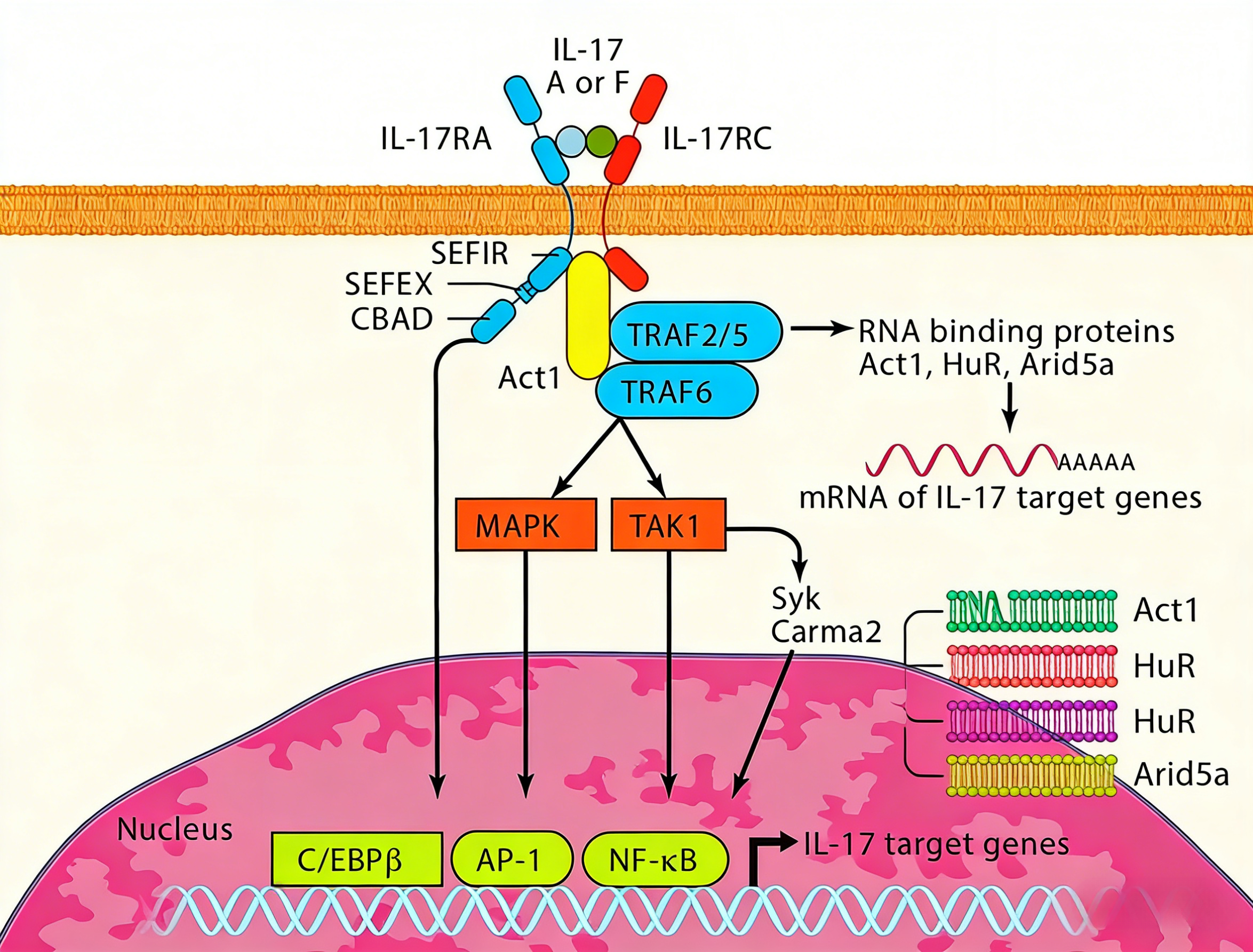
Among the IL-17 family, IL-17A and IL-17F are the most extensively studied. They are produced by Th17 cells, CD8-positive T cells, γδT cells, NKT cells, NK cells, and ILC3s. In psoriasis, IL-17A produced by Th17 cells stimulates keratinocytes to produce pro-inflammatory cytokines, antimicrobial peptides, and chemokines, leading to abnormal skin immune function and hyperproliferation of keratinocytes. IL-17A expression in psoriatic lesions is approximately 90 times higher than in normal skin. In multiple sclerosis, IL-17 mRNA expression is increased in patient blood and cerebrospinal fluid, with Th17 cells crossing the blood-brain barrier and accumulating in lesions to produce inflammatory cytokines like GM-CSF, causing central nervous system myelin damage. The TR-FRET IL-17A/IL-17RA Kit can screen antibody molecules that block IL-17A-receptor binding and evaluate their affinity and specificity.
IL-17A expression is significantly increased in the serum and inflamed mucosa of patients with active ulcerative colitis or Crohn's disease. Anti-IL-17F antibodies alleviate murine colitis, whereas anti-IL-17A antibodies do not. IL-17A may play divergent or even opposing roles in inflammatory bowel disease: on one hand, it can directly inhibit Th1 cell development to suppress inflammation; on the other hand, it may promote intestinal inflammation and fibrosis by inducing epithelial-mesenchymal transition in intestinal epithelial cells. IL-17A and IL-17F act as double-edged swords in inflammatory bowel disease, both protecting the gut from infection and injury while potentially driving pathological processes. TR-FRET technology can quantitatively assess the effects of different blocking strategies on IL-17A-receptor binding, providing molecular-level insights into its dual mechanisms.
IL-17E is produced by Th2 cells, mast cells, and eosinophils, with its receptor being an IL-17RA/IL-17RB heterodimer. It plays a key role in regulating type II immune responses and is associated with hypersensitivity pneumonitis, asthma, and parasitic infections. IL-17B binds to IL-17RB and is implicated in malignancies, promoting angiogenesis by activating NF-κB and AP-1 to induce IL-8 expression. IL-17C is primarily derived from epithelial cells, with protein levels in psoriatic skin approximately 100-fold higher than IL-17A. The IL-17D receptor CD93 was discovered in 2021; IL-17D regulates intestinal ILC3 function via CD93 binding to maintain gut homeostasis. Different family members exert diverse immunoregulatory functions through unique receptor combinations and signaling pathways.
Monoclonal antibody drugs targeting IL-17 and its receptors have made clinical advances. Anti-IL-17A mAbs treat moderate-to-severe plaque psoriasis and psoriatic arthritis, while bispecific mAbs targeting both IL-17A and IL-17F are also clinically used. Anti-IL-17RA mAbs similarly treat moderate-to-severe plaque psoriasis. IL-17C antibodies show symptom improvement in clinical trials for atopic dermatitis. As the first global IL-25-targeting antibody, IL-25 antibodies are in early-stage clinical studies for inflammatory and allergic diseases. The TR-FRET IL-17A/IL-17RA Kit holds significant value in screening and characterizing these antibody drugs, offering high-throughput, high-sensitivity binding activity detection.
Nanjing UA-Bio Technology Co., Ltd. has independently developed the "UniOne® TR-FRET Human IL17A/IL17RA Binding Kit" (Catalog No.: UA086014), a high-performance analytical platform specifically designed to study the interaction between interleukin-17A (IL-17A) and its receptor IL-17RA. Based on time-resolved fluorescence resonance energy transfer (TR-FRET) technology, this kit enables precise and efficient quantification of binding activity between human IL-17A and IL-17RA, providing standardized, reliable solutions for autoimmune diseases (e.g., psoriasis, ankylosing spondylitis), inflammation research, and antibody drug development.
| Core Advantages | Detailed Parameters / Functional Description |
|---|---|
| High Purity & Full Bioactivity | The kit's core components feature rigorously validated high-purity, bioactive human IL-17A (maintaining native homodimeric conformation) and IL-17RA. Both retain correct spatial structures and intact binding functions, accurately mimicking physiological high-affinity IL-17A/IL-17RA interactions to ensure data accuracy, reproducibility, and functional relevance. |
| Exceptional Lot Consistency & Stability | With advanced protein expression platforms and standardized production under strict QC, the product delivers outstanding long-term stability and lot-to-lot consistency, providing robust quality assurance for continuous drug screening and mechanistic studies. |
| Ready-to-Use Flexible Platform | This homogeneous TR-FRET kit features a simple "add-incubate-read" workflow without washing steps. Its optimized formulation supports 96/384-well automation for diverse applications: anti-IL-17A antibody/antagonist screening (e.g., secukinumab, ixekizumab biosimilar evaluation), receptor blocker assessment, competition assays, affinity analysis, and pathway studies. |
| Comprehensive Solutions & Expert Support | We provide validated protocols, standard dose-response curves, and detailed interpretation guides to expedite robust assay establishment. Nanjing UA-Bio's technical team offers end-to-end support for experimental design, optimization, and data analysis. |
Nanjing UA-Bio Technology Co., Ltd. is dedicated to delivering cutting-edge reagents and tools for immunology, cell therapy, and innovative drug development. For detailed specifications, validation data, or application inquiries about the "UniOne® TR-FRET Human IL17A/IL17RA Binding Kit" (Catalog No.: UA086014), please contact us anytime.








