





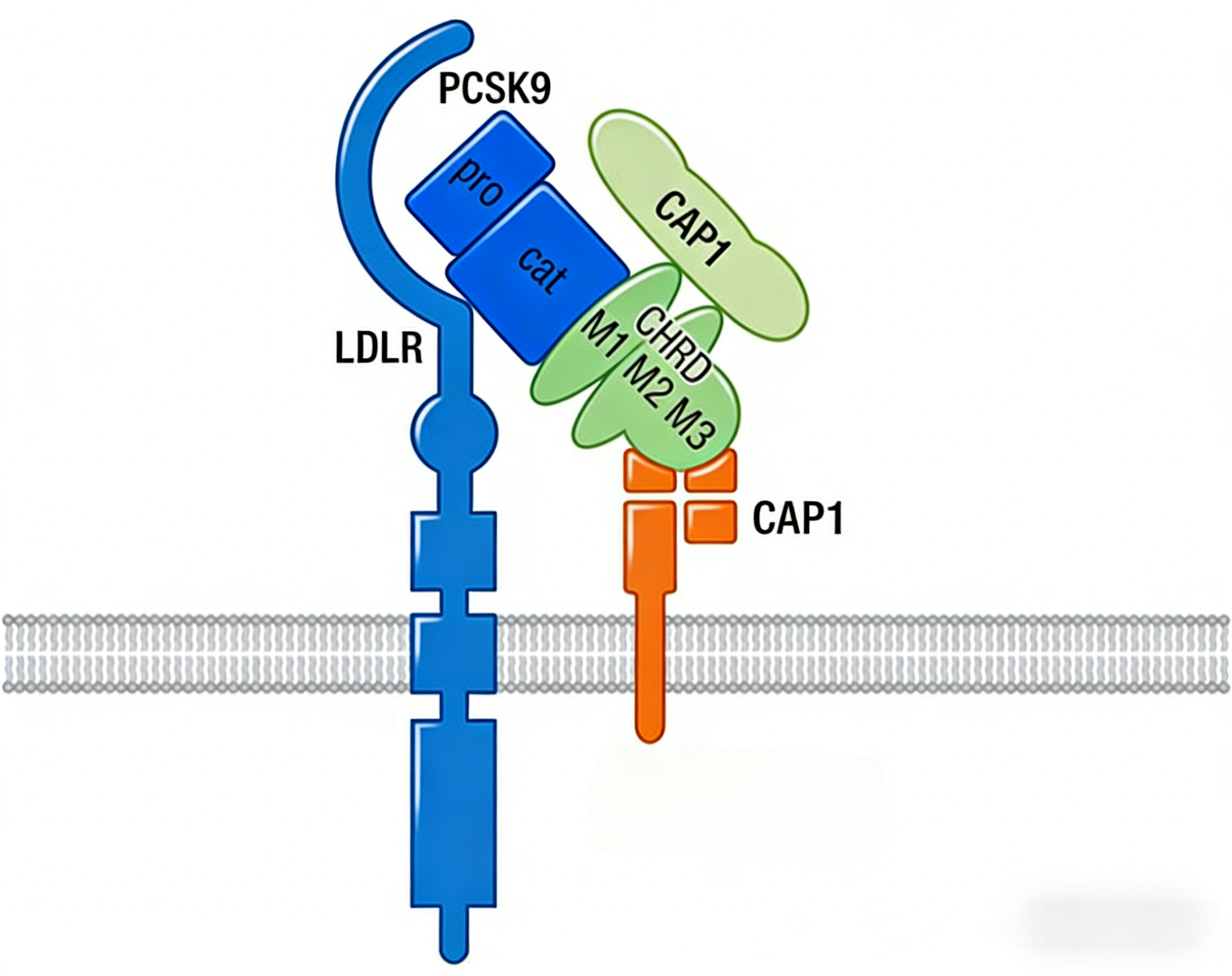
PCSK9 is primarily synthesized in the liver as a secreted serine protease that plays a crucial role in maintaining cholesterol homeostasis. It elevates LDL-C levels by inhibiting circulating LDLR, competitively binding to LDLR on hepatocyte surfaces to form PCSK9/LDLR complexes, which are then transported into cells via vesicles and degraded by lysosomes, leading to increased plasma LDL-C levels. Additionally, PCSK9 promotes the degradation of LRP-1, VLDLR, and ApoER2, and enhances hepatic lipid and lipoprotein production through apolipoprotein E and LDLR-related pathways. The TR-FRET PCSK9-LDLR Assay Kit can be used to quantitatively measure the binding activity between PCSK9 and LDLR, providing a technical tool for studying the biological functions of this protein.
PCSK9 induces endothelial cell apoptosis via the JNK/p38 MAPK pathway, promoting atherosclerosis caused by ox-LDL and reducing the stability of atherosclerotic plaques. During plaque progression, apolipoprotein E produced by macrophages and smooth muscle cells binds to ApoER2, reducing intracellular lipoprotein accumulation and inhibiting foam cell formation. PCSK9 diminishes the vascular protective effects of apolipoprotein E by lowering ApoER2 expression. In platelet activation and thrombosis, elevated plasma PCSK9 levels are an independent risk factor for platelet hyperactivation and accelerated thrombosis. On one hand, increased PCSK9 indirectly activates platelets by reducing lipoprotein consumption; on the other hand, PCSK9 directly promotes platelet activation and thrombosis by binding to the CD36 receptor independently of the LDLR pathway. TR-FRET technology can be applied to screen inhibitors that block PCSK9-LDLR binding and evaluate their blocking efficiency.
The FOURIER study evaluated the efficacy of PCSK9 inhibitors in 27,564 ASCVD patients, showing a 15% reduction in MACE risk and a 20% reduction in ischemic stroke risk after 48 weeks of treatment. The ODYSSEY OUTCOMES study assessed PCSK9 inhibitors in 18,924 ACS patients, with subgroup analysis indicating significant ischemic stroke risk reduction after 78 weeks of treatment, without increasing hemorrhagic stroke risk. The GLAGOV study demonstrated that 64% of patients achieved atherosclerotic plaque regression after 76 weeks of statin plus PCSK9 inhibitor therapy. Additionally, PCSK9 inhibitors increase fibrous cap thickness, reverse lipid-rich plaques, and improve plaque morphology.
Clinical data indicate that PCSK9 inhibitors are generally well-tolerated. Common adverse reactions include injection site reactions such as mild erythema, pain, or swelling, typically transient. Compared to placebo, PCSK9 inhibitors show no significant difference in new-onset diabetes or neurocognitive events. Hemorrhagic stroke risk is also not increased, a critical safety feature for long-term management of ischemic stroke patients. In patients with renal impairment, the pharmacokinetics and pharmacodynamics of PCSK9 inhibitors are similar to those with normal renal function, requiring no dose adjustment. The TR-FRET PCSK9-LDLR Assay Kit can be used to evaluate the binding affinity of different PCSK9 inhibitors to their targets, providing molecular-level insights for safety assessments.
Small interfering RNA drugs degrade PCSK9 mRNA, preventing its translation into protein. Clinical studies show these drugs significantly reduce PCSK9 and LDL-C levels, with effects lasting up to 6 months, and all adverse events were mild or moderate. Research reveals that PCSK9 binding to LDLR depends on CAP1, suggesting CAP1 as a potential lipid-lowering target. Furthermore, PCSK9 inhibitors may prevent or reduce ischemic stroke risk by inhibiting platelet activation and thrombosis. Natural compounds like berberine, curcumin, and polydatin show potential to inhibit PCSK9 expression in vitro, offering new avenues for PCSK9 inhibitor development. TR-FRET technology can be applied for high-throughput screening of novel PCSK9 inhibitors and evaluating their binding activity to LDLR.
As research on PCSK9 as a novel lipid-lowering target deepens, its mechanisms in elevating lipids, accelerating atherosclerosis, and promoting thrombosis are being progressively elucidated. Multiple clinical trials of PCSK9 inhibitors are underway, some investigating their efficacy in acute stroke and others assessing their impact on intracranial atherosclerotic plaques. The mechanisms behind PCSK9-mediated platelet activation remain incompletely understood, warranting further exploration to develop more targeted ischemic stroke therapies. The TR-FRET PCSK9-LDLR Assay Kit provides a sensitive, efficient tool for studying PCSK9-LDLR interactions and inhibitor screening, applicable in drug discovery, activity evaluation, and quality control.
PCSK9 inhibitors lower LDL-C by blocking PCSK9-LDLR binding while inhibiting atherosclerotic plaque formation and thrombosis, offering clinical benefits for ischemic stroke patients. Clinical studies confirm PCSK9 inhibitors significantly reduce ischemic stroke risk and reverse atherosclerotic plaques. The TR-FRET PCSK9-LDLR Assay Kit holds significant value in drug development and quality control for such therapies.
Nanjing UA-Bio Technology Co., Ltd. has independently developed the "UniOne® TR-FRET Human PCSK9-LDLR Assay Kit" (Catalog No.: UA086058), a high-performance analytical platform specifically designed to study the interaction between proprotein convertase subtilisin/kexin type 9 (PCSK9) and low-density lipoprotein receptor (LDLR). This kit utilizes time-resolved fluorescence resonance energy transfer (TR-FRET) technology to accurately and efficiently assess the binding activity between human PCSK9 and LDLR, providing a stable, reliable, and standardized solution for cardiovascular drug development, lipid-lowering drug screening, and cholesterol metabolism research.
| Core Advantages | Specifications / Functional Description |
|---|---|
| High Purity and Full Biological Activity | The kit's core components include high-purity, biologically active human PCSK9 and LDLR proteins validated through multi-dimensional quality control. Both proteins maintain correct native conformations and intact binding functionality, accurately simulating the specific interaction between PCSK9 and LDLR under physiological conditions, ensuring experimental accuracy, reproducibility, and functional relevance. |
| Exceptional Batch Consistency and Stability | Leveraging an internationally advanced protein expression platform and highly standardized production processes, combined with a rigorous quality control system, the product offers outstanding long-term stability and excellent batch-to-batch consistency, providing reliable support for long-term, continuous drug screening and mechanistic research. |
| Ready-to-Use Flexible Platform | This TR-FRET-based kit features a simple "add-mix-read" workflow without cumbersome washing steps. Its optimized formulation is compatible with automated multi-well (96/384-well) platforms, making it suitable for high-throughput screening of PCSK9 inhibitors (e.g., alirocumab, evolocumab biosimilars), affinity measurements, competitive binding assays, and biosimilar activity analysis. |
| Comprehensive Solutions and Expert Support | We provide fully validated standard protocols, typical dose-response curves, and detailed result interpretation guides to help establish stable, reproducible workflows. Nanjing UA-Bio's technical team offers professional consultation and support for research design, experimental optimization, and data analysis. |
Nanjing UA-Bio Technology Co., Ltd. is dedicated to providing cutting-edge, high-quality reagents and tools for immunology, cell therapy, and innovative drug development. For detailed technical parameters, validation data, or application inquiries regarding the "UniOne® TR-FRET Human PCSK9-LDLR Assay Kit" (Catalog No.: UA086058), please feel free to contact us.








