





Autoimmune diseases occur when the immune system malfunctions, leading to tissue and organ damage caused by autoantibodies or autoreactive effector lymphocytes attacking normal cells. With over 100 types, these diseases rank as the third major category following cardiovascular diseases and cancer. B cells, as one of the most critical effector cells in autoimmune diseases, play a central role in disease pathogenesis. Systemic lupus erythematosus (SLE) is a chronic systemic autoimmune disease characterized by multisystem damage. Its pathogenesis involves complex mechanisms, including the proliferation and activation of autoreactive T and B cells, production of various pathogenic autoantibodies, and abnormal cytokine secretion and receptor expression.
B-cell activating factor (BAFF), also known as TNFSF13B or CD257, is a key survival factor for B cells and belongs to the tumor necrosis factor (TNF) ligand family. It exists in both soluble and membrane-bound forms. BAFF is expressed on various cell types, including monocytes, dendritic cells, and bone marrow stromal cells. It interacts with three receptors: TACI, BCMA, and BAFF receptor. By binding to these receptors, BAFF plays a pivotal role in supporting B-cell survival and proliferation, regulating class-switch recombination, and selecting autoreactive B cells. Research also indicates that BAFF can promote T-cell activation, proliferation, and differentiation. The TR-FRET BAFF/TACI Assay Kit enables quantitative measurement of BAFF binding to TACI receptors, providing a technical tool for studying this signaling pathway.
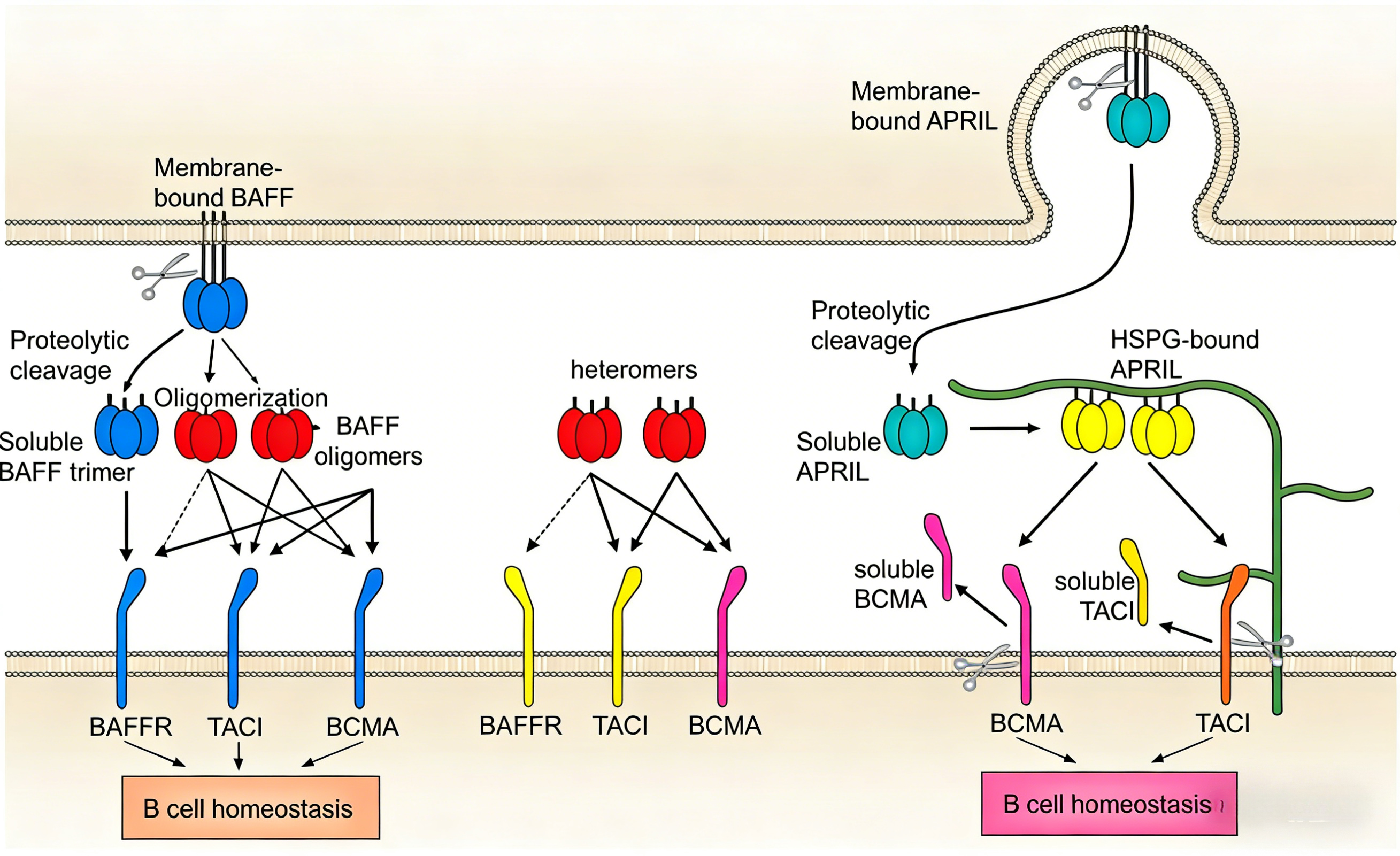
Upon binding to its receptors, BAFF activates multiple downstream signaling pathways, including NF-κB, PI3K-AKT, and MAPK. These pathways promote B-cell survival and proliferation by upregulating anti-apoptotic proteins such as Bcl-2, Bcl-xL, and Mcl-1, thereby prolonging the survival of autoreactive B cells. BAFF signaling also regulates class-switch recombination in B cells, influencing antibody isotype production. In autoimmune diseases, excessive BAFF signaling leads to abnormal survival and expansion of autoreactive B cells, driving autoantibody production and contributing to disease pathology. TR-FRET technology can be applied to study conformational changes in BAFF-TACI interactions and evaluate dynamic changes in receptor-ligand binding under varying conditions.
BAFF is implicated in the pathogenesis of various autoimmune diseases. In SLE patients, serum BAFF levels are significantly elevated and correlate positively with disease activity and autoantibody levels. Similarly, abnormal BAFF levels are observed in other autoimmune conditions, including multiple sclerosis, IgA nephropathy, Sjögren's syndrome, and rheumatoid arthritis. These clinical findings suggest that BAFF overexpression may play a central role in autoimmune disease pathology by promoting the survival and expansion of autoreactive B cells and enhancing autoantibody production. The TR-FRET BAFF/TACI Assay Kit can be used to screen molecules that block BAFF-TACI binding and evaluate their immunomodulatory activity.
Given BAFF's critical role in B-cell regulation and autoimmune pathogenesis, targeting BAFF has emerged as a key therapeutic strategy. BAFF inhibitors neutralize excess BAFF, suppress the survival and differentiation of autoreactive B cells, and reduce autoantibody production, thereby alleviating symptoms and controlling disease progression. Therapeutic approaches include anti-BAFF monoclonal antibodies (to neutralize soluble BAFF), anti-BAFF receptor antibodies (to block BAFF-receptor binding), and TACI-Fc fusion proteins (as decoy receptors). These strategies have demonstrated varying degrees of efficacy in clinical trials. TR-FRET technology can assess the impact of different interventions on BAFF-TACI binding, providing a quantitative method for drug screening and dose optimization.
Serum BAFF levels serve as a biomarker for assessing disease activity and predicting treatment response in autoimmune diseases. In SLE patients, elevated BAFF levels correlate with increased disease activity, renal involvement, and specific autoantibody positivity. Changes in BAFF levels can also monitor therapeutic responses, as reductions following BAFF inhibitor treatment often align with clinical improvement. Additionally, differential BAFF receptor expression across B-cell subsets may influence cellular responsiveness to BAFF signaling, offering insights into disease heterogeneity and personalized therapy. The TR-FRET BAFF/TACI Assay Kit enables quantitative measurement of BAFF-receptor binding activity in clinical samples, supporting disease monitoring.
Nanjing UA-Bio Technology Co., Ltd. has independently developed the "UniOne® TR-FRET Human BAFF/TACI Binding Kit" (Catalog No.: UA086120), a high-performance analytical platform designed to study the interaction between BAFF and its receptor TACI. Utilizing time-resolved fluorescence resonance energy transfer (TR-FRET) technology, this kit provides precise and efficient evaluation of BAFF-TACI binding activity, offering a standardized solution for research in autoimmune disease mechanisms, antibody drug development, and B-cell immunotherapy.
| Core Advantages | Specifications / Functional Description |
|---|---|
| High Purity and Biological Activity | The kit features rigorously validated, high-purity human BAFF protein (maintaining native trimeric conformation) and TACI receptor, both exhibiting correct spatial conformation and full binding functionality. This ensures accurate, reproducible, and physiologically relevant data. |
| Exceptional Batch Consistency and Stability | Produced via an advanced protein expression platform and standardized manufacturing processes, the kit demonstrates outstanding long-term stability and batch-to-batch consistency, providing reliable support for sustained drug screening and mechanistic studies. |
| Ready-to-Use Flexible Platform | The homogeneous TR-FRET-based assay requires no washing steps and operates on a simple "add-mix-read" protocol. Optimized for 96/384-well plates, it is compatible with automated systems and adaptable for diverse applications, including anti-BAFF/TACI antibody/antagonist screening (e.g., belimumab biosimilar evaluation), receptor blockade studies, competitive binding assays, affinity analysis, and B-cell immunomodulatory drug testing. |
| Comprehensive Solutions and Support | The kit includes validated protocols, standard dose-response curves, and detailed interpretation guides to facilitate rapid assay establishment. Nanjing UA-Bio's technical team offers expert consultation for experimental design, optimization, and data analysis. |
Nanjing UA-Bio Technology Co., Ltd. is dedicated to providing cutting-edge, high-quality reagents and tools for immunology, cell therapy, and innovative drug development. For detailed technical parameters, validation data, or application inquiries regarding the "UniOne® TR-FRET Human BAFF/TACI Binding Kit" (Catalog No.: UA086120), please contact us.








