





IL-33 is the 11th member of the IL-1 family, featuring an IL-1-like cytokine domain at its C-terminus, a nuclear localization domain at the N-terminus, and a protease-sensing domain in the middle. The full-length IL-33 can function both as an intranuclear factor and an extracellular cytokine. The ST2 receptor is primarily expressed on the surface of Th2 cells, mast cells, and group 2 innate lymphoid cells, with two main isoforms: soluble sST2 acting as a decoy receptor, and transmembrane ST2L that promotes NF-κB signal transduction. Upon binding with ST2L, IL-33 forms a complex with IL-1RAP, recruiting MYD88, IRAK1, IRAK4, and TRAF6 to activate downstream NF-κB, JNK, p38, and ERK signaling pathways. The TR-FRET IL-33/ST2 Kit enables quantitative detection of IL-33 binding activity to ST2 receptor, providing a technical tool for studying this signaling pathway.
IL-33 plays paradoxical roles in autoimmune diseases, functioning as both a pro-inflammatory and anti-inflammatory cytokine. In conditions such as multiple sclerosis, rheumatoid arthritis, systemic lupus erythematosus, psoriasis, Sjögren's syndrome, and inflammatory bowel disease, the IL-33/ST2 axis can upregulate pro-inflammatory cytokine release and participate in disease pathogenesis. However, in metabolic disorders like type 1 diabetes, IL-33 may act as an anti-inflammatory cytokine. This dual role depends on disease type, genetic background, disease stage, and microenvironmental factors. TR-FRET technology can be applied to study IL-33 binding characteristics with ST2 under different disease states and evaluate dynamic changes in signal transduction.
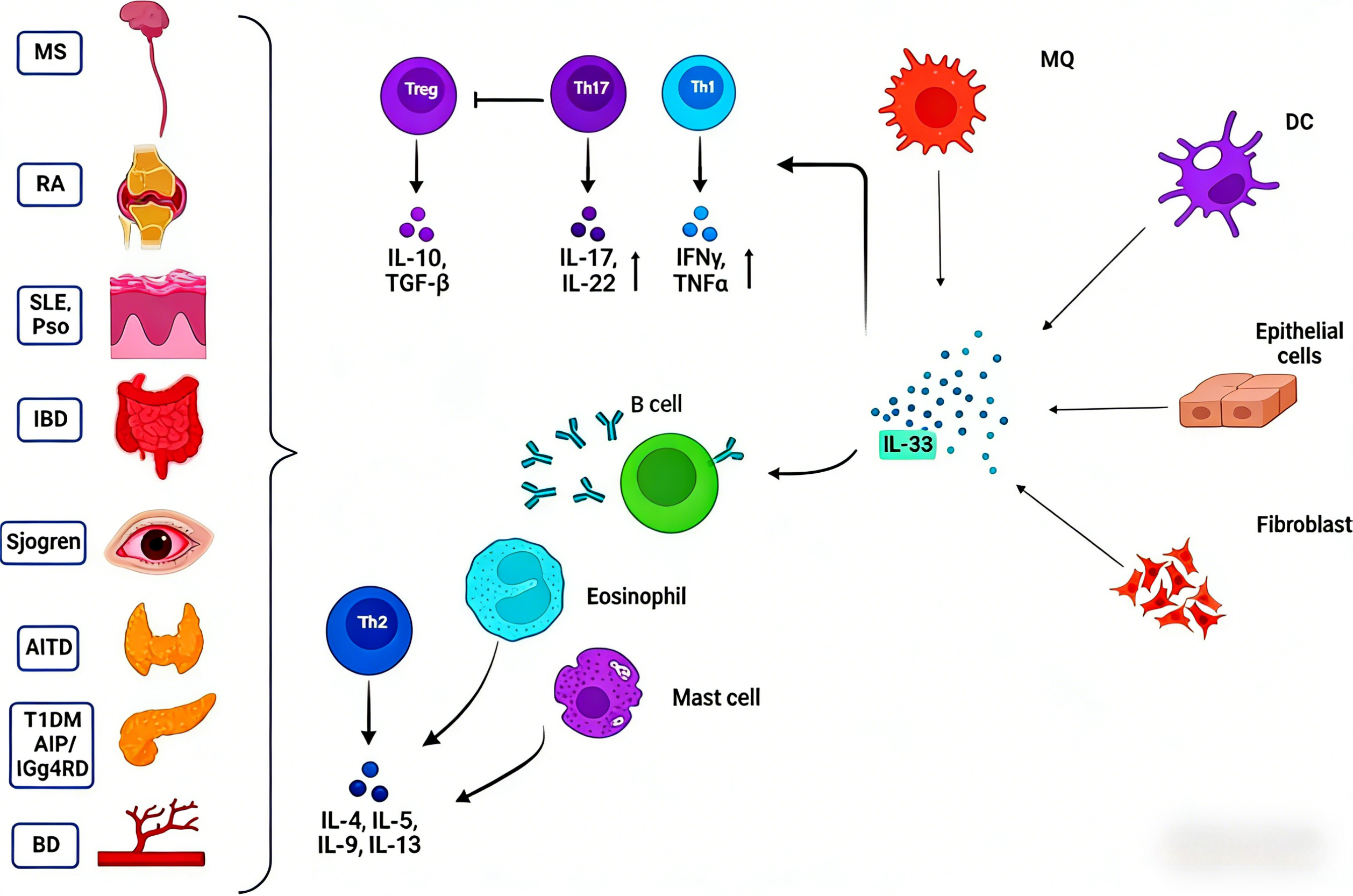
Multiple sclerosis is a heterogeneous inflammatory disorder of the central nervous system characterized by immune cell infiltration, microglial activation, and neurodegeneration. Elevated IL-33 levels have been detected in patients with relapsing-remitting, secondary progressive, and primary progressive forms, with serum IL-33 levels showing significant correlation with disease severity. Treated patients exhibit lower IL-33 levels compared to untreated counterparts. Compared to healthy brain tissue, lesion sites in patient brains show increased expression of IL-33 and ST2. Microglia serve as primary targets of IL-33 in the CNS, with ST2 knockout mice demonstrating elevated inflammatory molecule levels and reduced anti-inflammatory cytokine expression. The TR-FRET IL-33/ST2 Kit can detect binding activity in clinical samples, providing quantitative data for disease monitoring.
Systemic lupus erythematosus is a systemic autoimmune disease characterized by atypical production of autoantibodies and pro-inflammatory cytokines. Overexpression of soluble ST2 in patients may exert immunomodulatory effects, with sST2 levels correlating with disease activity indices. Active patients show significantly higher serum sST2 levels than inactive patients or healthy controls. Furthermore, patient IL-33 levels strongly correlate with ESR, CRP, and IgA, suggesting IL-33/ST2 signaling plays a role during acute phases. In vitro analyses confirm that patient neutrophils release IL-33-rich NETs that activate dendritic cells via ST2 to induce robust type I interferon responses. IL-33 antibodies can increase Tregs and MDSCs while reducing Th17 cells and levels of IL-1β, IL-6, and IL-17, indicating IL-33 blockade has protective effects. TR-FRET technology can screen antibody molecules that block IL-33/ST2 binding.
Rheumatoid arthritis is a chronic inflammatory disease primarily affecting joints. ST2 is expressed on synovial tissue, macrophages, and activated neutrophils, with IL-33 inducing neutrophil migration through macrophage activation. Patient serum and synovial fluid show significantly elevated IL-33 levels correlating with IL-1β and IL-6. Treatment with sST2 protein or anti-ST2 antibodies reduces severity in collagen-induced arthritis mouse models. In inflammatory bowel disease, patients—particularly those with ulcerative colitis—exhibit elevated IL-33 levels compared to healthy controls. Blocking IL-33/ST2 signaling has been shown to reduce active disease. The ST2/IL-33 pathway is associated with ulcerative colitis, where patient sST2 levels further increase after corticosteroid treatment. IL-33 promotes IgA production to maintain gut microbial homeostasis and controls IL-1α-dependent colitis and colitis-associated cancer. The TR-FRET IL-33/ST2 Kit can evaluate inhibition efficacy of different blocking strategies.
Psoriasis is a chronic inflammatory skin disease considered a Th1/Th17-driven autoimmune disorder. About 30% of patients may develop psoriatic arthritis. Serum IL-33 levels are higher in psoriasis patients than healthy controls and positively correlate with disease severity. Increased IL-33 mRNA expression is detected in psoriatic skin but not in atopic dermatitis lesions or normal skin. IL-33 is recognized as a key alarmin in psoriasis, where persistent release stimulates Th1 phenotype polarization creating localized hyperinflammatory environments. TNF-α, INF-γ, and IL-17 stimulate IL-33 release, while anti-TNF-α treatment downregulates serum IL-33 levels and mRNA expression. These results suggest IL-33 elevation may contribute to psoriasis development and represent a novel therapeutic target.
Nanjing UA-Bio Technology Co., Ltd's independently developed "UniOne® TR-FRET Human IL33/ST2 Binding Kit" (Catalog No.: UA086118) is a high-performance analysis platform specifically designed for studying interleukin-33 (IL-33) interactions with its specific receptor ST2. Based on time-resolved fluorescence resonance energy transfer (TR-FRET) technology, this kit enables precise and efficient evaluation of human IL-33 binding activity with ST2, providing standardized solutions for type 2 immune response research, allergic disease mechanism exploration, and anti-inflammatory drug development.
| Core Product Advantages | Detailed Parameters / Functional Description |
|---|---|
| High Purity & Complete Bioactivity | Core components feature rigorously validated high-purity, biologically active human IL-33 protein (maintaining native conformation) and ST2 receptor (IL-1RL1). Both retain proper spatial conformation and intact binding functionality to authentically simulate physiological high-affinity interactions, ensuring data accuracy, reproducibility, and functional relevance. |
| Exceptional Batch Consistency & Stability | Utilizing internationally advanced protein expression platforms and highly standardized production processes with strict QC release systems to ensure superior long-term stability and batch-to-batch consistency, providing reliable quality assurance for continuous drug screening and mechanistic studies. |
| Ready-to-Use Flexible Platform | The homogeneous TR-FRET-based kit employs a simple "add-incubate-read" workflow without washing steps. Its optimized formulation supports 96/384-well plate automation for diverse applications including anti-IL-33/ST2 antibody/antagonist screening, receptor blocker evaluation, competitive binding assays, affinity analysis, and biosimilar activity assessment. |
| Complete Solutions & Professional Support | Includes validated protocols, standard dose-response curves, and comprehensive interpretation guides to facilitate rapid establishment of robust workflows. Nanjing UA-Bio's technical team provides full-cycle professional consultation for experimental design, optimization, and data analysis. |
Nanjing UA-Bio Technology remains committed to providing cutting-edge, high-quality core reagents and tools for immunology, cell therapy, and innovative drug development. For detailed specifications, validation data, or application consultations regarding the "UniOne® TR-FRET Human IL33/ST2 Binding Kit" (Catalog No.: UA086118), please contact us anytime.








