





Thalidomide is a compound composed of glutarimide and phthalimide, with its derivatives lenalidomide and pomalidomide collectively known as immunomodulatory imide drugs (IMiDs), primarily used to treat hematologic malignancies such as multiple myeloma. Thalidomide is one of the most severe drug disasters in history, but its clinical value and novel mechanism of action have garnered widespread attention. Using nanomagnetic bead technology, researchers immobilized a carboxyl derivative of thalidomide on magnetic particles for affinity purification of cellular extracts, specifically purifying CRBN and DDB1, which were identified as thalidomide-binding proteins. Further analysis revealed that CRBN is the protein directly binding to thalidomide, while DDB1 binds indirectly through CRBN. CRBN and DDB1, together with Cullin 4 and Ring-Box 1, form the E3 ubiquitin ligase complex CRL4CRBN. This discovery was a breakthrough in the rapid development of protein degraders. The TR-FRET CRBN Ligand Screening Assay Kit can be used to quantitatively measure the binding activity of compounds to CRBN, providing a technical tool for ligand screening.
CRBN is the substrate recognition receptor of the Cullin 4 RING E3 ubiquitin ligase, consisting of an N-terminal Lon-like domain similar to bacterial Lon protease and a C-terminal thalidomide-binding domain. DDB1 binds to the central region of CRBN, while three tryptophan residues in the TBD are essential for thalidomide binding. DDB1 comprises three β-propeller domains, with CRBN binding to the cavity between BPA and BPC. The glutarimide moiety of thalidomide is critical for binding to CRBN, with its glutarimide ring inserted into a hydrophobic pocket formed by three tryptophan residues and one phenylalanine residue, while the phthalimide ring protrudes outward and is exposed on the CRBN surface. TR-FRET technology can be applied to study conformational changes in CRBN after compound binding and evaluate dynamic changes in ligand-receptor interactions under different conditions.
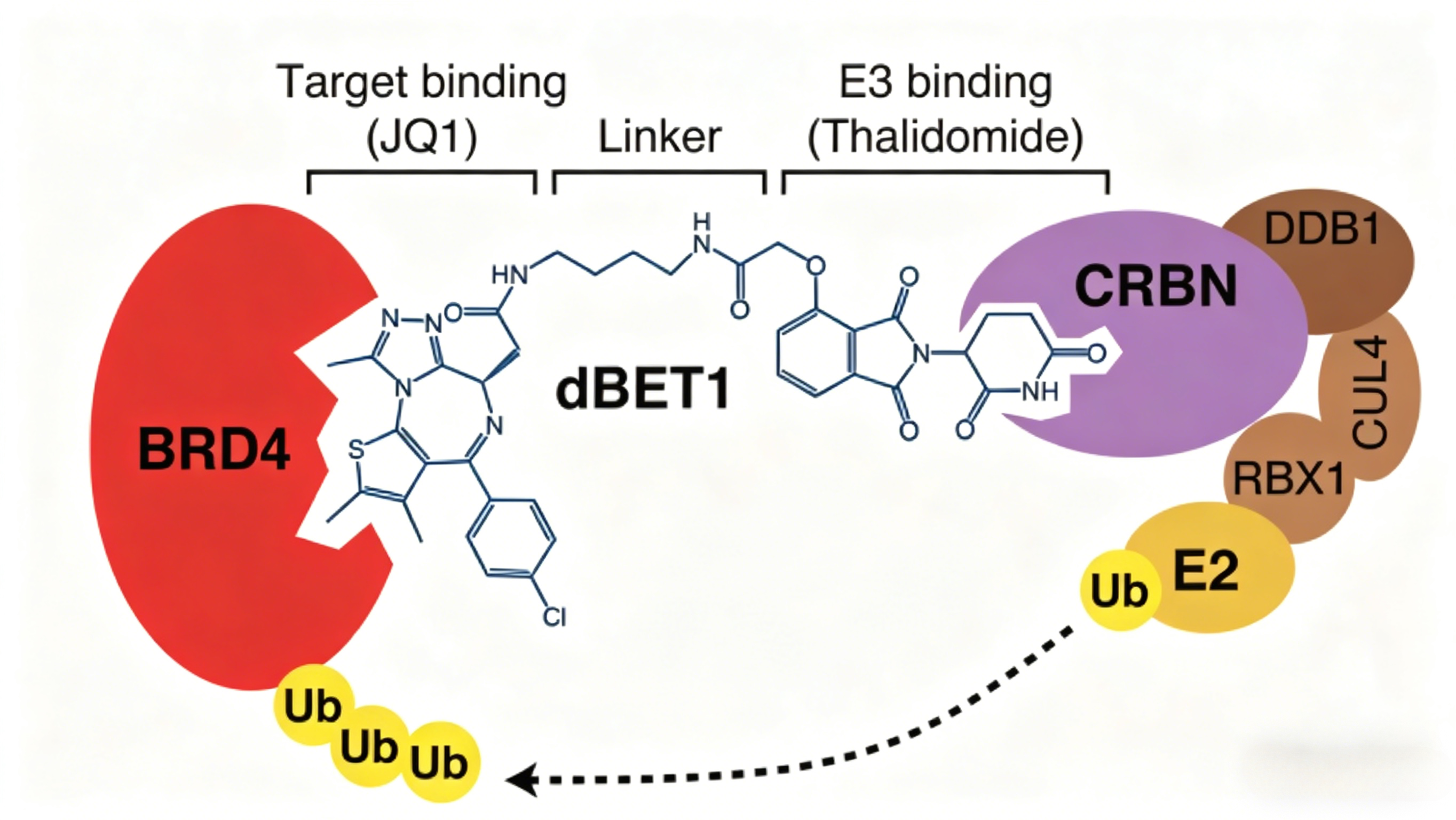
Thalidomide and its derivatives primarily exert pharmacological activity by binding to CRBN and altering its substrate specificity. Thalidomide derivatives act as molecular glues, promoting the binding of E3 ubiquitin ligase to specific target proteins and leading to their degradation. In the presence of thalidomide or its derivatives, CRL4CRBN can recognize and degrade non-native substrates, collectively referred to as neosubstrates. Tertiary structure studies of complexes containing neosubstrates, IMiDs, and CRBN reveal that the β-hairpin loop of neosubstrates binds to the surface provided by CRBN and lenalidomide. Thalidomide derivatives are currently the only protein degraders with clinical benefits. The TR-FRET CRBN Ligand Screening Assay Kit can be used to screen molecules that bind to CRBN and alter its substrate specificity, assessing their potential as molecular glues.
PROTACs were first reported in 2001, containing a membrane-impermeable phosphopeptide fragment that could not target intracellular proteins for degradation. The elucidation of thalidomide's mechanism of action accelerated the rapid development of PROTACs. For CRBN-based PROTACs, thalidomide or its derivatives are used as E3 binding sites. CRBN-based PROTACs targeting various proteins have been reported. CLIPTACs have been proposed as a novel strategy to improve poor pharmacokinetics caused by large molecular weight, where two pharmacokinetically favorable precursors generate PROTACs in cells via click chemistry. Photoactivatable or inactivatable PROTACs have also been developed to address on-target off-tissue toxicity. PROTAC technology has garnered particular attention in anticancer drug development, with several PROTACs currently in clinical trials. TR-FRET technology can be applied to evaluate the binding activity of the CRBN ligand moiety in PROTAC molecules, providing quantitative data support for PROTAC design.
Over the past decade, significant progress has been made in understanding the mechanism of action of thalidomide. The breakthrough driving this progress was the discovery of CRBN as the direct target of thalidomide. Thalidomide and its derivatives act as molecular glues, altering CRBN's substrate specificity and leading to the degradation of various neosubstrates. This discovery has enabled a molecular understanding of the diverse pharmacological effects of thalidomide and its derivatives, including their antimyeloma and teratogenic effects. The clinical validation of molecular glue degraders has spurred rapid development in protein degrader research, including PROTACs. The TR-FRET CRBN Ligand Screening Assay Kit provides a sensitive and efficient detection tool for studying CRBN-ligand interactions, applicable to mechanistic studies, drug screening, and preclinical evaluation.
The discovery of CRBN as the target of thalidomide was a major breakthrough in the development of protein degraders. CRBN-based molecular glue degraders and PROTACs provide novel strategies for targeting "undruggable" proteins. The TR-FRET CRBN Ligand Screening Assay Kit holds significant value in the development of such drugs, offering high-throughput and high-sensitivity binding activity detection. Future research will further explore the synergistic effects of CRBN with other E3 ligases and develop next-generation protein degraders with higher selectivity and improved pharmacokinetic properties. As understanding of CRBN's functional mechanisms deepens, the therapeutic applications of protein degraders will continue to expand.
Nanjing UA-Bio Technology Co., Ltd. (UA-Bio) has independently developed the "UniOne® TR-FRET Human CRBN Ligand Screening Assay Kit" (Catalog No.: UA086023), a high-performance analytical platform specifically designed for studying the interaction between CRBN (Cereblon) protein and ligands. CRBN is a key substrate recognition subunit of the E3 ubiquitin ligase complex and the direct target of immunomodulatory drugs (IMiDs) such as lenalidomide and pomalidomide. Based on time-resolved fluorescence resonance energy transfer (TR-FRET) technology, this kit enables precise and efficient evaluation of the binding activity between human CRBN protein and ligands (or candidate compounds), providing a stable and reliable standardized solution for targeted protein degradation (PROTAC) technology development, immunomodulatory drug screening, and novel drug discovery.
| Core Product Advantages | Detailed Parameters / Functional Description |
|---|---|
| High Purity and Intact Biological Activity | The kit's core components include highly purified, biologically active human CRBN protein (containing intact DDB1-CRBN complex) and fluorescently labeled IMiD ligand probes, validated through multi-dimensional quality control. The CRBN protein maintains its native conformation and full substrate recognition function, accurately simulating the specific binding of CRBN to ligands under physiological conditions, ensuring experimental data accuracy, reproducibility, and functional relevance. |
| Excellent Batch-to-Batch Consistency and Stability | Supported by an internationally leading protein expression platform and highly standardized production processes, combined with a stringent quality control system, the product exhibits outstanding long-term stability and excellent batch-to-batch consistency, providing a solid foundation for long-term, continuous drug screening and mechanistic research. |
| Ready-to-Use Flexible Experimental Platform | Based on homogeneous TR-FRET technology, the kit employs a simple "add-incubate-read" workflow without cumbersome washing steps. Its optimized formulation is compatible with multi-well plate (96/384-well) automation platforms, suitable for high-throughput screening of CRBN ligands/molecular glue degraders, affinity measurement of IMiD compounds, competitive binding assays, and activity evaluation of PROTAC molecules. |
| Comprehensive Solution and Professional Support | We provide fully validated standard protocols, typical dose-response curves, and detailed result interpretation guidelines to help establish stable and reproducible experimental workflows. Nanjing UA-Bio's professional technical team offers full-cycle support for research design, experimental optimization, and data analysis. |
Nanjing UA-Bio Technology Co., Ltd. is committed to providing cutting-edge, high-quality core reagents and tools for immunology, cell therapy, and innovative drug discovery. For detailed technical parameters, validation data, or application inquiries regarding the "UniOne® TR-FRET Human CRBN Ligand Screening Assay Kit" (Catalog No.: UA086023), please feel free to contact us.








